


Merged Range
A merged range mixes strong hands and moderately strong hands when betting or raising. It includes hands that can be called for value, not only the absolute nuts. You use hands like top pair, good kickers, medium pairs and strong draws aggressively. This contrasts with a polarized range, which focuses on the very strongest hands and bluffs. Value bet means betting to be called by worse hands; three-bet refers to the preflop re-raise.
Merged Range in No-Limit Texas Hold’em
What a merged range is
A merged range mixes strong hands and moderately strong hands when betting or raising. It includes hands that can be called for value, not only the absolute nuts. You use hands like top pair, good kickers, medium pairs and strong draws aggressively. This contrasts with a polarized range, which focuses on the very strongest hands and bluffs. Value bet means betting to be called by worse hands; three-bet refers to the preflop re-raise.
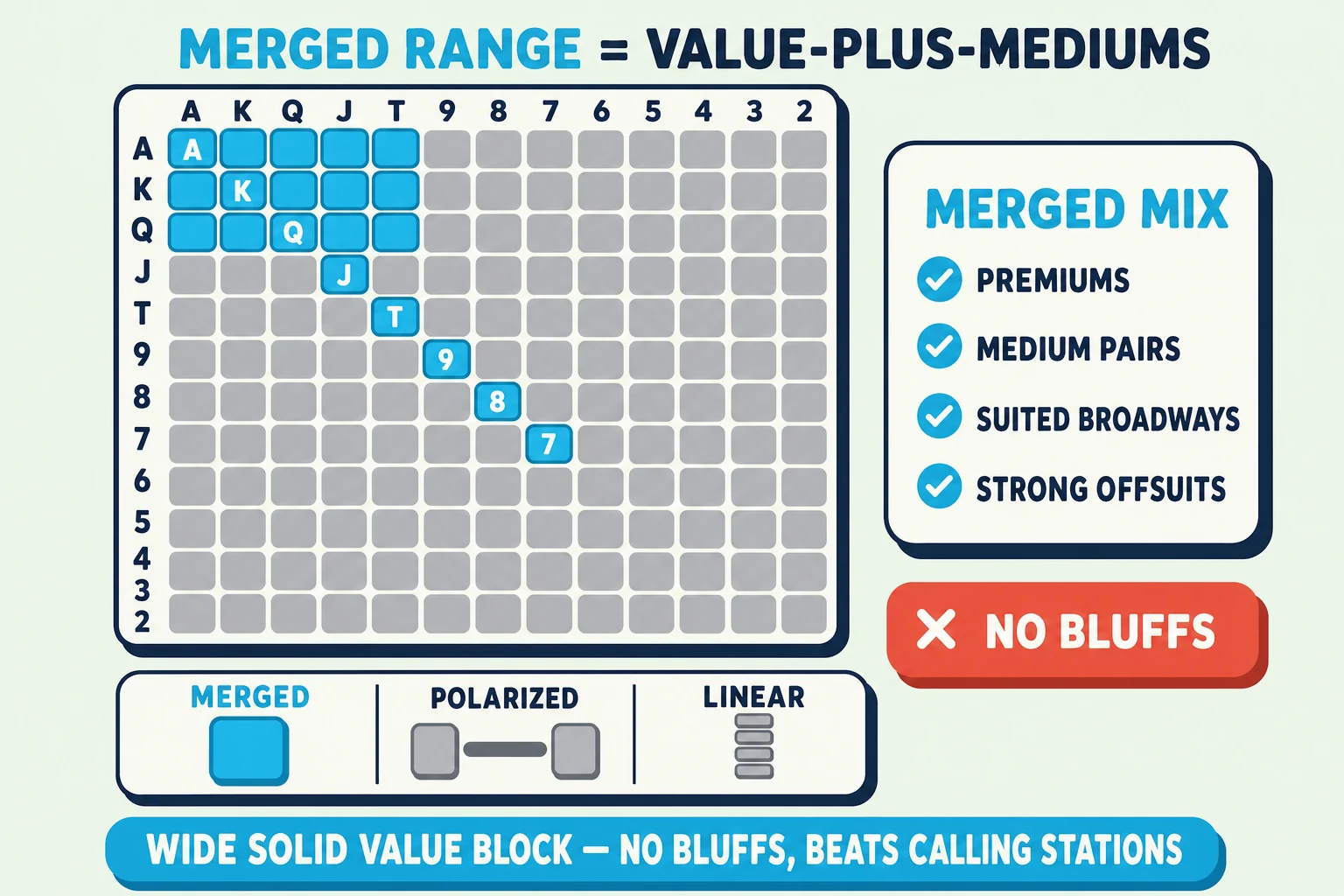
When to use merged ranges
Merged ranges work best against opponents who call too often, often called calling stations. Against such players you can extract value from many holdings they will call with. Use merging when many of your hands sit ahead of the opponent’s continuing range. Prefer polarization when opponents fold excessively; bluffs then carry more weight and value should be concentrated.
Example: Villain is a sticky middle-position player who calls three-bets and continuation bets too often. Instead of three-betting only AA/KK, add AJs, 77, and KQ to form a merged three-betting range. Those hands will often be called and extract value rather than serve as bluffs.
Poker Skill’s Polarized Continuation Bets lesson practices the opposite choice on the flop, betting value hands and strong draws and checking the medium pairs a merged range would bet.
How to construct a merged range (practical example)
Follow these steps to build a merged three-betting range:
- Categorize hands: start with premiums (QQ+, AK). Then add medium-strength hands like AJs, KQs, 77-99, and suited broadways.
- Size and mix: choose three-bet sizes that induce calls from your target; smaller sizes attract marginal hands.
- Example: you’re on the button and MP opens to 3bb while the CO frequently calls. You three-bet to 10bb with a mix of QQ, AJs, and KQo. Against that caller, AJs and KQo often sit ahead of his continuing range and will be called. They function as value rather than bluffs.
Aim to include enough genuine value hands so your aggression doesn’t rely solely on bluffs or the nuts.
Position and opponent tendencies: tailoring merge decisions
“In position” means acting after your opponent on later streets, which gives you control to expand a merged range. You can probe turns and rivers to extract more value or fold when you miss. Out of position, be more cautious merging because postflop maneuvering becomes harder. Against calling stations, widen your merged range; against tight, fold-prone opponents, tighten or polarize instead. Always factor stack sizes, table image, and recent history into your merge decision.
Common mistakes and how to fix them
- Over-merging versus players who fold too much. Fix: tighten into a polarized strategy, using fewer marginal value hands and more bluffs.
- Under-merging versus callers. Fix: add more top-pair and medium-strength hands to your three-bets and continuation bets.
- Becoming predictable. Fix: vary which moderately strong hands you play aggressively and mix sizes to remain unreadable.
Quick checklist
- Assess opponent fold and call frequencies before choosing merged or polarized.
- Favor merged ranges when you are in position and face frequent callers.
- Include top-pair and similar hands in three-bet/value ranges against calling stations.
- Tighten or polarize when opponents fold excessively to protect your bluffs.
- Review hands after play to ensure your merged range extracts value without becoming predictable.