


Medium Stack
Medium Stack (20-50 BB) in No-Limit Texas Hold'em
Medium Stack (20-50 BB) in No-Limit Texas Hold’em
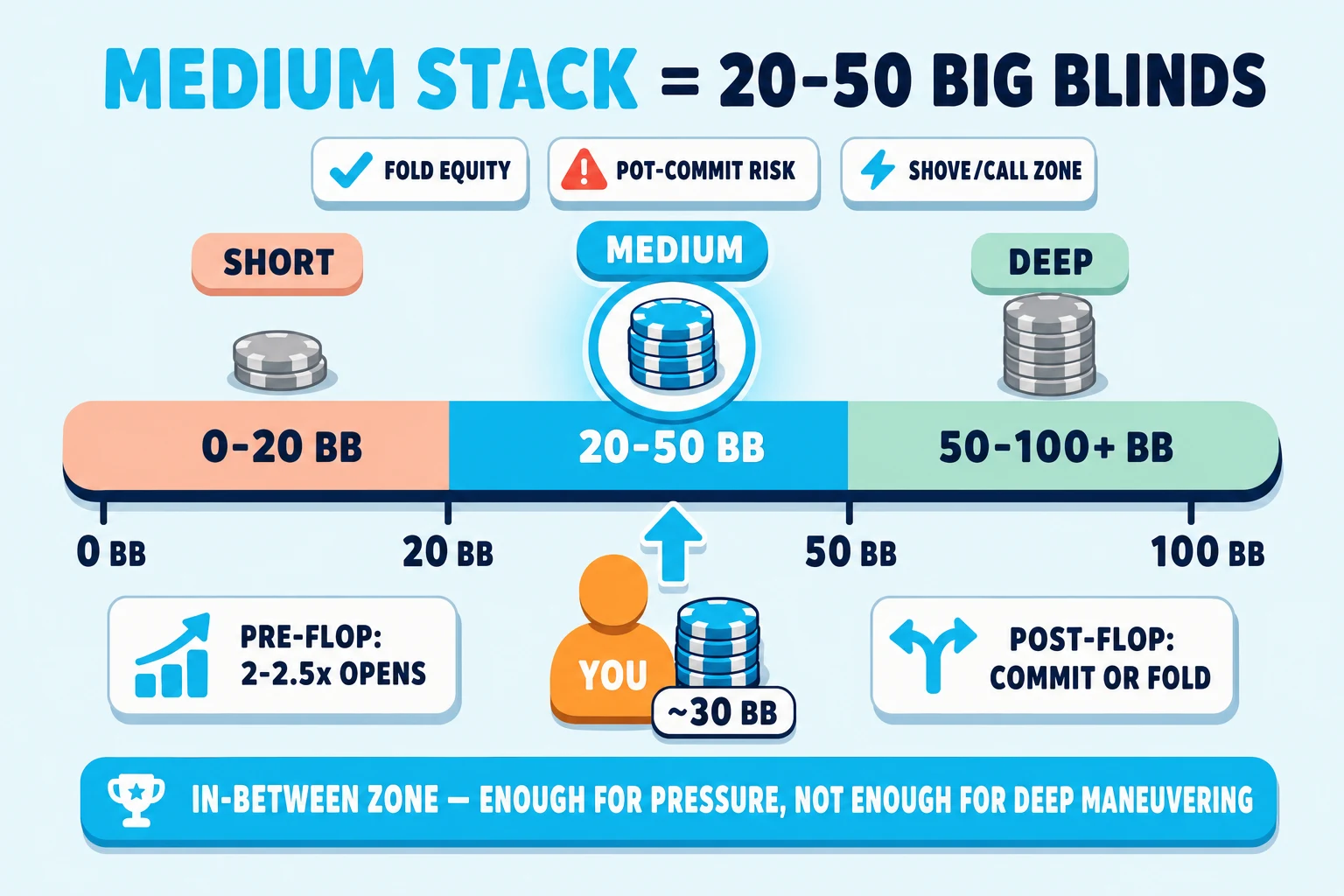
What a “Medium Stack” Means A medium stack is roughly 20-50 big blinds (BB), between short-stack and deep-stack play. You retain meaningful fold equity - opponents can fold to your bet - and you can apply pressure. But you lose full post-flop maneuverability, which changes which hands to play and when to commit. Aim for balance: be aggressive enough to win pots without turning every decision into an all-in crisis.
Pre-flop Adjustments for 20-50 BB
- Size your opens smaller: use conservative open-raise sizes around 2x-2.5x big blinds. Smaller opens preserve fold equity against callers and reduce the cost if someone re-jams.
- Choose hands that hold up in shallower pots; big pairs and strong broadways gain value. Speculative hands like small suited connectors lose value because implied odds for set-mining (hitting a set) shrink.
- Plan shove/call rules: decide before action which hands you will shove and which you’ll fold. Avoid frequent raise-folding - opening then folding to aggression wastes chips. With 30BB, a 2.5x open preserves more options than a raise that commits one-third of your stack.
Poker Skill’s raise-or-fold lessons deal every hand at 100 big blinds, which makes them the deeper baseline that a 20-50 BB stack trims back toward big pairs and broadways.
Post-flop Commitment and Folding Post-flop play with a medium stack often becomes commit-or-fold by the turn when the pot grows. Either commit early with clear equity - top pairs, sets, or strong draws - or fold. Don’t drip chips into a pot after you’ve invested roughly half your stack with a marginal holding. Example: with ~25BB, investing 12BB into a multiway pot with middle pair on a scary board usually warrants a fold.
Bet Sizing, Shove Thresholds, and Fold Equity Optimal sizing protects your stack and creates fold equity - the value of opponents folding instead of calling. Smaller pre-flop opens increase flexibility and reduce the chance a re-jam forces you into an awkward decision. A useful rule: risking more than about one-third of your stack often leaves you committed. Use semi-bluff shoves (shoving with a draw or a hand that can improve) to convert fold equity into immediate wins. Know the transition point where a hand moves from playable to shove/call. For example, AK on a dry board can be shove-worthy pre-flop or call a shove, while 87s often are not.
Exploiting Other Stack Sizes with a Medium Stack
- Versus short stacks (≤20BB): shove to pressure them and force folds from marginal holdings. Their limited stack forces narrow defense ranges.
- Versus similar stacks (20-50BB): use controlled aggression but respect mutual shove dynamics. Both players can be forced all-in with marginal hands.
- Versus big stacks (>50BB): avoid over-extension since they can comfortably play back at you. Only engage when your equity and commitment are clear.
Quick checklist
- Stick to 2x-2.5x open-raises to retain flexibility and preserve fold equity.
- Prioritize big pairs and strong broadways, and de-emphasize speculative hands like small suited connectors.
- Decide shove/fold thresholds pre-flop and on the flop to avoid pot-commit situations.
- Use semi-bluff shoves to extract fold equity instead of making small, marginal bets.
- Exploit short stacks with pressure, but be cautious when facing larger stacks who can punish over-commitment.