


Jam
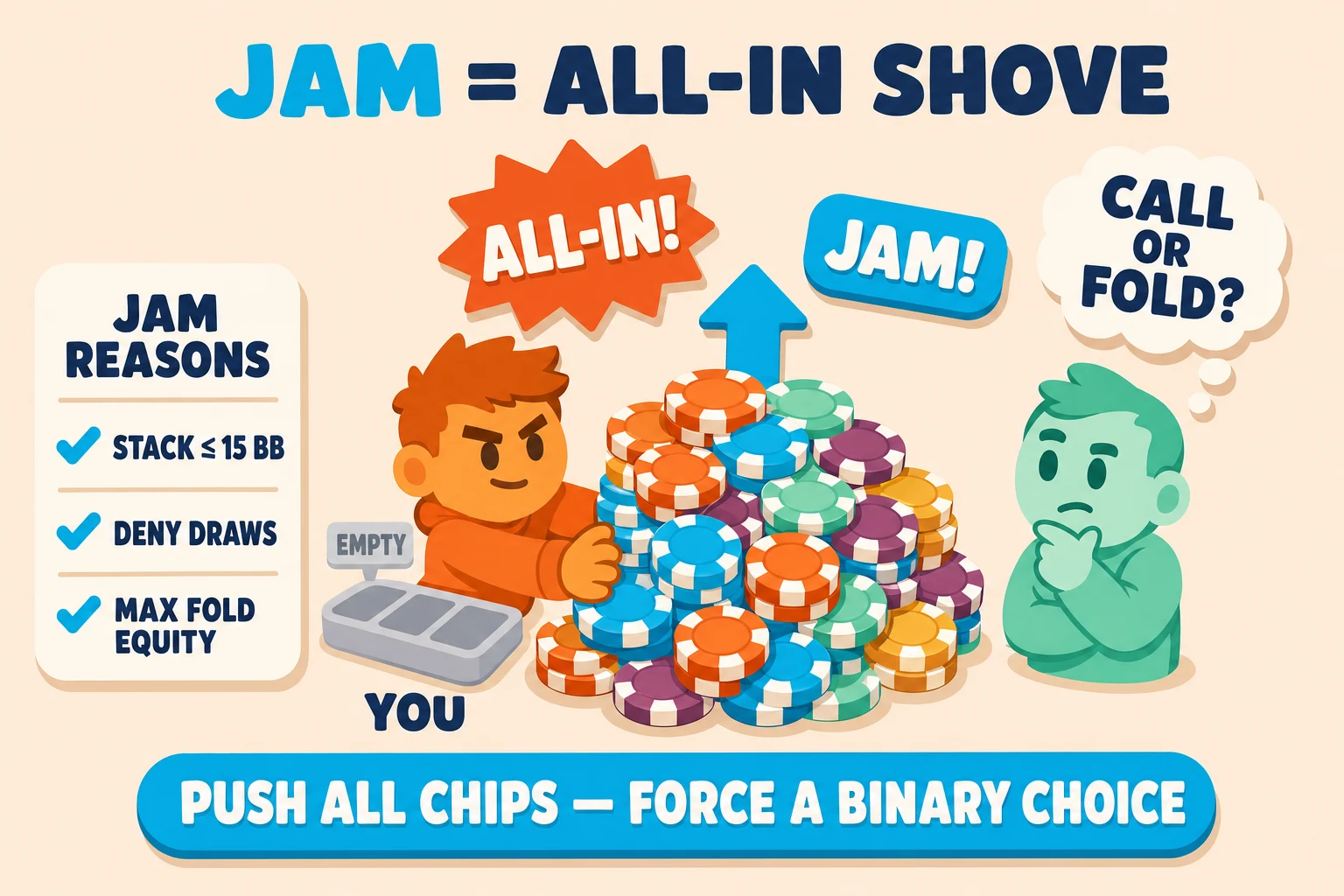
A "jam" is an all-in bet - you push all remaining chips into the pot. This play forces opponents to call for all their chips or fold. Jamming can represent a very strong hand, a bluff, or a mathematical push based on stack dynamics. It creates fold equity - the chance opponents fold better hands when facing an all-in.
Practice this in Poker Skill. A jam at least a full raise in size reopens the betting, so players who already acted can raise again, a rule the Raise Mechanics & Reopening lesson tests with all-ins of both sizes.
Get the free appJam in No-Limit Texas Hold’em
What a “Jam” Is
A “jam” is an all-in bet - you push all remaining chips into the pot. This play forces opponents to call for all their chips or fold. Jamming can represent a very strong hand, a bluff, or a mathematical push based on stack dynamics. It creates fold equity - the chance opponents fold better hands when facing an all-in.
When to Jam: Stack Sizes and Typical Situations
Stack size largely determines whether you should jam. Short stacks use a jam-or-fold approach, typically around 15-20 big blinds (bb); the big blind measures stack depth. With 15bb you can shove and make opponents pay to see all five community cards. With roughly 40bb or less, a 4-bet (a re-raise after a raise and a re-raise) often becomes an all-in. A non-all-in 4-bet at those depths either pot-commits you or gives callers attractive odds, so many players prefer to shove. Jamming also fits late-street scenarios: on the river an all-in extracts maximum value or serves as a last-ditch bluff.
Pre-flop Jam Strategy
Late-position and blind shoves work well with short stacks because they maximize fold equity and steal blinds. Example: blinds 200/400, you have 6,000 chips (15bb) on the button with A♦5♦ - shoving denies opponents correct odds and can win the pot outright. Use pre-flop jams to deny drawing equity; a shove reduces opponents’ incentive to chase straights or flushes. Adjust your shove range to opponent tendencies: tighten against sticky callers and widen against players who fold too often. When stacks sit around 35-40bb, prefer a 4-bet shove to a large non-all-in 4-bet to preserve fold equity and avoid awkward post-raise decisions.
Post-flop and River Jamming
Shoving on the flop or turn is a heavier move and requires care. Use post-flop all-ins when the opponent’s calling range is narrow or when you block strong hands. On the river, jam to extract value from hands that will call for their tournament life or cash-game stack. Example: you hold K♠K♥ and the board runs 8♣7♦2♣J♠Q♦ on the river. Pushing all-in can force worse kings or pairs to call and denies turn-and-river drawing hands the chance to win. Always weigh opponents’ likely calling ranges and remaining equity before shoving on later streets.
Hand Selection, Opponent Types, and Math
High pocket pairs (pocket tens or better) make natural jam candidates; they maximize value and deny drawing outs. Versus wide-callers, jam for value because they will call with worse hands. Versus tight or fold-prone opponents, use selective jam bluffs to exploit fold equity. Base decisions on pot odds and expected value (EV): estimate how often opponents will call versus fold and whether the shove is profitable long-term. When stack depth, hand strength, and opponent tendencies align, a jam is often correct.
Quick Jam Checklist
- Confirm stack threshold: is this a <15-20bb shove or a <40bb 4-bet situation?
- Assess hand strength and position: is your holding jam-worthy from this seat?
- Check opponent types: are they wide-callers or frequent folders?
- Run the math: do pot odds and EV justify the all-in?
- Factor tournament life and payout implications before risking all chips.
Run this checklist quickly before committing chips - it prevents rushed, costly mistakes.