


Shove
Shove (All-In) - When and How to Push Your Stack
Shove (All-In) - When and How to Push Your Stack
What a shove is and why it matters
A shove - also called an all-in - means wagering your entire remaining stack in one bet. It’s unique to No-Limit Texas Hold’em because there is no cap on bet size. A shove forces opponents into a binary decision: fold or call for all their chips. That creates fold equity - the chance opponents fold better hands - and can turn a marginal hand profitable. Shoves appear most in tournaments and when short stacks require conserving or doubling chips.
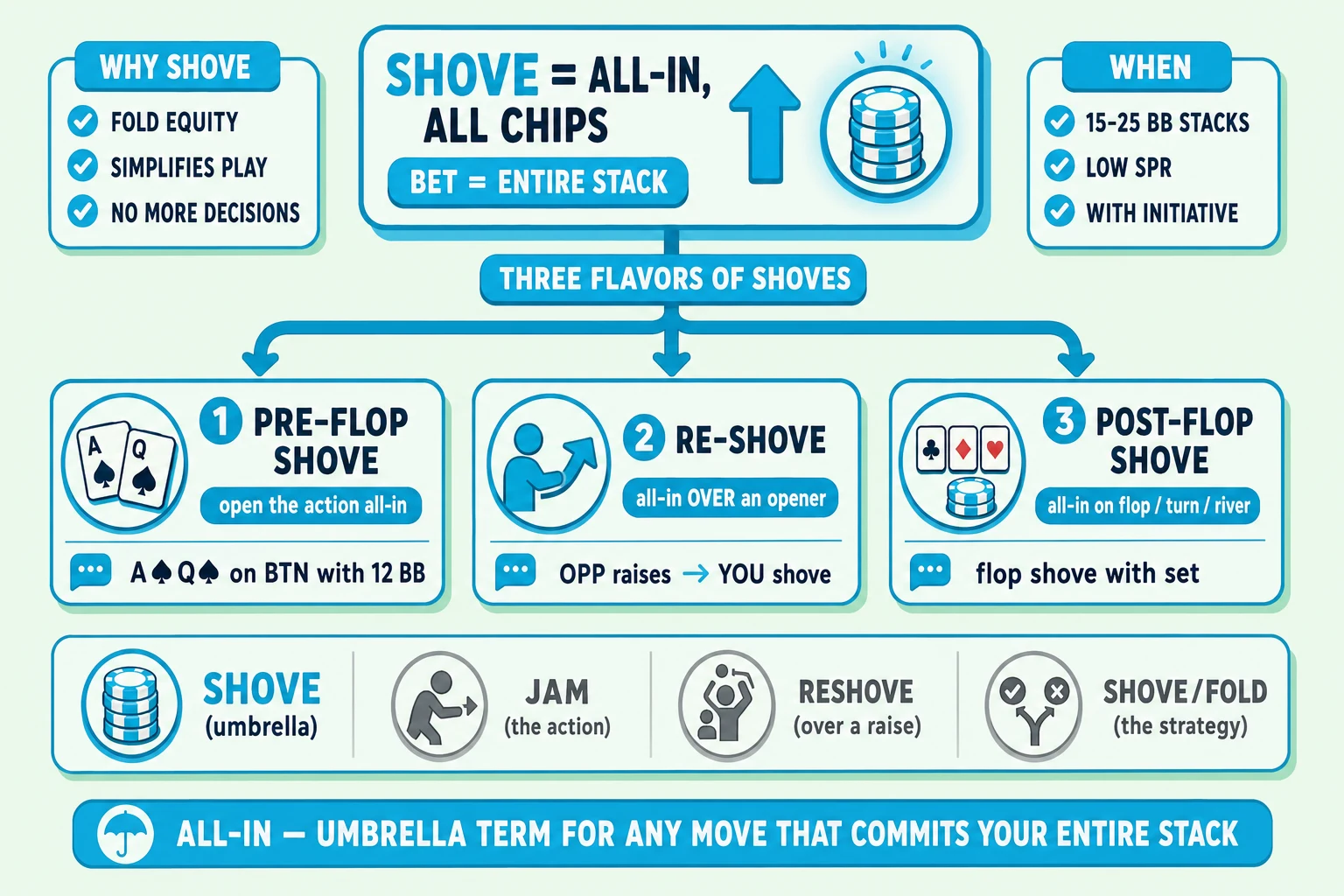
Short-stack shoving: when to push (15-25 BB guideline)
When your stack is about 15-25 big blinds, shoving becomes a frequent and often correct option. From the blinds or late position, an all-in can steal the pot or isolate an open raiser. Example: You’re on the button with 18 BB and A♣8♣. If the cutoff opens, shoving folds out many hands and avoids tough post-flop decisions. Preferred shove hands here include pocket pairs (22-TT+), some offsuit A-x (A9o+ depending on opponent), and selected suited connectors like 76s. Shoving converts marginal hands into spots where fold equity and immediate payoff beat post-flop maneuvering.
Using fold equity and blockers to improve shove EV
Fold equity powers shoving: you force opponents to surrender hands that still have equity. Blockers are cards in your hand that reduce the chance an opponent holds specific premium holdings. For example, an ace lowers the odds they hold A-K or A-Q. Example: With K♠J♠ and 16 BB, shoving looks stronger versus a tight opener who folds A-x often. K♠J♠ blocks many ace-king combinations, improving your shove’s expected value because callers include fewer dominating hands. Favor shoves when your range is ahead of expected callers or when hands play poorly post-flop.
Shoving from the big blind: defending and exploiting openers
The big blind has positional quirks: you already have a partial investment and act first post-flop. Versus late-position openers, their opening range is typically wider, so the BB can shove a wider spectrum profitably. Example: Facing a button open with 20 BB, a shove with 88, ATo, or KQo can be justified because many button opens fold. Tighten your BB shove range versus early-position opens because their ranges are stronger and callers will include more dominating hands. Always adjust to opponent tendencies and exploit excessively wide openers with more all-ins.
Poker Skill’s Big Blind vs Button Open lesson reads a wide button range this way at 100 big blinds, where the answer is a 3-bet or a fold rather than a shove.
SPR, initiative, and the shove decision framework
Stack-to-pot ratio (SPR) is the ratio of effective stacks to the pot size. Low SPR (about 0-3) favors committing with strong hands because there is less room for post-flop maneuvering. Initiative - being the last aggressor before the shove - increases fold equity and makes all-ins more profitable.
A simple 3-step shove checklist:
- Check SPR: if it’s about 0-3, be willing to shove top pair+ or strong two-pair/sets.
- Assess initiative: if you opened or are the aggressor, widen your shove range.
- Evaluate blockers and opponent range: shove when you block likely premium hands or callers’ ranges look weak.
Avoid limping when a shove can seize initiative and fold equity. Use solver ranges or studied pre-flop charts to refine exact hands by position and stack size.
Quick checklist
- Short-stack threshold: consider shoving frequently around 15-25 BB.
- Prefer shoves with blockers or hands that are hard to play post-flop.
- Shove more with initiative and when SPR is low (0-3).
- From the BB, widen shoves versus late-position opens and tighten versus early opens.
- Avoid limping when a shove can seize fold equity and initiative.
- Use studied solver ranges or pre-flop charts to refine position- and stack-specific shove ranges.