


Fold Equity
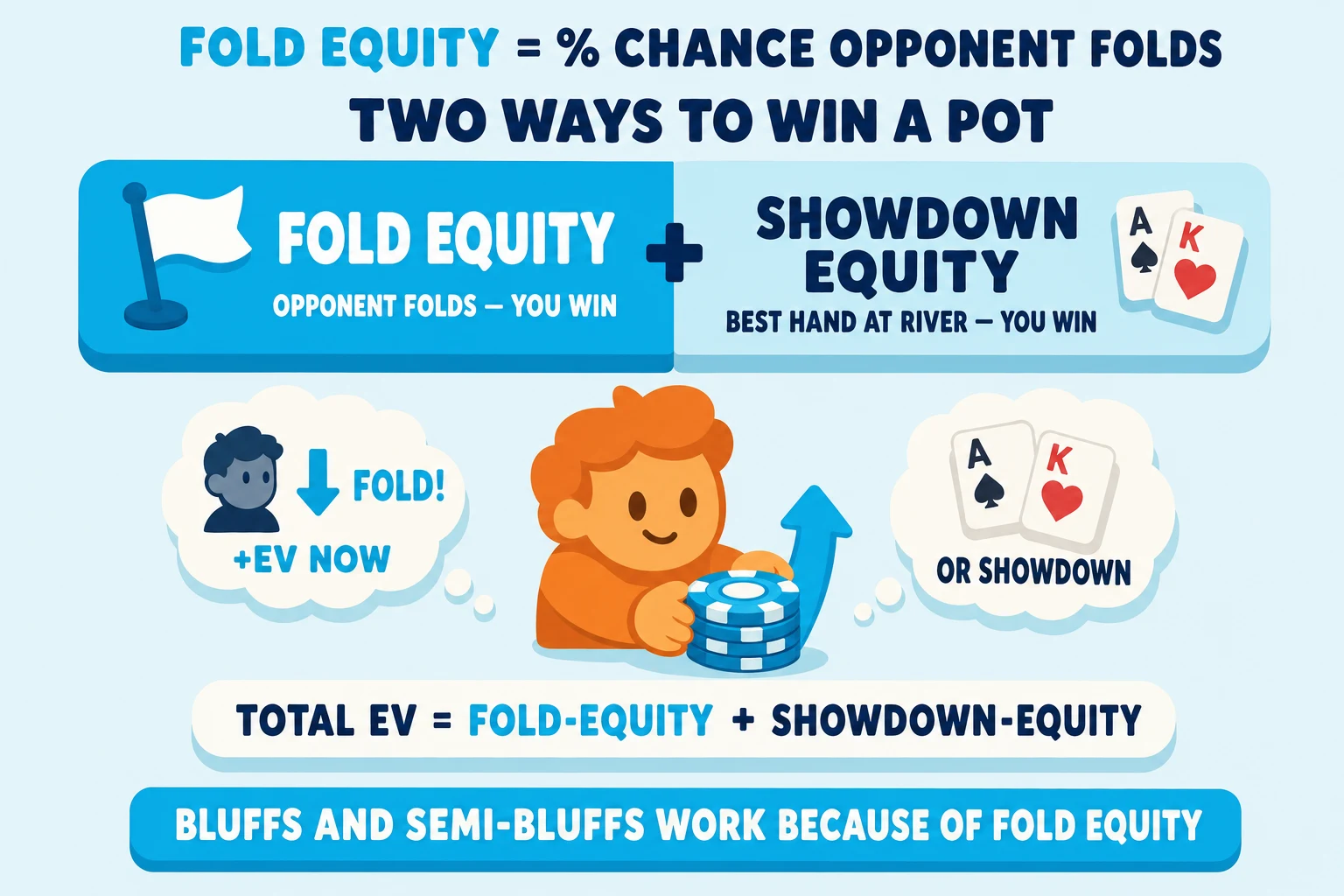
Fold equity equals the portion of a pot you expect to win when opponents fold to your bet or raise. It differs from showdown equity, which measures your chance to win if all players see the river. No-Limit Hold'em magnifies fold equity because players can bet any amount, including going all-in to commit their entire stack. That freedom lets players win pots by applying betting pressure instead of always holding the best cards.
Practice this in Poker Skill. The number of players changes fold equity, and the lesson on multiway c-bets shows why: three-way, 9♦ 10♥ checks on 4♥ J♥ 3♥, because a draw-heavy flop gets called too often with two players left to act.
Get the free appFold Equity in No-Limit Texas Hold’em
What fold equity is
Fold equity equals the portion of a pot you expect to win when opponents fold to your bet or raise. It differs from showdown equity, which measures your chance to win if all players see the river. No-Limit Hold’em magnifies fold equity because players can bet any amount, including going all-in to commit their entire stack. That freedom lets players win pots by applying betting pressure instead of always holding the best cards.
Why fold equity matters
The threat of a large bet or shove often makes opponents fold marginal or even superior hands. Hands with limited showdown value become profitable when bets have a realistic chance of forcing folds. Fold equity enables pure bluffs and semi-bluffs-bets with drawing hands that can improve-to work. It’s also why No-Limit play has deeper psychological and strategic complexity. You compete not only on card strength but on how much fear and respect your bets create.
How to create and estimate fold equity
Several concrete factors generate or reduce fold equity:
- Bet size and position. Larger, well-timed bets increase pressure and folding likelihood. Late position gives extra informational advantage and raises folding frequency.
- Stack sizes and “put-it-in” metrics. Threatening a meaningful portion of an opponent’s stack generates more fold equity.
- Opponent tendencies and patterns. Moderate aggression often folds tight, risk-averse players. Loose or calling-station players call more and yield little fold equity.
Practical estimation: compare pot size to your planned bet, check effective stacks, and use reads to predict opponent fold frequency. If reads suggest a high folding rate, fold equity is strong; otherwise rely more on showdown equity.
When to use fold equity (bluffs and semi-bluffs)
Common spots to pursue fold equity:
- Pure bluffs on scare cards. If a board card suggests a completed strong hand, a big bet can force folds.
- Semi-bluffs with draws. Betting with a draw gives two ways to win: opponents fold now, or you hit and win at showdown.
- Late-position steals and continuation bets (a continuation bet, or “c-bet,” is when the preflop raiser bets again on the flop). Use these when opponents show weakness or have poor draw odds to call.
How opponents can counter fold equity
Defenders can reduce an aggressor’s success by adjusting:
- Call more with hands that have showdown value when you suspect frequent bluffs.
- Re-raise or apply pressure if you believe the bettor overuses bluffing.
- Observe patterns. Consistent large bets in known steal spots signal overreliance on fold equity. Widen calling or raising ranges accordingly.
Quick checklist
- Check stack-to-pot dynamics before committing to a shove or large bet.
- Size bets to make folding unattractive when you want action.
- Use opponent tendencies and recent betting patterns to choose bluffs vs. value bets.
- Favor semi-bluffs when you also have outs to improve at showdown.
- Be prepared to call or re-raise when opponents appear to be overleveraging fold equity.
Fold equity is a tool. Used correctly, it turns marginal hands into winners and forces opponents into costly mistakes. Used incorrectly, it strips chips against stubborn or well-adjusted opponents. Keep the factors above in mind and adapt to the table.