


Fold Frequency
Fold frequency is how often a player folds in a specific spot defined by street, position, bet size, board, and line. It is not a global character trait. It's the input bluff math compares against, and the number worth measuring before any bluff plan.
Practice this in Poker Skill. The beginner flop lessons decide whether to bet by how often the caller will fold: a small bet takes a dry K-7-2 often, because the board barely touches the caller’s hands, while a missed hand checks J-10-9, where a bet meets too many calls.
Get the free appFold frequency: how often a player folds in this exact spot
What fold frequency is
Fold frequency is the rate at which a player folds in a specific situation: a particular street, position, bet size, board, and line. It is not a global character trait. It’s the empirical number a bluff plan estimates before pulling the trigger, and the number the bettor’s break-even math is compared against. Two players with the same overall preflop profile can have totally different fold frequencies in the spot you actually care about, because the spot is what the number describes.
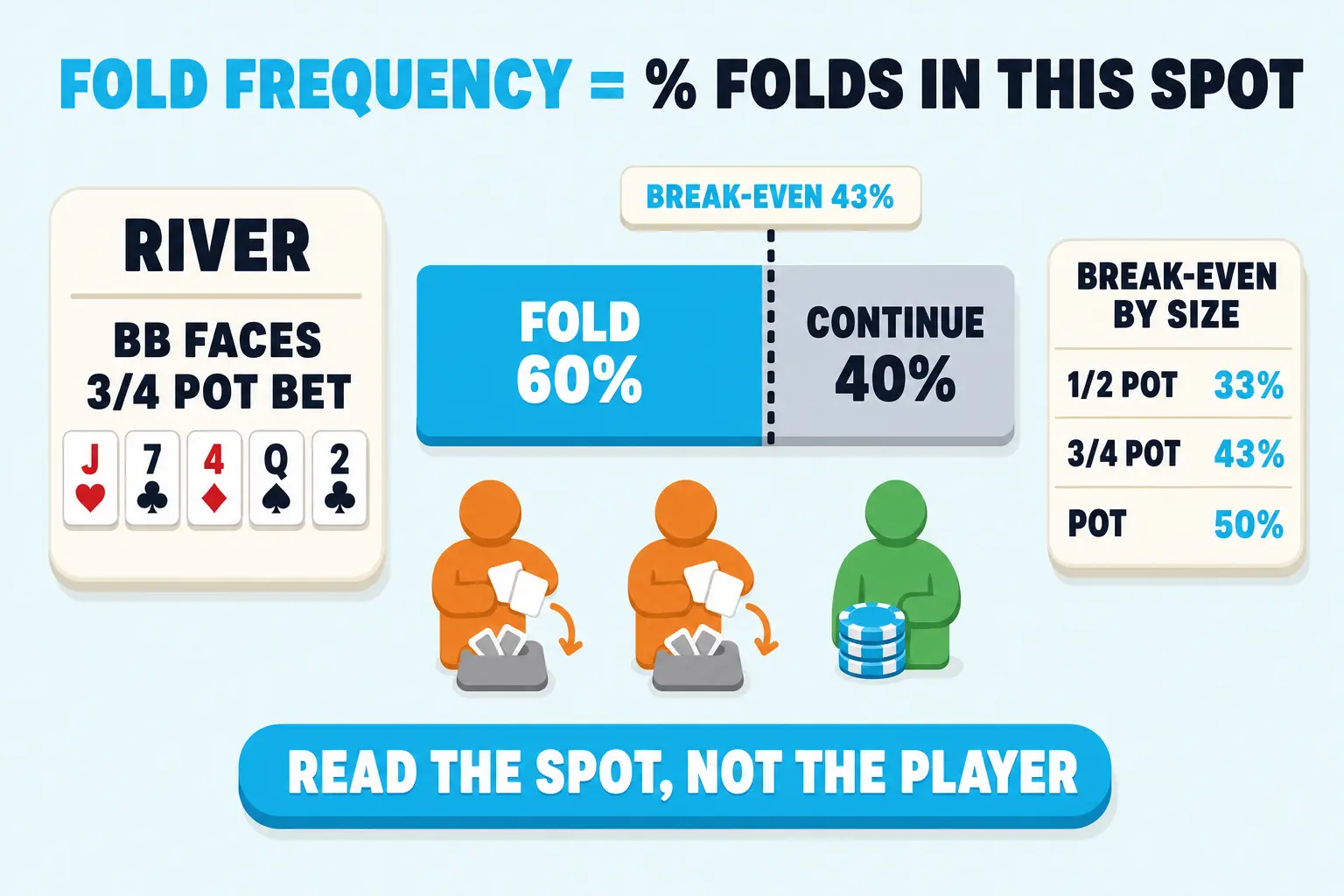
The mental shortcut is read the spot, not the player. A nit folds the river to a 2x overbet at a much higher rate than they fold a button open preflop. Same player, two totally different fold frequencies. A “fold to c-bet” tracking stat is already a spot stat, which is why it’s useful. A global “fold percentage” rolled across every node a player has ever been in mostly is not.
Related terms
Fold frequency vs the neighboring concepts
Five terms cluster around the same math. Use the one that names the seat you’re in.
| Term | What it measures | Whose seat |
|---|---|---|
| Fold frequency | How often someone actually folds in this spot | Either |
| Fold equity | The EV the bettor gets from folds at the chosen size | Bettor |
| Break-even fold percentage | The fold rate a zero-equity bluff needs to be 0 EV | Bettor |
| Minimum defense frequency | The defender’s continuing rate that prevents profitable bluffs | Defender |
| Overfold | Folding above the rate the math supports | Defender |
The thread that ties them together: fold frequency is the empirical number; break-even fold % is the threshold; MDF is the mirror of break-even fold % from the defender’s chair. When the opponent’s actual fold frequency at a given size sits above break-even, a zero-equity bluff is +EV. When it sits below, the bluff is -EV. When it equals break-even, the bluff is exactly 0 EV.
When fold frequency matters most
Fold frequency carries the most weight in spots where the math reduces cleanly:
- River bluffs. No more cards to come, no equity to realize, no future streets. The bettor’s bluffs are zero-equity hands by definition; opponent fold frequency vs your size is the whole question.
- C-bet sizing. C-bet plans on dry boards lean on a high estimated fold frequency from the caller’s range. Coordinated boards drop that estimate; the same size that works on K♣7♦2♠ rainbow may struggle on T♠9♠8♥.
- Steal attempts and blind defense. A button open’s success leans on the combined fold frequency of SB and BB. A 2.5x open risks 2.5bb to win 1.5bb, so the blinds together folding more than ~62% of the time makes the steal +EV from fold equity alone.
- Population reads. A population tendency like “small-stakes regulars overfold turn after a flop check-raise” is a fold-frequency claim about a class of opponent in a specific node, not a claim about all their folds everywhere.
- Bluff size selection. Bigger bets demand higher fold frequencies to break even; smaller bets need less. Match the size to the fold rate you actually expect, not the one you wish for.
It matters less, and is misleading, on the flop and turn. There, “bluffs” still have equity to improve, and bettors do not lose the entire pot when called. The fold-frequency-vs-break-even-% comparison is necessary but not sufficient on those streets.
Worked example
Pot is $100 on the river. Villain called the flop and turn on an undisturbed jack-high runout where their preflop calling range is mostly underpairs and missed broadway hands. Your hand is 7♣6♣ — a missed gutshot that beats nothing they reach the river with.
You consider a $75 bet (3/4 pot).
- Break-even fold percentage at this size:
75 / (75 + 100)≈ 43%. - Estimated fold frequency for this villain in this exact node (river, jack-high dry runout, two prior calls), based on what you know about the population and any reads on this player: maybe 40%.
40% sits below 43%, so the bluff is slightly -EV from fold equity alone. Two reasonable adjustments:
- Drop to a half-pot bet. Risk $50 into $100. Break-even ≈ 33%. If your 40% fold-frequency estimate is right, the smaller size is +EV without changing the read at all.
- Pick a different combo. A bluff with a card that blocks villain’s most confident calls (an ace with a relevant kicker, for example) lifts your estimated fold frequency in this node, because it removes some of the combos they would defend with.
The math doesn’t choose the bluff for you. It tells you which size your fold-frequency estimate has to clear, and where your read is too thin to support the line.
Common mistakes
1) Treating fold frequency as a player trait
A “tight folder” is shorthand. The actual question is always “in this spot.” A nit who folds a lot preflop may be very sticky on the river when they finally make a hand. A loose-passive who calls down with bottom pair may fold any river overbet because the size doesn’t match their sample experience. The number lives in the node, not on the player’s forehead.
2) Using a global tracking stat for a specific node
Fold to c-bet is itself a spot-conditioned number, but only one node deep. The fold frequency you actually need for a turn double-barrel after a flop check-raise is not the same as their fold to flop c-bet overall. The deeper into the line a spot lives, the smaller the relevant sample, and the further the global stat drifts from the real per-node answer.
3) Ignoring sample size on a per-spot read
A villain who has folded to your last two c-bets on dry boards may be a 100% folder of dry-board c-bets, or they may be a 50% folder you happened to catch twice in a row. Two hands is not a fold frequency. Wait for the sample to mean something, or label the read as a guess and size accordingly.
4) Conflating fold frequency with MDF
MDF is the defender’s continuing rate that stops an opponent from bluffing any two cards. Fold frequency is what they actually fold in this spot. They are related (MDF plus break-even fold % always equals 1), but they are not the same object. MDF is the ceiling the defender can’t exceed without becoming exploitable; fold frequency is what the defender actually does.
FAQ
How do I estimate an opponent’s fold frequency before betting?
Two steps. First, compute the break-even fold percentage for your chosen size: risk over risk-plus-reward. Second, judge whether the opponent’s range, profile, and recent line history fold above that threshold in this specific node. Boards that connect with their calling range drop the number; cards in your hand that block their strongest continues raise it. The strength of your card is the wrong reference point. The opponent’s range is the right one.
Does fold frequency change with bet size?
Yes, sharply. Bigger bets tend to fold out more hands but also demand a higher break-even rate to be +EV. A pot-sized bet usually lifts fold frequency above a 1/3-pot bet, but it also requires the fold rate to cross 50% instead of ~25%. The right size is the one whose break-even fold % sits below your honest estimate of the opponent’s actual fold rate at that size, not the largest size you can find.
Is “fold to c-bet” the same as fold frequency?
It’s a kind of fold frequency — the one specifically conditioned on facing a continuation bet on the flop. Useful and well-sampled in tracking software because flops happen often. But it’s only one node. Fold frequency vs a turn double-barrel after a flop call, or vs a river overbet on a brick runout, are different numbers and usually need separate reads. A player’s fold to c-bet of 65% does not mean their river-overbet fold frequency is also 65%.