


Four of a Kind
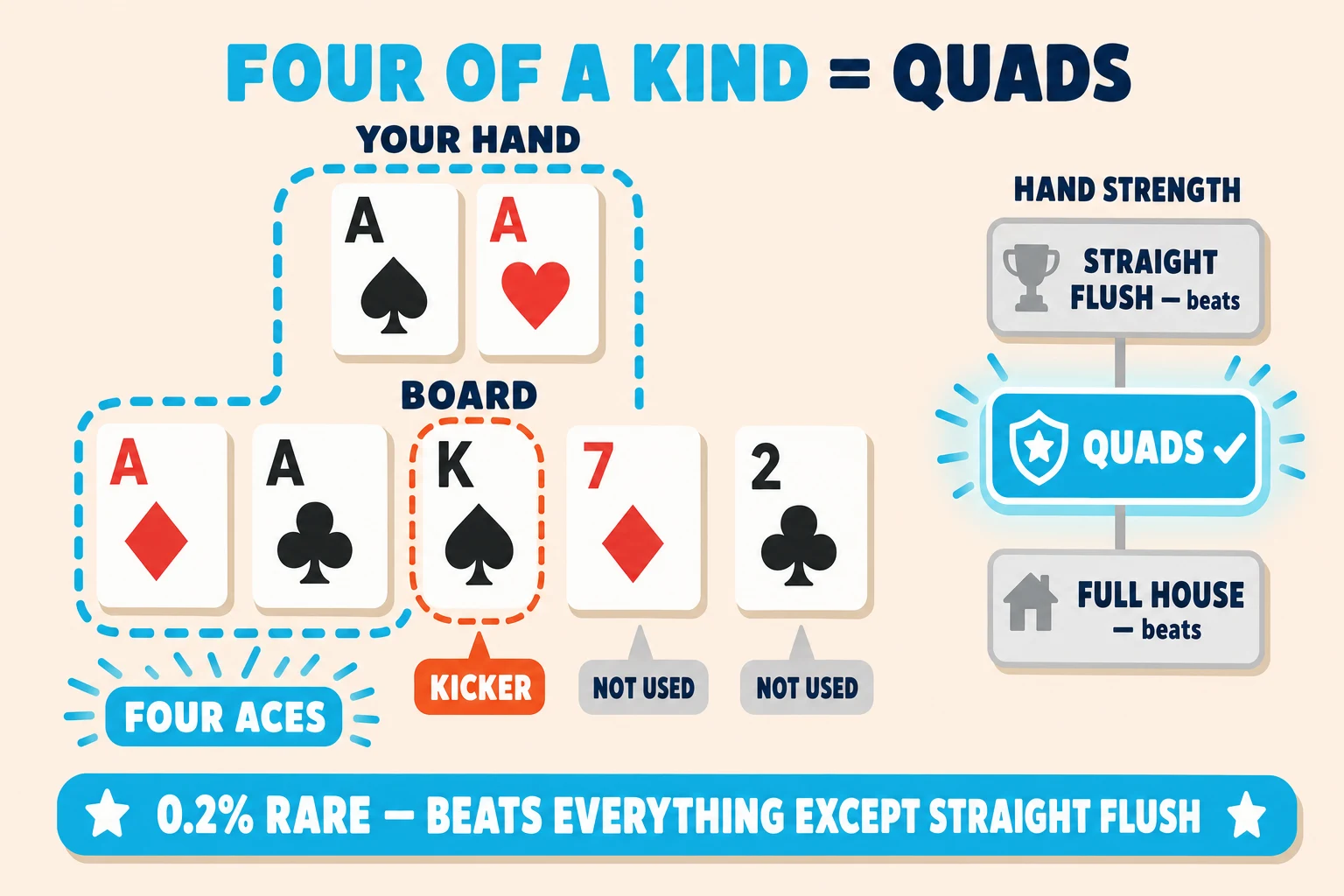
Four of a Kind (quads) is a five-card hand: four cards of one rank plus an unrelated kicker. The kicker is the highest other card in your five-card hand and breaks ties at showdown (when players reveal hands). Example: you hold A♠ A♥ and the board shows A♦ A♣ K♠ 7♦ 2♣. Your best five cards are A♠ A♥ A♦ A♣ K♠ - four aces with a king kicker. If all four matching ranks appear on the board, every player shares the same quads. Then the highest remaining card outside the quads becomes the kicker, which can produce split pots.
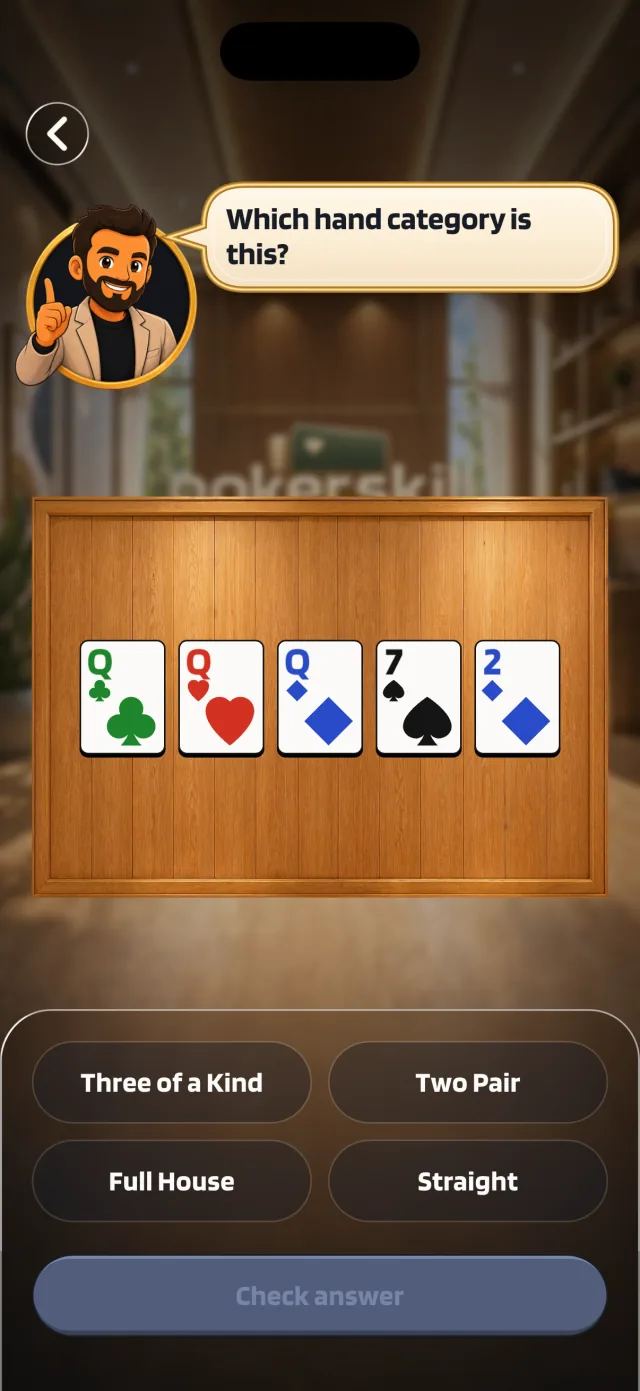
Practice this in Poker Skill. Asked for the best hand on 7♥ 8♥ 9♥ 9♠ 2♣ in the Straight Flush & Royal lesson, you pass over the four nines that 9♦ 9♣ make and pick 10♥ J♥, a jack-high straight flush.
Get the free appQuads lose to any straight flush, and both can come from one board.
Four of a kind
What four of a kind is
Four of a kind (quads) is a five-card hand made up of four cards of one rank plus an unrelated kicker. The kicker is the highest other card in your five-card hand; it breaks ties at showdown. For example, you hold A♠ A♥ and the board shows A♦ A♣ K♠ 7♦ 2♣. Your best five cards are A♠ A♥ A♦ A♣ K♠: four aces with a king kicker. If all four cards of a rank appear on the board, every player at showdown shares the same quads, and the highest card outside the quads becomes the kicker. That can produce split pots when no one has a card higher than the board’s fifth.
For the full order of hands, odds and tie-break examples, see the poker hand rankings chart.
How rare four of a kind is
In Texas Hold’em, four of a kind shows up roughly 0.17% of the time across seven cards (about 1 in 595 deals). Opponents rarely expect them, and they tend to win big pots when stacks go in.
Where four of a kind sits in the ranking
Quads rank below a straight flush and above a full house. The four matching cards decide the comparison; if both players share the same quads, the kicker decides. If both kickers match, the pot splits.
How to play four of a kind in No-Limit Hold’em
The priority is extracting value without losing track of the rare cases where you’re beaten.
- Value-bet most of the time. Size bets to keep worse hands in: sets, full houses, top pairs. Quad kings on a river will often get called by two pair and weaker full houses.
- Disguise the hand when the line allows it.
- Read the board. Only two hands beat quads: a straight flush, which needs at least three suited cards close in rank on the board, and higher quads, which need two paired ranks on the board. If the board allows either, slow down.
Reading boards and opponents with four of a kind
Board texture, how coordinated or dangerous the community cards are, controls how you present quads. A dry, unconnected board hides them and lets you bet straightforwardly. A board with three suited cards close in rank raises the small but real chance you are behind.
Watch opponents’ sizing and lines for information. Big river raises or unusual check-raises can hint at a straight flush in the rare cases where the board allows it. If a previously passive opponent suddenly fires big into a paired or four-flush board, slowing down for a beat gives up a little value when you are ahead and saves chips in the rare case you are not.
Compare all ten poker hand rankings, best to worst to see where four of a kind sits.
For the two hands that can still beat quads, and the rest of the ladder below them, see what beats what in poker.
Checklist
- Identify the four matching ranks and the kicker before you act.
- Read the board for disguise versus straight-flush danger.
- Pick a sizing that pulls maximum value from the realistic calling range.
- Account for kicker and shared-board tie scenarios.
- Remember the hand’s roughly 0.17% frequency when planning aggression. Quads rarely show up; when they do, the goal is the biggest pot you can build.