


Four-Flush
A four-flush is four cards of the same suit on the way to a flush. The term covers two situations: four cards of one suit between your hand and the board (a flush draw), or four community cards of one suit on the board itself. The board-side meaning is a specific runout texture where any player holding even one card of that suit has already made a flush.
Practice this in Poker Skill. When the ace of the suit sits on the board, the king is the top card left: on A♥ Q♥ 7♥ 2♥ 9♣, the last question of the Nut Flushes & Monotone Boards lesson, K♥ 5♣ beats J♥ 10♥.
Get the free appFour-Flush in No-Limit Texas Hold’em
What a four-flush is
A four-flush is four cards of the same suit on the way to a flush in poker. The term covers two situations:
- Hand-side four-flush. You have four cards of one suit between your hole cards and the board. You need one more card of that suit to make the flush. This is the same idea as a flush draw.
- Board-side four-flush. Four of the five community cards are the same suit. Any player holding a single card of that suit has already made a flush.
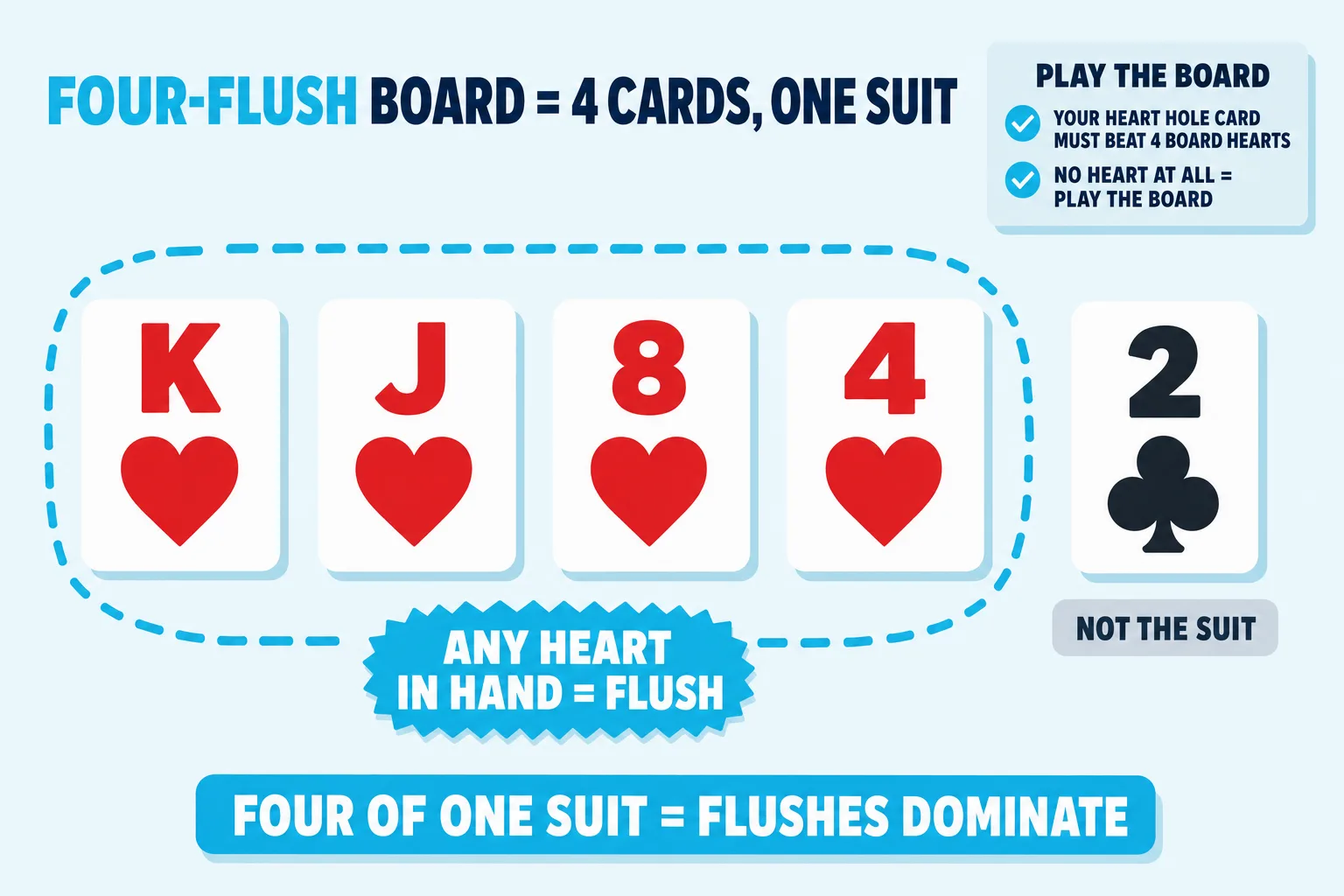
The two meanings come from the same root: four cards of one suit, one card short of the five needed for a flush. Most everyday poker conversation uses “flush draw” for the hand-side and “four-flush board” or “four to a flush” for the board-side, and that’s the cleanest way to keep them straight.
Hand-side four-flush vs board-side four-flush
| Type | Suited cards | Where | What it means |
|---|---|---|---|
| Hand-side four-flush | 4 | Your two cards + the board | You’re drawing — see flush draw for outs and odds |
| Board-side four-flush | 4 | All on the board | Anyone with one card of the suit has a flush |
| Monotone flop | 3 | All on the board | Flush already possible if a player holds two of the suit |
| Two-tone flop | 2 | All on the board | Flush draw is live; no flush yet |
The board-side four-flush is the texture this entry mostly cares about, because the hand-side meaning is already covered by flush draw. The board-side version usually arrives in one of two ways: a monotone flop where the turn or river adds the fourth card of the same suit, or a two-tone flop where the turn and river both bring the same suit.
Why a board four-flush matters most
The fourth card of one suit on the board changes the strategic picture in three ways:
- Anyone with one card of the suit has a flush. Hands like A♥3♣ on a K♥ 8♥ 4♥ 2♣ J♥ board now have an ace-high flush. The threshold for “having a flush” dropped from two suited hole cards to one.
- The top card of the suit wins. When the board carries four of one suit, the player with the highest card of that suit wins the flush battle. The ace of the suit is the nut flush. The king is second-nut, and so on.
- Players without a card of the suit have no flush. Four suited cards are one short of five, so a hand with none of the suit plays its best non-flush five. On an unpaired board that loses to any flush.
Compare this to a monotone flop: monotone needs two suited hole cards to make a flush, while a board four-flush needs only one. That single-card threshold is why four-flush boards reshape ranges so hard.
Example: the river brings the fourth heart
You open from the cutoff with K♣ Q♣. The big blind defends. The flop is 8♥ 4♥ 2♣ — a two-tone board with a heart flush draw live but not yet completed. You c-bet half pot and the big blind calls.
The turn is J♥. Now the board reads 8♥ 4♥ 2♣ J♥ — three hearts. A player holding two hearts has a flush already, and the board still needs one more heart to four-flush.
The river is K♥. Final board: 8♥ 4♥ 2♣ J♥ K♥. Now four of the five community cards are hearts. This is a board four-flush.
Your hand:
- You hold K♣ Q♣. Neither of your cards is a heart.
- The board itself is K♥ J♥ 8♥ 4♥, a king-high four-card flush.
- For you to make a flush, you’d need a fifth heart in your hand. You don’t have one.
- Your actual hand is the pair of kings (K♣ on the board K♥), with a queen kicker.
What changed:
- Any opponent holding even one heart has at least a king-high flush (using the K♥ from the board).
- A player with the A♥ has the nut flush, which can’t be beaten.
- A player with no hearts at all is in the same boat you are, holding their best non-flush five.
If the big blind bets the river large, your pair of kings is now near the bottom of the hands you’d want to call with. The bet represents at least a one-card flush. Even if villain is bluffing, the price has to be very generous to make the call worthwhile.
Common mistakes on four-flush boards
1. Defending only with flushes
A pot-sized river bet on a four-flush board needs about half-defense to deny villain a free profitable bluff. You won’t have a flush often enough to defend with flushes alone. Sets, two pair, and the right top-pair hands need to be in your call range too, especially when villain’s bluff range is wide.
2. Overvaluing a small one-card flush
A 3♥ in your hand on a board of K♥ J♥ 8♥ 4♥ 2♣ technically makes a flush, but the flush you make is a king-high flush using the four board hearts plus your 3♥, and any opponent holding a higher heart (the 5♥ or better) beats it. Bet sizes get tricky when your flush beats almost no other flush.
3. Forgetting the play-the-board scenario
You play the board for a flush only when all five board cards share the suit. Then a hole card of that suit helps only if it beats the lowest board card of the suit; if yours is lower, the board’s flush is your best hand and you split with everyone who can’t beat it, even players with no card of the suit.
4. Mis-labeling four-flush as monotone
A monotone flop is three cards of one suit. A board four-flush is four cards of one suit, usually completed on the turn or river. The strategic responses differ: monotone calls for small c-bets and pot control with medium hands, while a board four-flush often calls for bluff-catching wider than just flushes and check-raising the nut flush.
FAQ
What is a four-flush in poker?
A four-flush is four cards of the same suit, one card short of a flush. The term has two meanings. Either your hand has four of one suit between hole cards and board (a flush draw), or the board itself shows four of one suit, in which case anyone holding a single card of that suit has a flush.
Is a four-flush the same as a flush draw?
The hand-side meaning is. “I have a four-flush” usually means “I have a flush draw, four cards of one suit, needing one more.” The board-side meaning (“the board four-flushed on the river”) is different: it describes a board texture, not a drawing hand.
What happens when the board four-flushes and you don’t have any of that suit?
You can’t make a flush. Your best hand is the strongest five cards you can build from your two cards and the board, and a pair, two pair or straight all lose to anyone holding one card of the suit.
Quick checklist
- Spot the four-flush early: on the river, count suit pips on the board before sizing.
- Identify whether the four-flush is on the board or split between your hand and the board.
- If on the board, check whether you hold the highest card of that suit (the nut flush) or only a low one that most flushes beat.
- Defend with more than just flushes against river bets when the board four-flushes.
- Avoid building big pots with one-card flushes that play below the four board cards.
Four-flusher: the slang
A four-flusher is a player who bets a four-flush as if the fifth card had already arrived. The verb came first: to four-flush is to pass off four of a suit as a made flush, and four flushing is the act of doing it. Both words come straight from the card meaning above, and neither one makes sense anywhere a flush does not need five.
The word then left the card room. In ordinary English a four-flusher is a fraud or a pretender of any kind, and it is meant as an insult with or without cards on the table. That is worth knowing at a table, because a player who calls you a four-flusher after a hand is not describing your holding. They are saying they think you represented a flush you never had.
The poker sense stays narrower and more useful. Betting a four-flush is a real line, not a character flaw: a flush draw that bets is one of the few hands that wins two ways, by making the flush or by folding out a better hand right now. The insult only lands when the story does not fit the board.