


Four-Straight
A four-straight is a board that already shows four cards to a straight. Any one rank in an opponent's hand makes the made straight, the board can chop a lot, and your strong made hands lose value fast.
Practice this in Poker Skill. Once 5♣ 7♥ 6♦ adds the 4♣, a single eight or three makes a straight, and the lesson on bad barrel cards has K♠ Q♥, with no pair or draw, check that turn.
Get the free appFour-straight: when the board itself shows four cards to a straight
What a four-straight is
A four-straight is a board that already shows four cards in sequence — like 8-9-T-J on a turn or 9-T-J-Q-2 by the river. One more rank, in either direction or filling a gap, makes the straight. The whole texture is the threat: every opponent holding a single useful rank now has the made hand, and a lot of opponents have it for free because four of the five cards are already on the board for everybody.
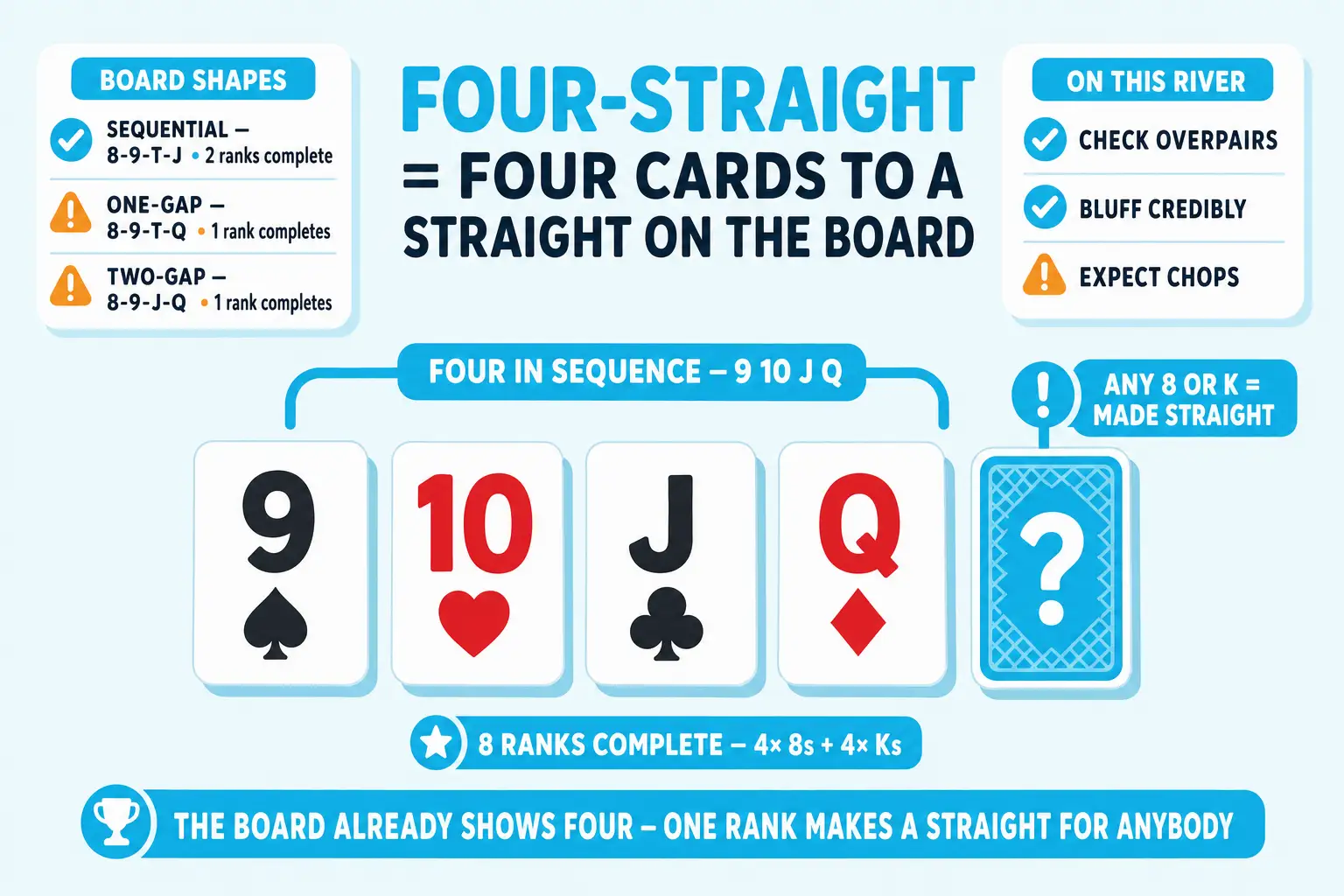
Bold the distinction so it never blurs: a four-straight lives on the board, not in your hand. A four-card sequence in your hand plus a flop card is a straight draw. Four cards on the board is a four-straight, and the burden of proof is on you to beat the straight your opponent just got handed.
The shape shows up as a runout feature most often: turn cards extending a connected board, or rivers that bring a card adjacent to the existing three. It is the canonical scare card, and it matters far more on the river than on the turn because there are no more cards left to bail you out.
Related terms
- Runout — the parent concept; four-straight is one specific shape the runout can take.
- Connected board — the flop family that produces four-straight turns and rivers most often.
- Scare card — the river card that turns a normal board into a four-straight is the canonical scare card.
- Straight — the made hand the board now threatens.
- Straight draw — what every adjacent-rank holding now is, with one card to come.
- Wet board — the umbrella that covers four-straight, four-flush, and other paint-everywhere textures.
- Board texture — the cluster hub for these shape entries.
Sub-shapes: sequential, one-gap, two-gap
Not every four-straight board behaves the same. Three sub-shapes show up in practice, and they vary by how many distinct ranks complete the straight.
| Board shape | Example | Ranks that make a straight | Number of completing ranks |
|---|---|---|---|
| Sequential | 8-9-T-J | 7 or Q | 2 |
| One-gap | 8-9-T-Q | only J | 1 |
| Two-gap | 8-9-J-Q | only T | 1 |
| Wheel-end | A-2-3-4 | only 5 | 1 |
| Broadway-end | T-J-Q-K | only 9 or A | 2 |
Sequential four-straights are the worst case: two distinct ranks complete, so any of eight cards in any opponent’s hand makes the straight, and a hefty chunk of pre-flop calling ranges contains at least one of those eight ranks. One-gap and two-gap shapes only get hit by four cards — still enough to fold most marginal made hands, but the chop / lose / win math shifts. Wheel and Broadway four-straights are special: they’re sequential, but the wheel uses the ace low and the Broadway run uses the ace high, so you have to remember the ace plays both ends.
When this matters most
The texture is decisive in a handful of recurring spots:
- Big blind defense in a single-raised pot. The BB defends a wide range loaded with connectors, gappers, and broadways. Sequential four-straight rivers (J-T-9-8 type) crush the opener’s overpair range and reward the BB’s calling range disproportionately.
- Multi-way pots. Each extra caller adds another chance somebody holds the completing rank. With three players to the river on a four-straight board, somebody has the straight a lot of the time.
- Deep stacks on the river. When stacks are deep and the pot is reasonable, the price to call a river bet is small relative to what’s at risk. Bluffs from a believable line can fold everything but the made straight.
- Heads-up on a paired four-straight. When the four-straight river also pairs the board (J-T-9-8-J), now both straights and full houses are live. The texture is loud enough that thin value-betting becomes a bluff in disguise.
It matters less when the four-straight needs an exact gap card the BB rarely defends (for example, a 3-4-5-7 board where only a 6 completes and most ranges fold 6x preflop), and on tight-EP-vs-tight-EP heads-up runouts where neither range carries many connector combos.
Worked example
You open the cutoff to 2.5bb with A♠ A♣. The BB calls. The flop comes 9♠ T♦ Q♥. You c-bet ⅔ pot, the BB calls. Turn is the J♦. The board now reads 9-T-Q-J — a sequential four-straight. Stacks are still ~85bb effective.
Your overpair was a comfortable favourite on the flop and is now one pair on a board where any K, any 8, any 7 (with a 9 or 8 in hand for the 7-8-9-T-J wheel-end), or any made straight beats you. The BB’s calling range carries plenty of K-x and Q-x with straight gutters, every suited 8-9 / J-T / Q-J / K-Q combo, and pocket pairs that just hit a set on a coordinated turn. Your A♠ A♣ has six outs to a set on the river and one or two extra outs to a higher straight only with very specific runouts.
The textbook play here is to check the turn. Betting again size-ups the hand against ranges loaded with made straights and combo draws, gives draws bad odds on a turn where they already have huge equity, and makes the river a guess game when stacks get short. Check, and let the BB build the pot for you only when they have a hand that can pay off. If the BB jams the turn, this is the spot where folding A♠ A♣ stops looking tight and starts looking correct: a competent BB raises the turn here with two pair, sets, and made straights, almost nothing you beat.
Common mistakes
1) Auto-firing overpairs on a four-straight river
The most expensive leak. K♠ K♣ that triple-barrels into a 7-8-9-T-x board pays off only the worse made hand a competent opponent has folded already. Once the river makes the board four to a straight, the natural call-down range narrows to “I have the straight or better.” Pot-control on the turn beats one more thin value bet on the river.
2) Forgetting the chop
When the board shows four to a straight and your hand contributes only the same fifth rank everybody else has, the pot chops a lot. K♠ Q♠ on a 9-T-J-Q-2 board has the same K-high straight as anyone else holding a king. Sizing big on the river to “extract value” turns into sizing big to chop the pot, which loses the rake.
3) Treating sequential and gapped four-straights the same
A sequential 8-9-T-J runout is hit by twice as many ranks as a one-gap 8-9-T-Q runout. The first deserves real fear from your overpair; the second deserves caution but still permits thin value-betting against ranges that don’t defend the gap card. Don’t paint with one brush.
4) Ignoring the bluff lever
The flip side of every common mistake above: when you don’t have the made hand and the board makes a four-straight on the river, this is the texture where a well-sized bluff works. The story is short, the made hand is plausible, and the calling range narrows hard. A line that already showed strength on the flop and turn often earns the fold here for the same reason an overpair stops getting paid.
FAQ
Does the board itself count as a four-straight?
Yes. The whole point of the term is that the four-card sequence is already on the board, not in your hand. If the board shows 7-8-9-T-2, every player at the table already has four to a straight; the question is who has the fifth rank to make it.
What’s the difference between a four-straight and a one-card straight draw?
A four-straight is a board feature: four community cards in sequence, with one card to come or already complete. A one-card straight draw is a hand feature: you need only one specific rank from the deck to make your straight, but that rank is not already showing on the board for everyone. The math is similar (one rank completes), but the strategic shape is opposite. On a four-straight, your opponents share the equity; on a one-card straight draw, only you have the angle.
Should I ever bluff into a four-straight board?
Yes, often. The four-straight river is one of the textbook scare cards for a reason: opponents struggle to call without the made straight, and your bet credibly represents the rank that completes it. The bluff is best when you’ve shown strength on earlier streets, the pot is large enough that the fold equity matters, and your opponent is not the kind of player who calls down with one pair anyway. Calling stations and players who just bet the turn for value are the wrong targets.