


Scare Card
A scare card is a community card on the turn or river that materially alters the board. It can add straights, flushes, or an obvious higher pair and change how strong hands appear. Scare cards matter most in No-Limit Texas Hold'em because large bets or all-ins can follow immediately. That can turn a single decision into a biggest-pot mistake.
Practice this in Poker Skill. The Bad Barrel Cards lesson practices scare cards from the bettor’s side, treating an ace or king that looks scary but adds nothing to your hand as a reason to check rather than fire again.
Get the free appScare Card
What Is a Scare Card?
A scare card is a community card on the turn or river that materially alters the board. It can add straights, flushes, or an obvious higher pair and change how strong hands appear. Scare cards matter most in No-Limit Texas Hold’em because large bets or all-ins can follow immediately. That can turn a single decision into a biggest-pot mistake.
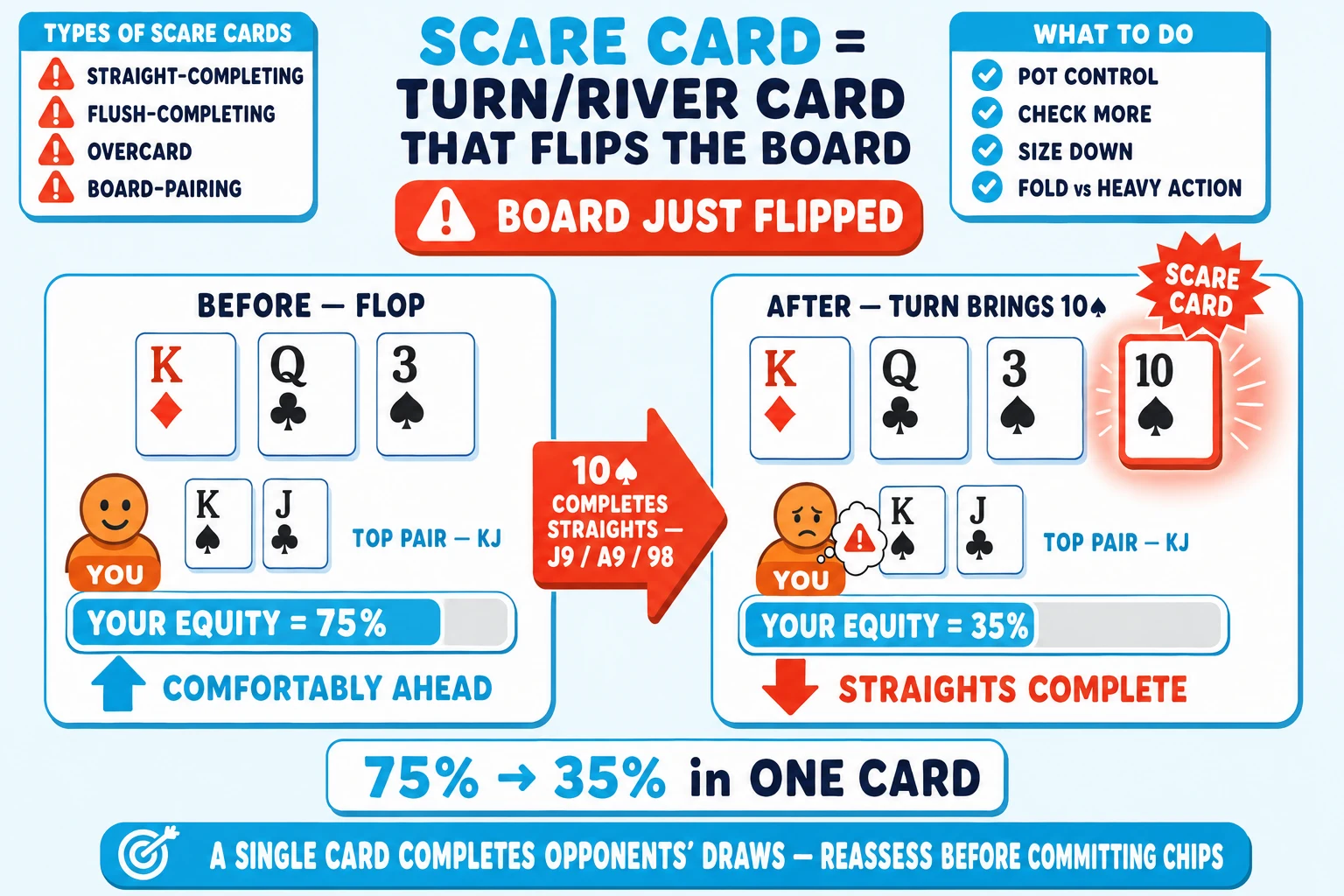
Example: the flop is K♦ Q♣ 3♠ and you hold K♠ J♣ (top pair). The turn brings 10♠, which completes many straight possibilities (J9, A9, 98) and suddenly improves two-card combos. A hand that looked comfortable on the flop becomes riskier.
A few terms that come up below: “in position” means you act after your opponent on later streets, “out of position” means you act first, and “range” is the set of hands an opponent could plausibly hold here.
How Scare Cards Change Betting Dynamics
When a scare card lands, players often change how they bet instinctively. Out-of-position players usually slow down, checking, calling, or folding instead of betting aggressively. In-position players can exploit that pause by applying pressure with larger bets or bluffs when the card favors their perceived range. Marginal hands that looked fine before become risky to continue with, since a big bet after a scare card often signals a made hand or a polarized range. Concrete reaction: on K♦ Q♣ 3♠ -> 10♠ turn, a player holding Kx may check to avoid a raise, while an in-position opponent might bet large to represent a completed straight.
Managing Risk When a Scare Card Hits
Practical principle: don’t commit chips automatically because you were strong before the card. Follow these steps:
- Re-evaluate your hand against the new board texture and ask which hands the turn or river completes.
- Default to cautious lines when out of position: prefer checks and smaller calls over big bets or raises.
- Use pot control with medium-strength hands so you avoid being forced into an all-in with poor equity.
- When in position, use sizing to gather information: a probe bet can show whether an opponent improved or folded.
Example: Flop A♠ 7♣ 2♦, you hold A♥ 9♦. The turn is 7♠, pairing the board and adding backdoor flush possibilities. Instead of leading big, check or make a small pot-control bet to observe reactions.
Adjusting GTO and Exploitative Play After a Scare Card
GTO thinking keeps your range balanced: after a scare card, mix bluffs and value bets so opponents can’t fold you out every time the board looks scary. Exploitatively, adjust to opponents’ tendencies. Versus players who fold too much after scare cards, increase your bluff frequency and press the advantage. Versus calling stations who underreact and call down light, simplify and value-bet your stronger hands thinner instead of bluffing. Balance example: if the turn completes many straights but an opponent folds often, convert some missed draws into bluffs. If they call wide, reduce your bluffs and focus on clean value.
Short Table Examples (Turn and River)
- Coordinated turn: Flop 9♦ 7♦ 2♣, you have 9♠8♠ (top pair with straight redraw). Turn J♦ completes a diamond flush and reduces your showdown value; check or call rather than bet big.
- In-position pressure: Flop K♣ Q♠ 3♦, you check-call KJ out of position. Turn J♠ favors your opponent’s perceived range; they can lead big to represent a made J or straight and often pick up the pot.
- Dry-to-coordinated river: Board K♥ 5♣ 2♦ 9♠ 10♠; the river 10♠ completes several connections. A hand that was strong on the flop (Kx) needs inspection for equity versus straight and flush possibilities before a value bet.
Quick checklist
- Check how the new card completes straights, flushes, or obvious pairs on the board.
- Default to pot control and cautious lines when out of position after a scare card.
- Increase bluffing versus opponents who fold too much; value-bet thinner versus frequent callers.