


Satellite
A satellite is a tournament whose prize is entry into a bigger event, not a scaled cash payout. The standard form awards multiple equal-value seats, so finishing first and finishing in the last qualifying spot pay exactly the same. That flat payout shape changes the math near the bubble: survival into a qualifying place beats accumulating chips, and many spots that would be profitable in a normal multi-table tournament become folds.
Satellite (Poker) — A Practical Definition
What a satellite is
A satellite is a poker tournament whose prize is entry into a larger event, awarded as a seat, ticket, or travel package rather than a scaled cash payout. The standard format hands out multiple equal-value seats, so the player who finishes first and the player who finishes in the last qualifying spot win exactly the same prize. Once you have the chips needed to lock a qualifying place, extra chips add almost no equity. That single structural fact reshapes every late-stage decision.
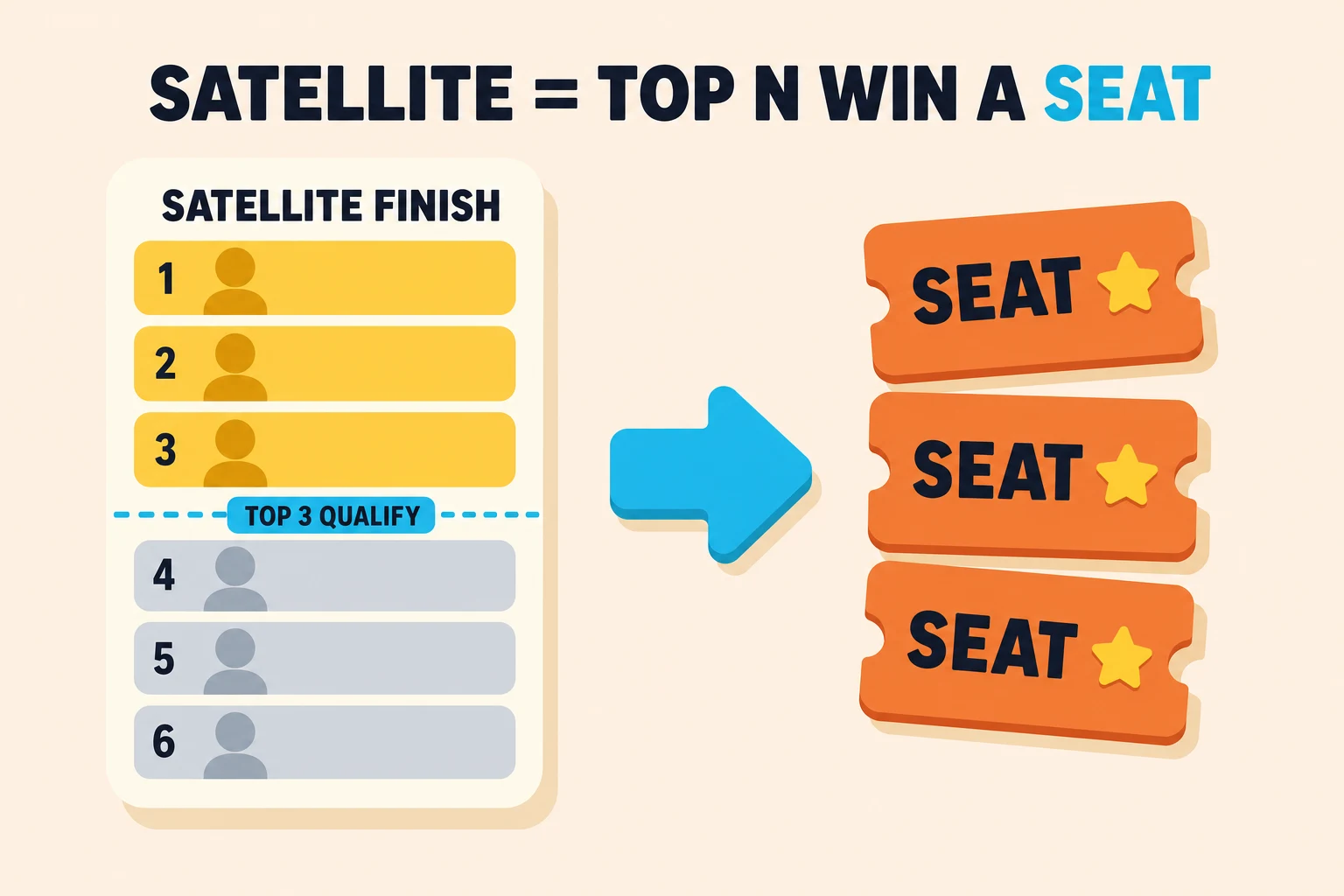
The classic example is a low buy-in event that feeds a much bigger one — a $215 satellite into a $10,000 World Series of Poker main event, or a small online qualifier into a live European Poker Tour stop. You pay a fraction of the destination buy-in and try to finish in the qualifying group; the seat itself is non-cash and usually arrives as a ticket on your operator account or a registration on the live event.
Satellites that exist purely to qualify for the main event are sometimes called “qualifiers” in player vernacular. The terms overlap heavily, but the mechanic is the same: equal-value prizes, survival-driven late play, and a payoff measured in the destination buy-in rather than chip count.
Satellite vs. ordinary multi-table tournament
Ordinary multi-table tournaments (MTTs) and satellites share the same surface: buy in, play down a field, hope to make the money. The math underneath is different.
| Dimension | Ordinary MTT | Satellite (multi-seat) |
|---|---|---|
| Payout shape | Top-heavy, scaled cash | Flat; seats of equal value |
| Optimal finish | Win it; first place pays the most | Make any qualifying spot |
| Chip-stack value at the bubble | Big stacks gain real cash by accumulating | Big stacks gain almost nothing once seats are locked |
| ICM intensity near the bubble | Real but moderate | Severe; survival dominates |
| Late-stage aggression | Calling ranges stay closer to chip-EV | Calling ranges contract, sometimes to AA-only |
The single line you should hold in your head: in an MTT you are getting paid for position, and in a satellite you are getting paid for survival into the group. The strategic deltas all fall out of that.
A separate variant, winner-takes-all (WTA) satellites, breaks this pattern. Only one seat is on offer, so there is no qualifying group to survive into: the whole prize goes to one player. Standard satellite ICM thinking does not apply to WTA satellites; chip-EV play (closer to a cash game) is the right model there.
When satellite math matters most
The seat-bubble is the single most consequential phase. A few specific spots trigger the biggest deviations from normal play:
- Right at the seat bubble. You and one or more opponents are eligible to lock the last seat. Calling ranges collapse; even premiums fold in the worst spots.
- Big stack vs. medium stack. A covering big stack can shove very wide because the medium stack risks busting just before the seat lock, where any chips above the lock-up threshold are basically free for the big stack.
- Medium stack vs. medium stack. Both players have something to lose; both should avoid confrontation.
- Small stack vs. small stack. Both players are close to busting, but that does not make the confrontation free: folding keeps a chance to outlast the other short stack and take a seat, while calling and losing ends the tournament.
- Late-level antes on a short structure. Antes accelerate stack erosion and force survival math earlier than a player used to deeper stack depth would expect.
Every one of these is a place where an action that is profitable in chip expected value (chip-EV) can be losing in dollar expected value (dollar-EV). The disconnect between chip-EV and dollar-EV is the core of ICM, and satellites push that disconnect to its limit. Poker Skill’s push/fold charts count chips, and their ICM section takes the first step toward satellite play: once a pay jump can be reached by folding, the all-ins that are only barely profitable in chips come out of the range.
Example: the seat-bubble fold
Three seats remain. Four players left.
- Big stack: 40,000 chips
- You (medium): 20,000 chips
- Two short stacks: 10,000 each
- Blinds: 500/1,000
Action folds to the big stack on the button, who jams. The small blind folds. You are in the big blind with A♣ Q♦ — a hand that crushes a random-card shove for chip-EV.
Calling has positive chip-EV. Folding has zero chip-EV. The chip-leader is in fact incentivized to shove any two cards here, because they cover you.
Yet you fold every time. The reason is the payout shape. If you call and lose, you are out in fourth, the one finish that wins nothing. If you fold, you stay above both shorts, who will be all-in within an orbit or two and frequently bust before you do. Folding locks you into the most likely seat-winning trajectory; calling, even with a hand that wins more often than it loses, risks the entire tournament for chips you do not need. AKs is in the same neighborhood, and on the harshest seat bubbles even AA can be a fold against a tight shoving range.
The shove is right. The fold is right. Both at the same time, because in a satellite the two players are playing for different prizes — the big stack for chips that compound into a locked seat, you for the seat itself.
Common mistakes
- Treating it like a normal MTT. Building chips, hunting first place, and pressuring middle stacks the way a top-heavy structure rewards. The flat payout shape punishes this; once you have the chips for a seat, the only useful chip is the one that keeps you alive.
- Refusing to fold premiums on the bubble. AKs and AA become folds in the worst spots because the downside (bust, no seat) dwarfs the upside (chips you do not need). The discomfort of folding aces is part of the game, not a sign you are playing badly.
- Skipping late registration. Many regs late-reg satellites because the early levels are slow and the money decisions all happen near the bubble. Refusing to late-reg out of habit costs no money but burns time better spent on the part of the event that actually matters.
- Hyper-aggression as the chip leader. Once you have a large enough stack to lock a seat by orbiting, you do not need any more chips. Boredom-shoving into other big stacks gives away equity that the structure would otherwise just hand you.
- Forgetting to re-loosen after the satellite. Players who only grind satellites can over-fold when they next play an ordinary MTT. The push/shove-fold ranges that are correct for a flat structure are too tight for a top-heavy one.
FAQ
Can I take cash instead of the seat I win?
It depends on the operator. Some online sites let you unregister from the destination event and credit your account with tournament-currency tickets (T$ or equivalent) of equivalent face value. Those tickets are usually non-withdrawable and only spendable on other tournaments. “Must-play” satellites do not allow this — the winner is auto-registered into the target event. Always read the satellite’s listing for the unregister policy before you play.
Is a “satellite” the same as a “qualifier” or a “feeder”?
“Qualifier” is used interchangeably with “satellite” most of the time and refers to the same equal-seat format. “Feeder” usually means a smaller event that wins entry into another satellite — one rung below the final qualifier — rather than directly into the destination event. Reading the listing is the only way to be sure which rung you are buying into.
Do satellites use the same bankroll as my regular tournaments?
Treat the satellite buy-in and the destination buy-in separately. Winning a $215 seat into a $10,000 event exposes you to the larger buy-in’s variance the moment you play it; pros often sell or swap a piece of that action so the destination event does not blow up the bankroll. Recreational players are usually better off thinking of satellites as a separate budget: money set aside for a shot at a marquee event, not part of the regular grind.