


Cash Game
A cash game is poker where the chips on the table represent real money at face value. The blinds stay fixed for as long as the table runs, you can buy in, sit out, and rebuy at your own pace, and there is no tournament survival pressure. Most of Poker Skill's lessons assume a 6-max no-limit hold'em cash game played around 100 big blinds deep, because that is the depth where strategy stays multi-street and decisions stay interesting.
Cash Game (NLHE)
What a cash game is
A cash game is poker where the chips on the table represent real money at face value. The blinds stay fixed at the same level for as long as the table is running. You can sit down with a fresh buy-in, stand up and walk away after a single hand, top your stack back up after a loss, or sit out for an orbit and let the big blind pass without losing your seat. There is no clock running down your tournament life. Win the pot, and the chips you scoop are worth what they say on the chip. You can carry them to the cashier and cash out whenever you choose to leave.
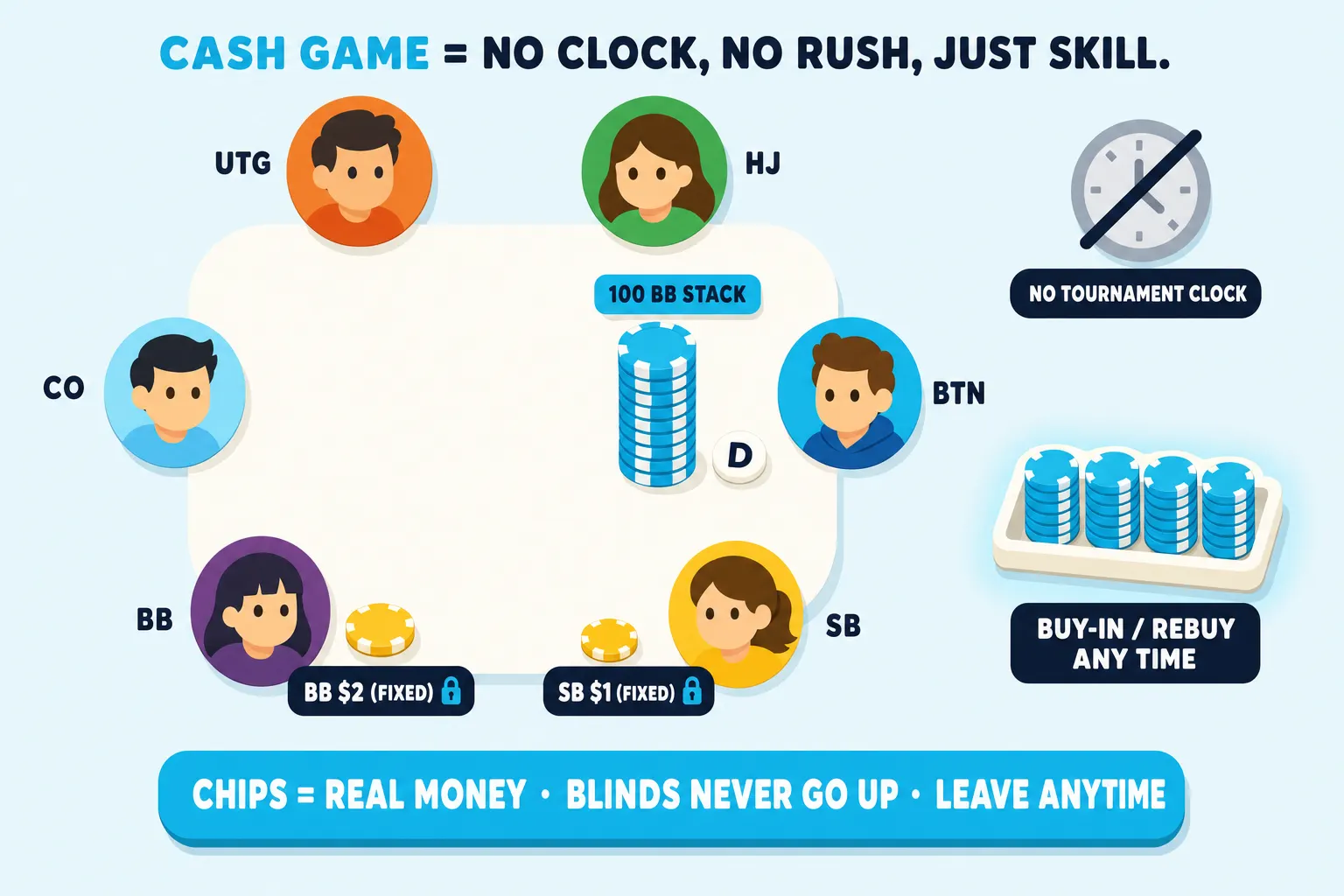
The four pillars of the format:
- Chips equal money. A $200 stack at $1/$2 is $200 in your pocket the second you stand up.
- Blinds are fixed. A $1/$2 game stays $1/$2. The forced bets do not climb the way they do in a tournament.
- You control the session. Buy in inside the room’s allowed range, sit out for an orbit when you need to, top up your stack, or leave whenever you want.
- There is no survival math. You cannot get knocked out of a cash game. If you bust your stack, you can rebuy and keep playing, or you can stop.
Related terms
- Rake: the house fee a cash game charges per pot, the cost of admission for the format.
- Blinds: the small and big forced bets that seed every cash-game pot.
- Big blind: the bigger of the two forced bets and the unit your stack is usually quoted in.
- Stack depth: how many big blinds are in front of you, the language cash strategy is written in.
- Effective stack: the smaller of two stacks in a hand, the real ceiling on what you can win or lose.
- SPR: stack-to-pot ratio, the postflop number that drops out of cash-game depth.
- Preflop: the first betting round, before any community card hits.
- Position: your seat in the betting order, the structural edge that recurs every hand at a cash table.
Cash game vs tournament
A cash game and a tournament look like the same game from across the room. The starting hands are the same, the betting rounds are the same, the hand rankings are the same. The structure underneath is different in three ways that change every decision.
| Dimension | Cash game | Tournament |
|---|---|---|
| Chip value | Each chip equals real money. | Chips are tournament scrip — they only convert to money via finishing position. |
| Blinds | Fixed for the entire session. | Escalate on a timed schedule until the event ends. |
| Buy-in / leave | Buy in within the room’s range; leave anytime. | One buy-in (or a defined rebuy window); play until you bust or win. |
| Survival pressure | None. Lose the stack, top back up. | Total. Lose the stack, you are out. |
| Default stack depth | Around 100 big blinds (the typical cap). | Wide — 200bb early, 10bb late. |
| Table size (Poker Skill default) | 6 seats (6-max). | Varies, often 9-handed. |
The single sentence that captures the strategic difference: in a cash game, every chip you win or lose is worth its face value, so each hand is judged on its own EV. In a tournament, chips lost are worth more than chips won, so survival starts to matter more than any single pot. That asymmetry is why tournament strategy adds layers (bubble play, ICM, push-fold) that simply do not exist in a cash game.
Why Poker Skill’s examples are usually 6-max NLHE cash at 100bb
Most of Poker Skill’s lessons set the scene as no-limit hold’em, 6 seats, around 100 big blinds deep. That is not arbitrary. It is the format the modern cash-game corpus is built around.
- 6-max is the dominant short-handed online format and a common live setup. Six seats keep the action moving, push more hands into position decisions, and produce more two-way pots, the spots where decisions actually compound.
- 100 big blinds is the standard maximum buy-in in most no-limit cash rooms (the rule of thumb is “10x to 100x the upper stake number” for buy-in range, so a $1/$2 game caps around $200). That is why the cash-game examples in nearly every NLHE book assume 100bb unless they explicitly say otherwise.
- No-limit is the default cash variant nearly everywhere; pot-limit and limit hold’em are increasingly rare, and the strategy library has consolidated around no-limit.
When a lesson says “you open to 2.5bb on the button,” it is assuming this format. When the EV math shows a clear fold at 100bb, the same fold can become a clear shove at 15bb. Depth changes everything. Naming the format up front makes the lesson legible and lets you transfer it to your own table without translation work.
Example: a 100bb cash hand under fixed blinds
You sit down at a $1/$2 6-max no-limit cash table with a $200 stack. That puts you at the 100-big-blind cap. The blinds are $1 and $2 and they will still be $1 and $2 in two hours.
The cutoff opens to $6. You hold A♠Q♦ on the button with $200 behind. You 3-bet to $20. The blinds fold. The cutoff calls.
The pot is $43. The flop comes Q♣8♦4♠. The cutoff checks. You bet $25 for value. Cutoff calls. Pot is now $93.
The turn is the 5♥. Cutoff checks. You bet $50. Cutoff calls. Pot is $193.
The river is the 2♣. Cutoff checks. You check back with top pair good kicker, cutoff shows pocket nines, and you scoop the pot. After the rake is dropped, you pull in roughly $186. The chips were real dollars the whole time.
Two cash-game features just shaped that hand without you noticing. First, the blinds did not move; they were $1 and $2 on the first hand of the session and they will be $1 and $2 on the hundredth. Second, you were free to play A♠Q♦ for a 3-bet because losing the pot would not knock you out of anything; at worst you reload to $200 and the next hand looks identical. That freedom is the cash-game posture in one sentence: every pot is judged on its own merit, and the next hand starts fresh.
If the river had gone the other way and you had stacked off, you could rebuy back to $200 and keep playing. Or you could stand up, walk to the cashier, and trade what is left for cash. Both options are open at every cash table, every hand.
Common mistakes when switching to cash from tournaments
Players who learn poker through tournaments often carry tournament habits into their first cash sessions. The format-mismatch leaks are predictable.
1) Treating your stack like a tournament life
In a tournament, a lost stack ends your event. In a cash game, a lost stack is just chips, and you can rebuy. Players new to cash often play scared with their full $200, fold marginal value bets to avoid risk, and pass on profitable spots they would happily take if the stack felt replaceable. Reframe: your buy-in is the cost of your seat, not your last chance.
2) Waiting for the blinds to chase you
Tournament strategy widens as the blinds rise: you cannot fold forever, so you start opening lighter. Cash blinds never rise. Folding patiently for two hours costs you nothing structural, so there is no urgency-driven loosening. The flip side is that you also do not get permission to wait for premiums forever; the right cash range is the right cash range, and it does not change with time at the table.
3) Ignoring rake when calling thin
Tournaments charge their fee up front in the buy-in. Cash games charge it per pot. A flop or turn call that is barely break-even at the gross pot becomes a small loser once the rake is removed. Tight, aggressive preflop play earns a quiet bonus in raked cash games because it shifts you toward bigger pots, where the cap is a smaller share of what you win.
4) Bringing push-fold habits to a deep table
A 15bb tournament stack collapses every decision into “shove or fold.” A 100bb cash stack does the opposite. Almost every street has multiple sensible bet sizes, and almost every hand can be played for the full three streets. Pulling the push-fold tree out of your toolkit at a deep cash table leaves real EV on the table.
FAQ
What is the difference between a cash game and a ring game?
There is no difference. “Ring game” is the older term that older live rooms still use; “cash game” is the more common phrase online and in modern strategy material. Both describe the same format: real-money chips, fixed blinds, and the freedom to buy in, sit out, and leave at any time. Poker Skill uses “cash game” by default and treats “ring game” as the same thing.
What is a normal buy-in for a cash game?
The standard at no-limit hold’em rooms is a buy-in range of about ten times the small bet figure on the low end and one hundred times the big bet figure on the high end. At a $1/$2 game that means a buy-in window between $10 and $200; the $200 maximum is the 100-big-blind cap that Poker Skill’s examples usually assume. Some rooms also offer “deep” tables at 200bb or more; those are exceptions, not the default.
Can I just leave the table after one hand?
Yes. The defining freedom of a cash game is the ability to stand up after any hand, rack your chips, and walk to the cashier. The only caveat is that some rooms enforce a short cool-off period before you can re-enter the same game with a smaller stack; that rule prevents “hit and run” abuse where a player wins a big pot and immediately reloads short. There is no rule against leaving in the first place.