


6-Max
Short-handed No-Limit Hold'em with up to six seats. Pots go heads-up faster, blinds cycle quicker, and ranges open up at every position compared with full-ring.
Practice this in Poker Skill. Every table in the preflop lessons has six seats, and the lessons work through them one at a time, from under the gun, where A♠ K♠ raises, to the button, where Q♦ 10♦ does.
Get the free app6-Max
What 6-Max means and how it changes the game
6-Max is a short-handed No-Limit Texas Hold’em format with up to six players. Fewer opponents change the math and the pace: pots go heads-up or two-way more often, action speeds up, and blinds cycle more frequently. With fewer players, the blinds (the forced bets that seed each hand) gain value, and multi-way pots happen less often, so speculative hands like small pocket pairs and suited connectors lose some of their relative value. You face more decisions per orbit to open, defend, 3-bet (re-raise preflop), and 4-bet (re-raise a 3-bet) than in nine- or ten-handed full-ring play.
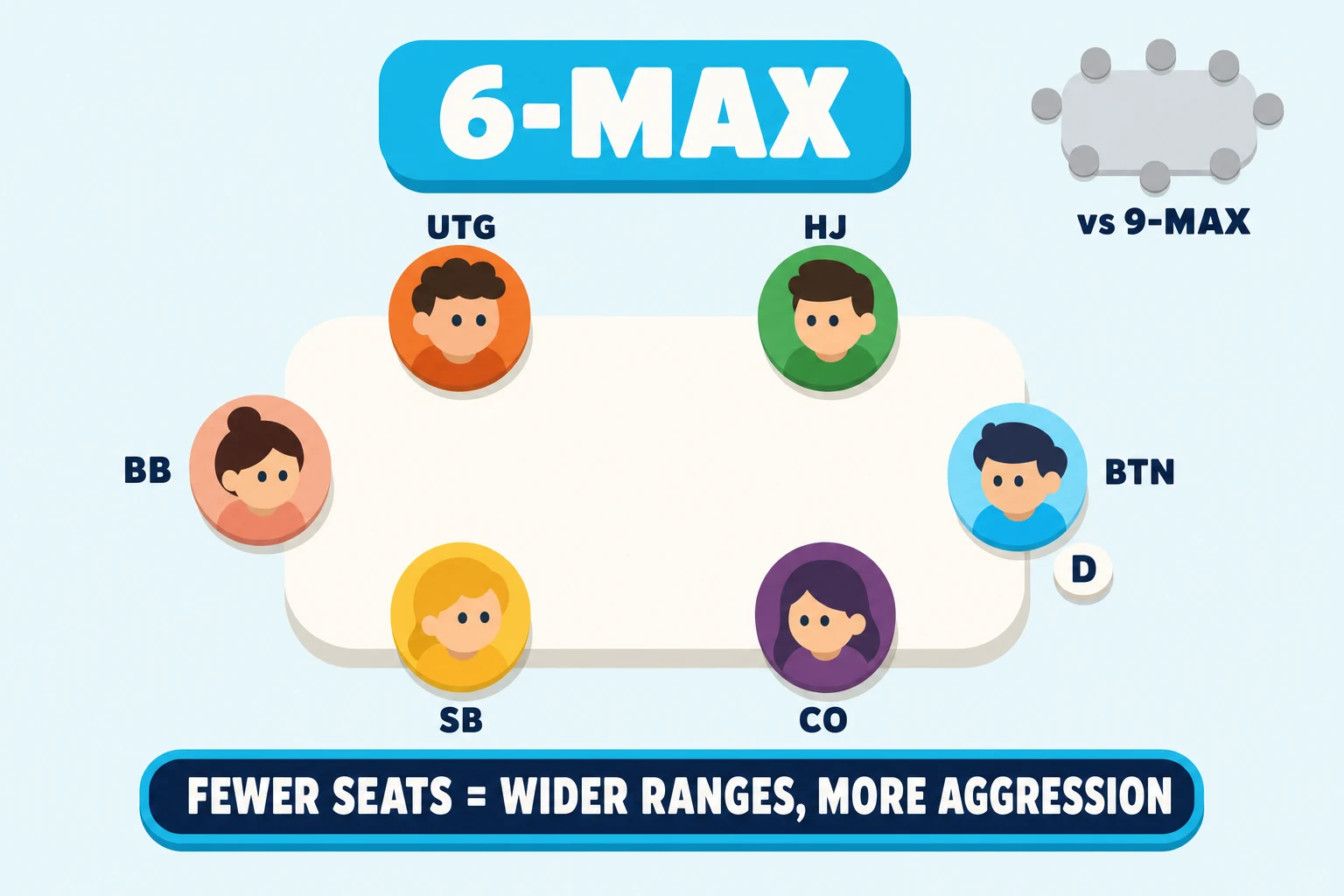
Preflop opening ranges and increased aggression
Smaller table size increases the value of stealing blinds and makes wider opening ranges profitable, especially from late positions. Many hands marginal in full-ring become playable short-handed. Play broadways (Ten through Ace combinations like KQ, AQ) and big cards (AK, AQ) more aggressively.
Practical adjustments:
- On the button, raise about 65% of hands as a short-handed benchmark. This range includes suited connectors, one-gappers, and many off-suit broadways you’d fold full-ring.
- Tighten slightly in early positions, but remain looser than in full-ring games. Fewer players behind reduce multi-way danger.
- Raise and 3-bet value hands like AK and AQ more often because they perform better against fewer opponents.
Example: In 6-max, you can open KJo on the button to steal blinds; in full-ring, you often fold it early.
Late-position stealing and postflop advantage
Acting last is the biggest source of edge in 6-max. You see every other player’s decision before yours, you control the final bet size on every street, and you decide whether the pot grows or stays small.
Late-position strategy:
- Cutoff and button should widen opening ranges to exploit their positional edge.
- On the button, raise a large proportion of playable hands and attempt frequent blind steals.
- Postflop, acting last lets you use more c-bets (betting the flop after raising preflop) and bluffs.
Example: If you raise from the button and face a single caller, a well-timed c-bet often wins the pot, even with marginal top pair or missed draws.
3-bet, 4-bet strategy and blind defense
3-betting and 4-betting occur more frequently in 6-max. Mix value and bluff hands to counter frequent preflop aggression.
Typical 4-bet ranges:
- Against top professionals, 4-bet ranges widen to include all pairs (AA-22), suited Aces (AKs-A2s), strong broadways, and suited connectors.
- Against amateurs, 4-bet ranges tighten and usually focus on premiums like AA, KK, QQ, and AK.
Defend your blinds more broadly; frequent steals punish passive defense. Mix calls and 3-bets based on the raiser’s tendencies.
Example: Against a frequent button raiser, 3-bet light from the small blind with hands like A5s or KJs to apply pressure and exploit postflop position.
Bankroll, variance, and the mental game
6-Max increases variance: wider ranges and bigger pots create larger short-term bankroll swings, so plan your roll accordingly and track results across meaningful samples. Reads and pattern recognition matter more, because the same five opponents repeat their habits in front of you all session, which makes bluffs and semi-bluffs more profitable when timed against the right player. Mix aggression with selectivity and adjust quickly when an opponent type changes seat or strategy.
Practical checklist
- Review opening ranges by position and practice tightening or loosening them during play.
- Practice 3-bet and 4-bet spots, and determine when to include bluffs.
- Prioritize late-position play and blind stealing as core profit sources.
- Manage your bankroll for higher variance and track results across meaningful samples.
- Work on reads and optimal bluff frequency, adapting quickly to each opponent type.