


Action Order
Before cards are dealt, the two players left of the dealer button post the small blind and big blind. The big blind is usually twice the small blind. These forced bets seed the pot and create action.
Practice this in Poker Skill. Working the rotation out is the first thing the lessons on positions ask of you: the dealer chip marks the button, the button moves one seat clockwise after each hand and the blinds follow it.
Get the free appAction Order in No-Limit Texas Hold’em
Pre-flop: who acts first and how the betting starts
Before cards are dealt, the two players left of the dealer button post the small blind and big blind. The big blind is usually twice the small blind. These forced bets seed the pot and create action.
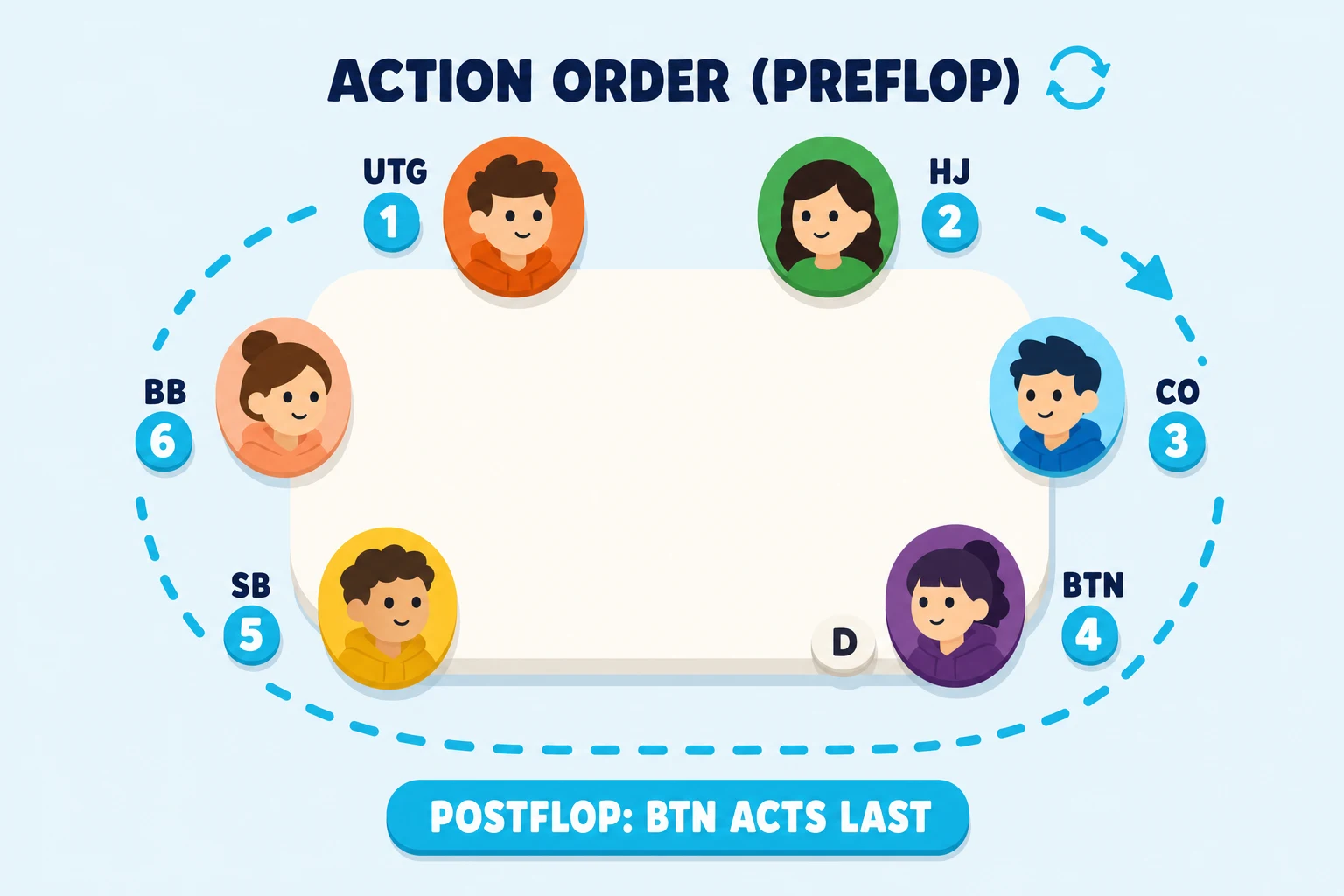
Each player receives two private hole cards. Pre-flop betting starts with the player left of the big blind, called under the gun (UTG). Action proceeds clockwise.
On your turn you can fold, call, or raise. Fold means give up your hand. Call matches the current bet-pre-flop that usually equals the big blind. Raise increases the bet. Example: with 1/2 blinds, UTG can fold, call 2, or raise to 6. Action continues until all active players have matched the latest bet or folded.
Post-flop rounds: flop, turn, river - order and options
After pre-flop betting, the dealer deals three face-up community cards, the flop. Then the turn (fourth) and river (fifth) follow in later rounds. Players combine hole cards and community cards to make the best five-card hand.
Each post-flop betting round begins with the first active player left of the dealer button and moves clockwise. Since blinds already acted pre-flop, the button acts last on flop, turn, and river, which is a key positional advantage.
Post-flop options include check if no bet exists; otherwise fold, call, or raise. Check means pass the action without betting. Example: on the flop the player left of the button checks, the next bets 10, and the button must fold, call 10, or raise.
Blinds and the dealer button: how positions set the order
The dealer button marks the nominal dealer and sets seating order for every betting round. After each hand the button moves one seat clockwise, rotating positions among players.
The two players left of the button post small and big blinds before cards are dealt. The button acts last on all post-flop streets, so that seat enjoys more information and can play more aggressively while controlling pot size.
Example: on the button, if everyone checks to you on the river, you can bluff after seeing others’ intentions.
Showdown: who shows first and how the pot is awarded
If more than one player remains after river betting, a showdown takes place and players reveal hands. The player who last bet or raised on the final street shows first. If no bet occurred on the final round, the first active player left of the button shows first.
The best five-card hand wins the pot. Example: three players reach showdown; Player A bet last on the river and reveals first, followed by the others to determine the winner.
Strategic implications: using action order to your advantage
Position shapes which hands to play and how to play them.
- Early positions (UTG and nearby seats) act first and should play tighter. Raise and bet with stronger hands because you act before most opponents.
- Late positions (cutoff, button) can play looser and more aggressively because you see opponents’ actions first.
- Use position to bluff, control pot size, or extract information and fold equity. A well-timed button raise can win pots without showdown.
Quick tips:
- Tighten pre-flop ranges in early position.
- Steal blinds more frequently from the button.
- With marginal hands, prefer calling in position and folding out of position.
Checklist:
- Small blind and big blind are posted before cards are dealt.
- Pre-flop action starts with the player left of the big blind and moves clockwise.
- Post-flop action starts with the first active player left of the dealer button; the button acts last.
- Showdown begins with the last bettor/raiser (or first active left of the button if no final bet).
- Adjust hand selection and aggression based on your position in the action order.