


Add-On
An add-on is a one-shot extra-chip purchase that everyone still in the tournament can buy at a fixed break, usually the end of the rebuy period. It is not a rebuy (which replaces a busted stack) and not a late registration (which is how a new player enters). The add-on is a single decision every survivor faces at the same moment, and the right answer depends on your stack relative to the table average.
Add-on: a one-shot extra-chip purchase at a fixed tournament break
What an add-on is
An add-on is a one-time chip purchase a tournament offers to every player who is still in the event at a fixed break, usually the end of the rebuy period. The price is roughly one buy-in, the chip count is fixed by the structure sheet, and you take it or leave it as a single decision. You do not have to be busted, short, or even at any particular stack size to buy the add-on. The only requirement is that you are still seated when the break hits.
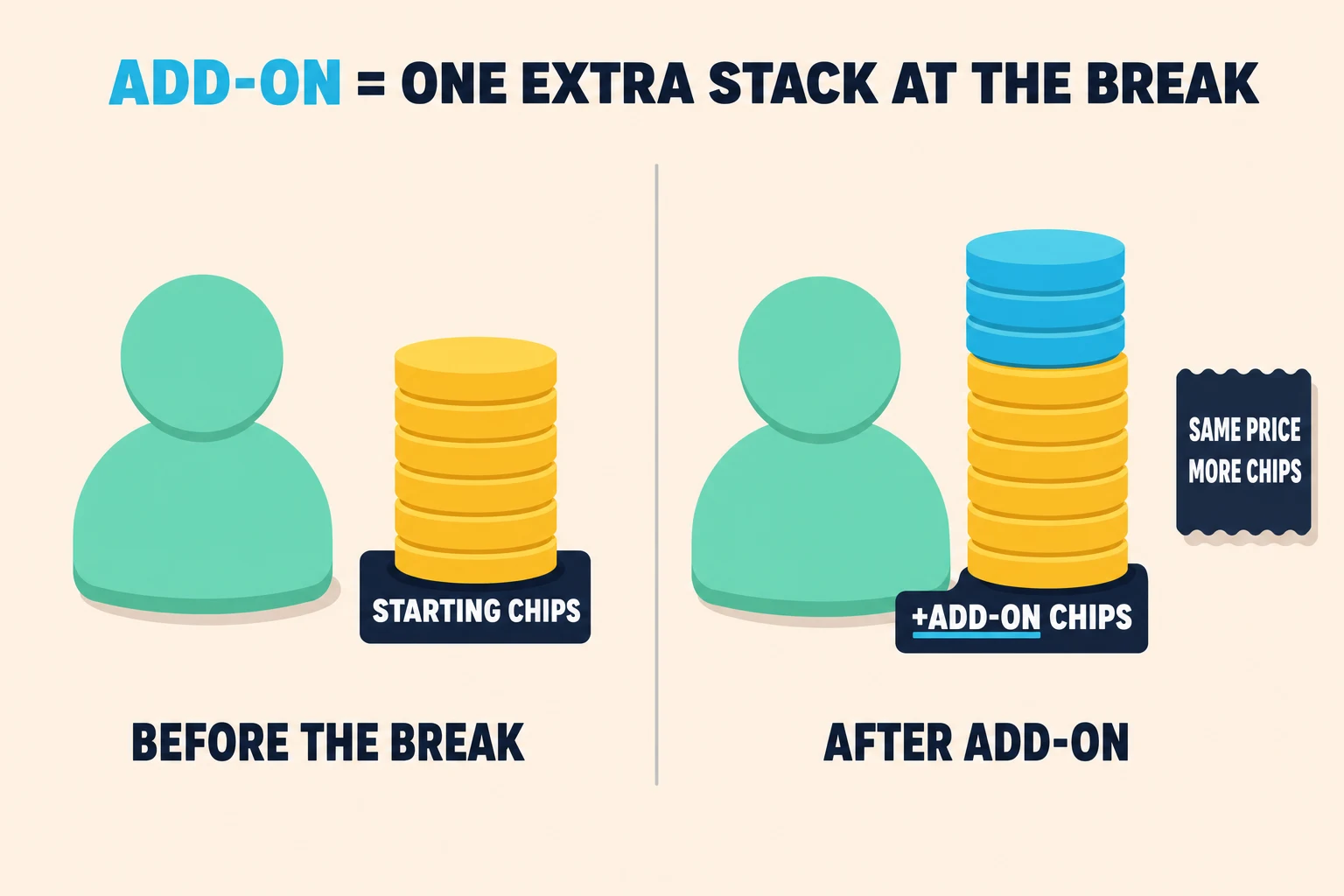
The add-on usually carries a small chip-per-dollar discount because the registration fee is not charged a second time. A $20 + $2 event with a 1,500-chip starting stack might offer a 2,000-chip add-on for another flat $20. That extra value, plus the fact that nearly every survivor buys it, is why the decision is rarely “should I add chips?” and almost always “what does my stack look like compared to the average right now?”
Poker Skill takes the purchase out of the picture: there are no chips to buy and no real money in its lessons or in Practice vs AI, where you play full hands against AI opponents.
Add-on vs. rebuy vs. late registration
These three options sound similar and live near each other on the structure sheet, but each one is a different mechanism. Mixing them up gets expensive quickly.
- Rebuy. A mid-table chip refill, available only when your stack drops below a threshold (usually the original starting stack) and only during the rebuy period. You can use a rebuy to come back from busting to nothing. Triggered by your stack; available during play.
- Late registration. How a new player gets into a tournament that has already started. You sit down with a fresh starting stack at whatever the current blind level is, and you forfeit the chips that would have accumulated while you were absent. Triggered by not yet being in the field; available until late-reg closes.
- Add-on. A one-shot extra-chip purchase available to everyone still in the tournament at a fixed break, usually when the rebuy period ends. You do not need to be short, you do not need to bust, and you do not need to have been gone. Triggered by the clock; available at one moment.
A freezeout, a tournament with one buy-in and no second chances, has none of these options. Most major events, including the WSOP Main Event, are pure freezeouts. The add-on lives in the smaller-buy-in rebuy structures where the operator is willing to trade a slightly looser early game for a deeper post-break stage.
Related terms
- Freezeout: the no-second-chances baseline that other tournament formats define themselves against.
- Satellite: a different format option where add-on math is dominated by flat-payout survival logic.
- ICM: the math that decides whether the marginal chips you would buy are worth their dollar price.
- Stack depth: the lever the add-on actually moves, measured in big blinds.
- Ante: kicks in around the same level the add-on offer arrives, and accelerates the chip burn the add-on is supposed to offset.
Add-on math: when it pays and when it doesn’t
The book-grounded rule is simple and stack-relative: compare your stack to the table average at the break, not to a fixed big-blind number. The decision is mostly about staying in the same chip-stack neighborhood as the other survivors, because most of them will buy the add-on too.
| Your stack at the break | Default decision | Why |
|---|---|---|
| Around the table average | Add on | Almost everyone else will; skipping costs you ground without saving much money |
| ~25% below the average | Skip | The extra chips can’t catch you up if everyone else also adds on |
| Top ~20% of the field | Skip | Marginal value of more chips is low; the price tag is real, the upside isn’t |
The reason the math goes nonlinear is that a chip added to a stack that already has a lot of chips is worth less than a chip added to a starting stack. A big stack does not need many more chips to keep applying pressure, and the marginal value of the next chip drops as the stack grows. A short stack gets the inverse boost (extra chips matter more), but a short stack has also already lost most of its tournament edge by being short, and the add-on cannot rebuild that edge by itself.
The decision is also a function of the table you are at and the field you are in. A loose-passive small-stakes field with heavy rebuys leaves players with very different chip counts at the break, so the “compare to average” rule applies cleanly. A tighter regional event with disciplined opponents tends to have stacks bunched more closely together at the break, and the decision is closer to a default add-on for almost everyone.
When the add-on decision matters most
The add-on break is one of the few moments in a tournament where every player makes the same decision under the same time pressure. A few specific spots are where the math actually moves.
- Right at the break, average stack. This is the modal case and the easiest call. Add on, you keep pace, the post-break game starts at the same depth as the rest of the field.
- Right at the break, deep stack. You are in the top 20% of the field. The marginal chips are worth less than the dollar price, and the larger stack already lets you press hard. Banking the entry fee for another tournament is usually the better move.
- Right at the break, short stack. You are 25%+ below the average and an add-on still leaves you in short-stack territory. The chips do not change your strategic mode (still shove-fold land), and the cash is better preserved for a future event.
- Just before antes kick in. Many structures introduce the ante a level or two after the add-on break. Skipping the add-on while staring down ante levels means a faster stack erosion and a quicker push toward shove-fold.
- Pre-bubble events with steep pay jumps. When the next pay jump is meaningful, the dollar-EV of more chips at the break compounds with ICM pressure later. Adding on is the safer survival move even when the chip-EV math is borderline.
Example: the rebuy-period add-on
A $50 + $5 nightly tournament with a single rebuy period and an add-on at the first break. Starting stack 5,000 chips. Add-on: 6,000 chips for $50, no registration fee. The break hits. Average stack at the break is 9,500 chips.
Case A, your stack is 9,200. You are right around the average. Almost everyone at your table is reaching for their wallet. You add on. Post-break you have 15,200 chips, slightly above the new post-add-on average of around 14,500, and the post-break play starts with stack depth that gives you room to play poker. The decision takes ten seconds.
Case B, your stack is 5,400. You are running about 43% below the average. Adding on takes you to 11,400, still well below the new post-add-on average of ~14,500. Most of the field will have add-on bigger than you do, the blinds will continue to climb, and you will be back in shove-fold range within a level or two. The $50 is better saved for a different event, where you can start with the field instead of chasing it.
Case C, your stack is 22,000. You are in the top 10% of the field. Adding on takes you to 28,000, but the new post-add-on average will be around 14,500, so you are still a chip leader by a wide margin. The extra 6,000 chips will not change which decisions you take post-break (you were already going to apply pressure with that stack), and the dollar price is real. Skip the add-on, play the post-break game, and the entry fee is yours back for the next session.
The shape of all three cases is the same: compare your stack to the average, then ask whether the extra chips actually change your strategic mode. If they do, add on. If they don’t, the cash is worth more than the chips.
Common mistakes
1) Treating the add-on like a rebuy
Players sometimes “save the add-on for later” the way they would save a rebuy decision. The add-on is one offer at one moment. Skip the break and the option is gone. The right framing is “do I take this single offer right now, given my stack relative to the average?”, not “do I want more chips at some point in the next two hours?“
2) Adding on by default with a deep stack
The most common spew at this break is the player who has run hot, sits at twice the average, and reaches for the wallet because everyone else does. Extra chips on a deep stack are worth less than their dollar price, and the entry-fee equivalent is much better deployed in a different tournament where it starts you at the field’s average instead of pushing an already-large stack a little larger.
3) Refusing the add-on with an average stack out of bankroll discipline
The mirror image of mistake #2. A player at the average stack who skips the add-on because “it’s another buy-in” is in fact ceding ground. Most of the rest of the field will add on, the post-break average will jump, and the responsible-bankroll decision turns into a quietly losing move. The add-on is part of the cost of playing this event, not an optional upsell. If you cannot afford it, the structure with rebuys and an add-on is not the right event for your bankroll.
4) Confusing the add-on window with the late-registration window
Late-reg lets new players enter; the add-on lets seated players double up their chip count. Many players see “more chips for buy-in money” on the structure sheet and assume the two work the same way. They do not. Late-reg gets you a starting stack at the current blind level. The add-on gets you the structure-defined add-on stack on top of whatever you already have. Read the structure sheet before you sit down so you know which gates are open at which times.
FAQ
Do all tournaments offer an add-on?
No. Add-ons live almost exclusively in rebuy-format tournaments at smaller buy-ins. Most major events (the WSOP Main Event, most World Poker Tour events, and most televised final-table tournaments) are freezeouts with no add-on at all. If a structure sheet does not mention an add-on explicitly, assume there is no option.
Is the add-on always at the first break?
Usually, but not always. The most common pattern is “rebuy period closes at the first break, add-on offered at that same break.” Some structures move the add-on to the second break or split it into two smaller add-ons. The structure sheet is the authoritative answer for the specific event you are playing.
Can I add on if I just busted on the last hand of the rebuy period?
This depends on whether the room treats your seat as “still alive” at the moment the break hits. In most rooms, busting on the last hand of the rebuy period gives you the choice to take a final rebuy plus the add-on right there at the break, which together restore a useful stack. The exact rule is event-specific. Ask the floor before the break starts; do not learn the rule by busting and finding out.