


Stack Depth
Your chip count in big blinds, measured against the smaller (effective) stack. The bb count picks the band: deep multi-street, medium mixed, short shove-or-fold.
Practice this in Poker Skill. The raise-or-fold lessons are dealt at 100 big blinds, so they practice the deep band, where the button opens suited connectors and every pocket pair.
Get the free appStack Depth
What stack depth is and how to measure it Stack depth equals a player’s chip count expressed in big blinds (bb). The big blind is the larger forced bet for the current blind level. Measuring stacks in bb standardizes decisions across stakes. Example: at $1/$2, a $200 stack equals 100bb (200 ÷ 2).
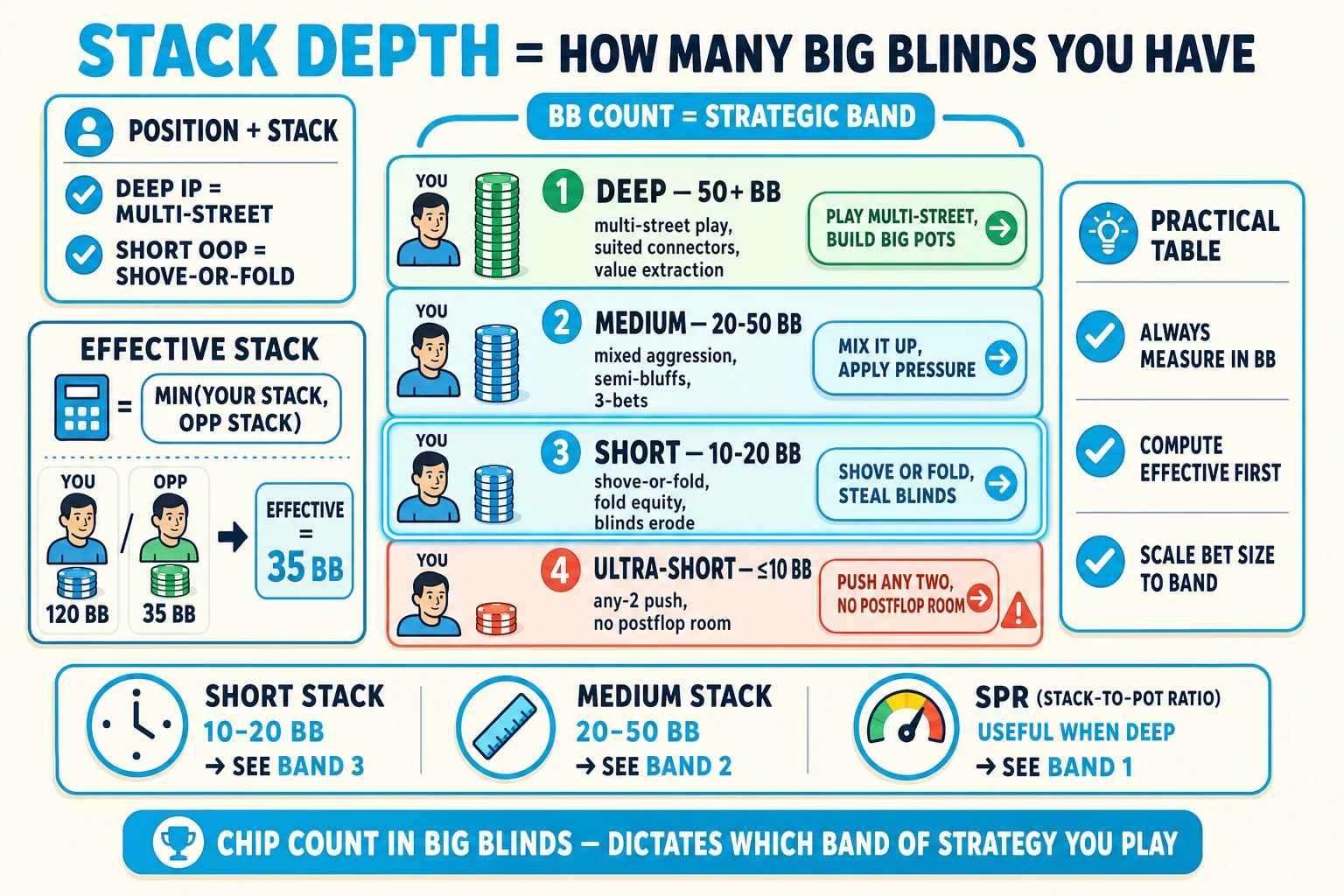
The effective stack equals the smaller of the two players’ stacks in a hand. It caps how much can be bet between them. Example: you have 120bb and your opponent has 35bb; the effective stack is 35bb. Always think in big blinds and calculate the effective stack before choosing a line.
Why effective stack size is the key strategic limiter The effective stack determines the maximum bet, realistic risk, and available lines. With a shallow effective stack, post-flop maneuvering is minimal and shove/fold decisions dominate. With a deep effective stack, you can pursue multi-street value or bluffs.
Example: with a 15bb effective stack, a 3-bet to isolate often ends in all-in or fold on the next action. There’s little incentive to play many post-flop streets. With a 100bb effective stack, the same preflop raise can produce small continuation bets, check-raises, and multi-street bluffs, since far more chips are at stake.
Make decisions - bet sizing, calling thresholds, and 3-bets - relative to the effective stack, not raw chip counts.
Stack-depth ranges and how strategy shifts Short stacks (10-20bb): Play simplifies. You often push (go all-in) or fold preflop because post-flop options are limited. Favor high-card hands (A-x), broadway cards, and medium-to-high pairs. Example: with 12bb, open-shoving A9s or 66 is standard; speculative hands like 76s lose value.
Medium stacks (20-40bb): Enjoy more maneuverability. You can widen opening ranges, use position, and employ semi-bluffs (bets with draws) and 3-bets (re-raises). Example: at 25bb effective, raising with KQo or suited connectors like 98s becomes playable - you can shove later or extract value on favorable boards. In tournaments, 20-30bb often creates jam-intensive tactics to exploit fold equity.
Deep stacks (50bb+): Multi-street dynamics matter. Include suited connectors and small pairs (for example, 76s and 55) since they can make straights or trips and win big pots. Focus on pot control, advanced bluffs, and extracting value across several betting rounds. Example: with 100bb, calling a raise with 77 in position to see a flop is reasonable; post-flop playability is high.
How position and game format interact with stack depth Position (acting later in the betting) amplifies deep-stack advantages. In position, you can use extra maneuverability to apply pressure or control pot size. Short stacks out of position face constraints and often must take aggressive preflop lines.
Tournament factors: antes (small forced bets from all players) increase pot size and widen profitable short-stack shoves because there’s more to win. Cash games lack antes, but decisions remain driven by relative stack sizes.
Practical table adjustments you can apply now
- Adjust starting-hand charts by bb category: tighten ranges when shallow and widen them when deep. Include suited connectors and small pairs in deep-stack charts. Example: fold 54s at 15bb, but play 54s at 100bb in position.
- Scale bet sizes to the effective stack: use larger or all-in commitments when shallow. Practice pot control with smaller bets when deep.
- Exploit opponent tendencies: if an opponent folds too often to pressure, increase your shove frequency. If they call too lightly, favor value hands and avoid large bluffs.
Quick checklist
- Measure all stacks in big blinds before each decision.
- Calculate the effective stack for every heads-up engagement.
- Pick a plan by bb range: push/fold (short), mixed aggression (medium), multi-street play (deep).
- Factor your position and whether antes are in play.
- Adjust starting ranges and bet sizing to the effective stack and opponent tendencies.