


Effective Stack
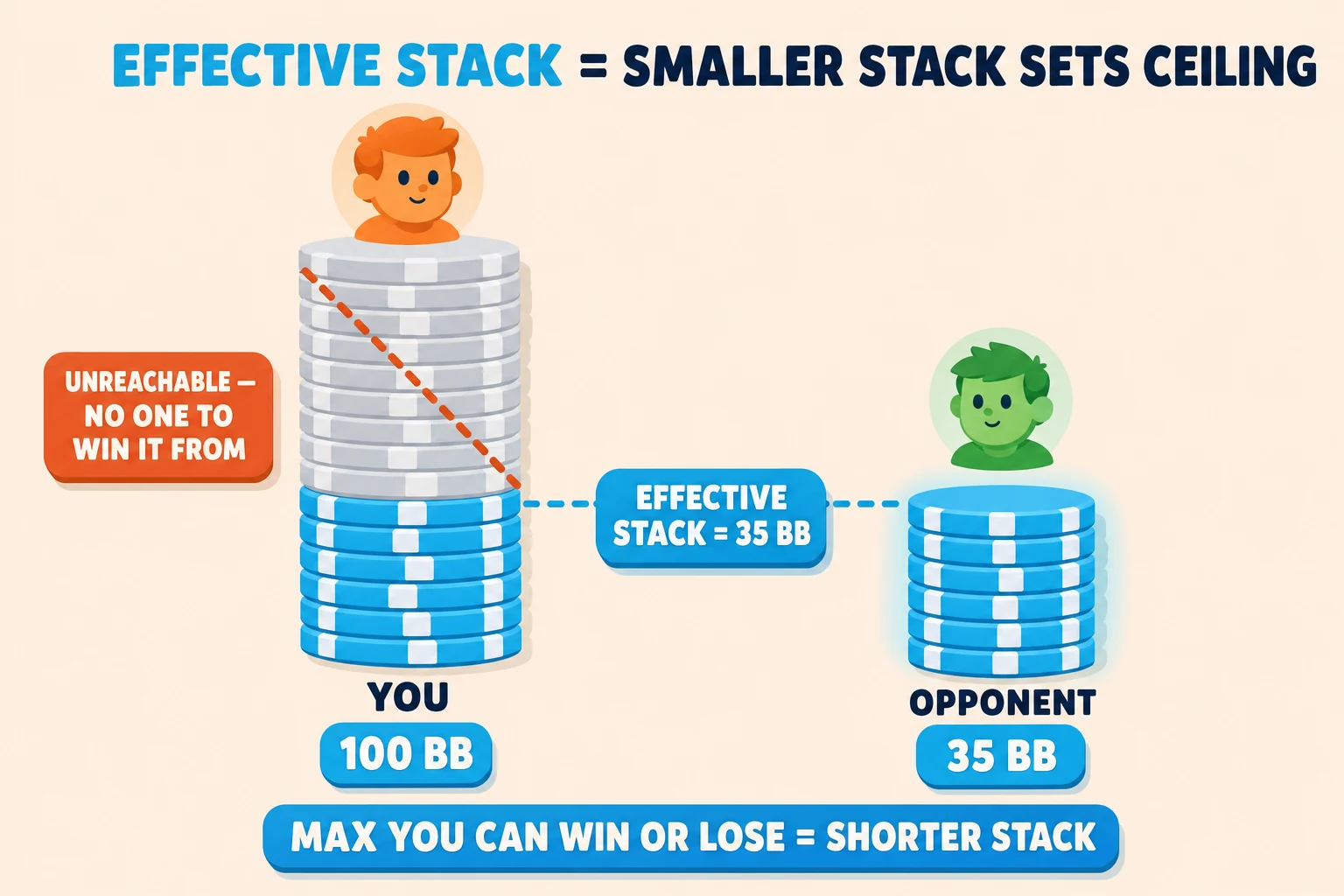
The effective stack is the smaller of two players' stacks in a hand. It sets the practical ceiling for how much can be bet, lost, or won between those players on that street or hand. With three or more players it is measured pair by pair, and the smallest stack in the hand caps only the main pot that all of them contest. Even if one opponent has a huge stack, money you can exchange with that opponent is limited by the smaller stack. That fact focuses decisions on realistic risk and reward-what you can actually win or lose-rather than full-table stacks.
Practice this in Poker Skill. The pot-control lesson plays with deep stacks, 100 big blinds to start, where a marginal pair calls to keep the pot small and top two pair raises to build it.
Get the free appEffective Stack: How to measure it and use it to shape your decisions
What the effective stack is and why it matters
The effective stack is the smaller of two players’ stacks in a hand. It sets the practical ceiling for how much can be bet, lost, or won between those players on that street or hand. With three or more players it is measured pair by pair, and the smallest stack in the hand caps only the main pot that all of them contest. Even if one opponent has a huge stack, money you can exchange with that opponent is limited by the smaller stack. That fact focuses decisions on realistic risk and reward-what you can actually win or lose-rather than full-table stacks.
Example: if you have 100 big blinds (bb) and your opponent has 35bb, the effective stack is 35bb. You cannot win more than 35bb from that opponent in that confrontation.
How to calculate the effective stack at the table
Quick calculation makes this a routine part of your thinking. Follow these steps:
- Identify all players still active in the hand (heads-up if two players remain; multiway if more).
- For each active player, note the amount they can still put into the pot-their active portion of the stack.
- Against each opponent, your effective stack is the smaller of your amount and theirs; the smallest amount in the hand caps only the main pot.
Example steps in practice:
- Heads-up: compare the two remaining stacks; the smaller one is the effective stack.
- Multiway: if three players remain with 60bb, 20bb, and 100bb, the effective stack is 20bb for the pot everyone contests.
- Watch for side pots: if one player is all-in for less, the main pot’s effective stack equals that all-in amount. Remaining players can contest a separate side pot for the extra chips.
Always use the amount that can actually be wagered between the involved players, not unrelated full-table stacks.
Preflop decisions shaped by effective stack size
Preflop choices-open sizes, raises, calls, or shoves-should reflect the realistic maximum you can win or lose. Short effective stacks push play toward shove-or-fold strategies. With a small effective stack, marginal hands often become shoves because postflop maneuvering is limited. You want fold equity or immediate value in those spots.
With larger effective stacks you can use varied open sizes, limp-raises, and speculative hands like suited connectors and small pairs. Deep effective stacks let you raise smaller to invite multi-street play and exploit postflop weaknesses.
Postflop strategy adjustments based on effective stack depth
Shallow effective stacks lead to simpler, polarized lines: commit or fold quickly. You’ll often be pot-committed by the turn or even the flop, so choose bluffs sparingly and size bets to force folds. Deeper effective stacks allow multi-street maneuvering. You can use smaller, frequency-based bluffs, mix value sizes, control pot size, and plan backdoor plays. Size bets to match how much you can realistically extract given the effective stack-don’t plan three streets you can’t afford.
When planning a bluff or value line, ask: does the effective stack let me apply pressure over multiple streets, or must I win this hand now?
Tournament vs cash-game implications of effective stack
Tournaments: the effective stack drives survival and risk tolerance. Consider ICM (Independent Chip Model), which values chips relative to payouts; short effective stacks increase all-ins and tighten calls near bubbles or pay jumps. Cash games: recurring deeper stacks let you exploit postflop skill edges more consistently. Effective stack still defines play depth, but you’ll see more nuanced bet sizes and multi-street lines when stacks are deep.
Adjust long-term thinking: tournaments reward correct push/fold and ICM-aware choices; cash games reward deeper-stack exploitation and flexible sizing.
Quick checklist
- Calculate your effective stack against each opponent, the smaller of your two stacks, before each decision.
- Size bets and calls according to the maximum you can win or lose given the effective stack.
- Use push/fold when effective stacks are short; expand postflop plans when they are deep.
- Reassess the effective stack whenever players commit chips or the active player set changes.
- Prioritize survival and ICM sensitivity in tournaments; exploit depth in cash-game settings.