


Side Pot
A side pot is a separate chip pool created when at least one player goes all-in and others keep betting. (An all-in means a player bets their entire stack.) Chips the all-in player can match form the main pot; any extra chips from larger stacks go into side pots. Side pots let deeper-stacked players contest additional chips without giving the all-in player a claim to them.

Practice this in Poker Skill. When a short stack is all-in at the three-player table in Practice vs AI, where two AI opponents share the table with you, the chips it can’t match form a side pot that only the two deeper stacks can win.
Get the free appSide Pot
What a side pot is
A side pot is a separate chip pool created when at least one player goes all-in and others keep betting. (An all-in means a player bets their entire stack.) Chips the all-in player can match form the main pot; any extra chips from larger stacks go into side pots. Side pots let deeper-stacked players contest additional chips without giving the all-in player a claim to them.
Example: Alice is all-in for 100. Bob and Carol have larger stacks and keep betting. The first 100 from each player forms the main pot; any extra bets go into a side pot Alice cannot win. Main pot and side pots together are still the pot in the ordinary sense; the split only tracks who is eligible for which chips. If you want the counting walked through hand by hand, including the three-way and multiple-side-pot cases, see side pots explained with worked examples.
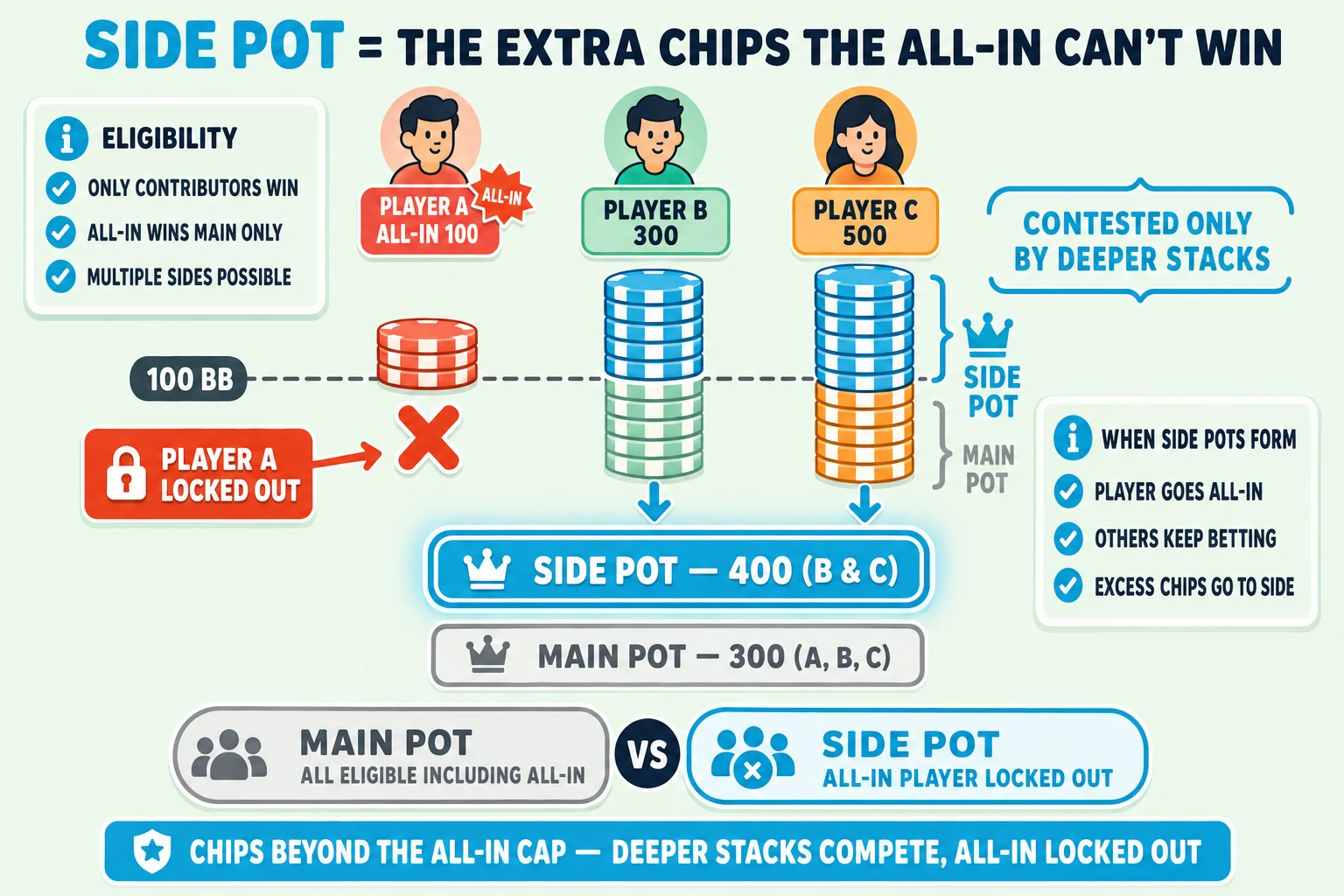
How a side pot forms at the table
Side pots form from straightforward betting mechanics.
- A player shoves all-in with fewer chips than a later bet or raise.
- The dealer sets aside, from each opponent, the amount equal to the all-in player’s bet as the main pot.
- Any additional bets by players who still have chips go into a separate side pot. If those remaining players keep betting past another player’s stack, another side pot can be created.
Concrete example: Three players - A has 100, B has 300, C has 500. A shoves 100. B calls 100. C raises to 300 and B calls the extra 200. Main pot = 100 × 3 = 300 (A, B, C eligible). Side pot = 200 × 2 = 400 (B and C eligible). C’s last 200 stays in C’s stack: with A and B both all-in, nobody is left to call a bet, and chips no opponent can match never become part of a pot.
Multiple side pots and eligibility
Each time betting exceeds the smallest all-in amount among remaining players, a new side pot forms. Only players who put chips into a particular side pot can win that side pot.
Example with two all-ins: Player1 all-in 100, Player2 all-in 200, Player3 and Player4 continue betting to 1000. Pots:
- Main pot: 100 × 4 = 400 (everyone eligible).
- Side pot 1: (200 - 100) × 3 = 300 (Player2, Player3, Player4 eligible).
- Side pot 2: (1000 - 200) × 2 = 1600 (only Player3 and Player4 eligible).
A player all-in for the smallest amount is eligible only for the main pot and cannot win side pots they did not contribute to.
Showdown: who wins the main pot and the side pots
At showdown, each pot is awarded separately to the best hand among the players eligible for that pot.
- An all-in player can only win the pots they contributed to, usually the main pot. If they have the best hand among eligible players, they take that pot.
- Side pots are contested only by the players who contributed to them.
- One player can win multiple pots - main and one or more side pots - if they have the best eligible hand in each contest.
Example outcome: Using the A/B/C example above, if A has the best hand, A wins the 300 main pot. If B has the best hand among B and C, B wins the 400 side pot. C could win nothing in this scenario.
Why side pots matter for fairness and strategy
Side pots ensure no player can win more chips than they could legally match, preserving fairness. They form in any betting structure once an all-in player has fewer chips than the others, and they need three or more players in the hand. They occur frequently in No-Limit Hold’em because unrestricted bet sizes produce mismatched stacks.
Strategic consequences:
- Knowing when a side pot will form affects shove and call decisions; short stacks limit how much they can win.
- In multi-way all-ins, stack sizes determine the number of pots and who competes for them.
- Effective stack management and pot control help you avoid being priced out of pots you want to win.
Quick checklist
- When a player can’t cover a bet, set aside their matched chips as the main pot.
- Pool any additional bets into side pot(s) and track which players contributed to each.
- At showdown, compare hands separately for the main pot and each side pot.
- Award each pot only to contributors who are eligible to win it.
- Remember: no player can win more than the pots they contributed to.