


Main Pot
The chips every active player matched equally, capped at the shortest all-in stack. The all-in player can still win it; excess chips form side pots.

Practice this in Poker Skill. The Raise Mechanics & Reopening lesson covers the betting side of an all-in, asking whether each one is a full raise that reopens the action or a short one you can only call or fold.
Get the free appMain Pot
What the Main Pot Is
The main pot is the primary pool of chips contributed by all active players. It begins with forced bets: the blinds (two players’ forced bets) and any antes (small forced contributions from every player). The main pot grows as players bet and call during the hand. Any player who has matched the current required amount can win the main pot at showdown. When nobody is all-in, the main pot is simply the whole pot.
How the Main Pot Forms During a Hand
The pot builds as players post blinds/antes and place bets:
- Start with blinds/antes. Example: small blind 50, big blind 100 - pot begins at 150.
- Players bet or call; when all remaining players match a bet, those matched chips go into the main pot.
- If a player raises and others call, the matched portion from each active player joins the main pot.
Example: three players remain. After the flop, Player A bets 200, Players B and C each call 200. The 200 from each player adds to the main pot. If every active player matches all bets, only the main pot exists. Any unmatched excess creates side pots, which are explained next.
All-in Situations and Side Pots
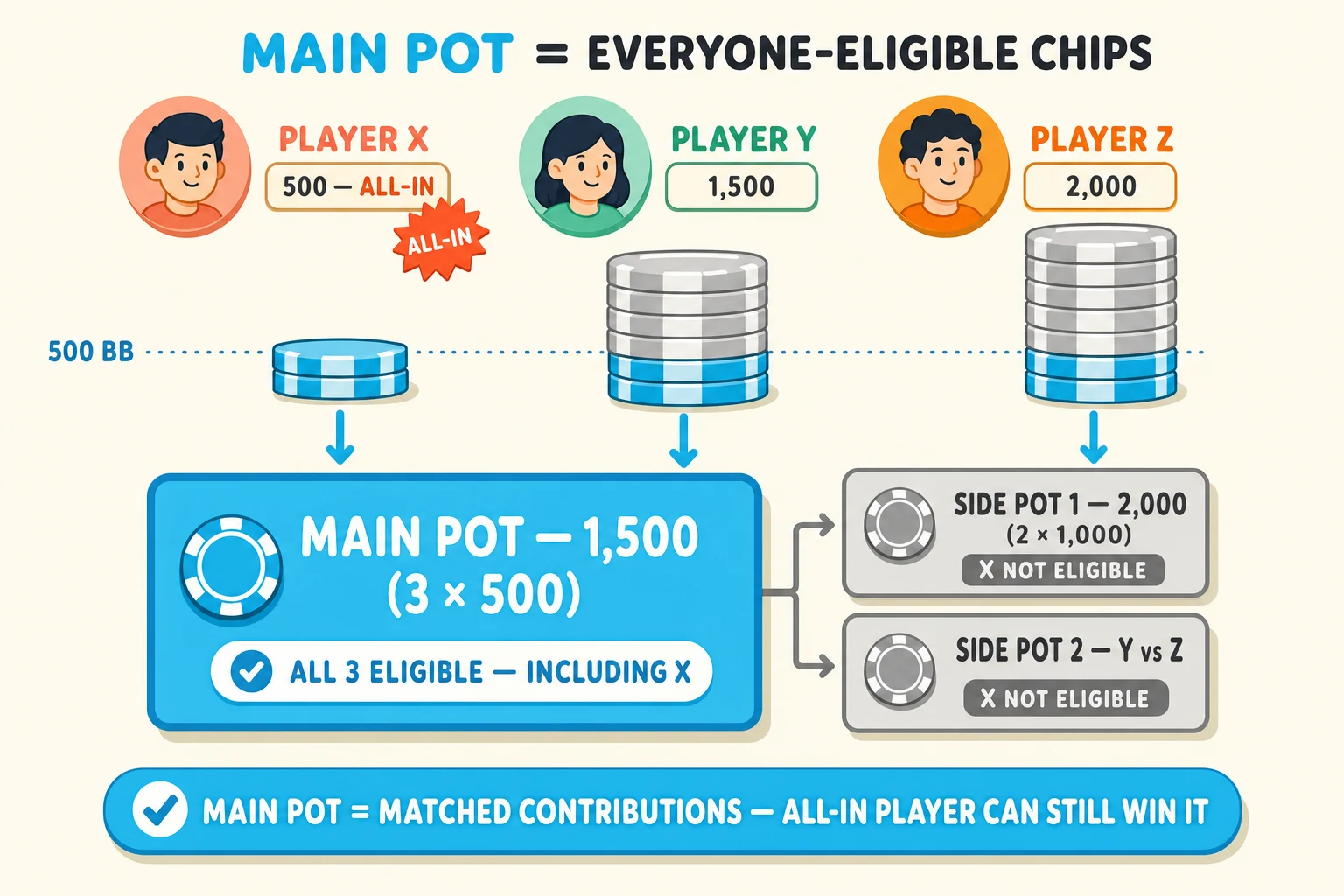
All-in means a player pushes all remaining chips into the pot. When an all-in occurs, only amounts up to the all-in are pooled in the main pot. Additional chips bet by deeper-stacked players form side pots that the all-in player cannot win.
Example: Player X has 500 chips, Player Y 1,500, Player Z 2,000. X goes all-in for 500; only 500 from each player goes into the main pot. Any further betting between Y and Z goes into side pots contested only by them.
Key points:
- An all-in player can win the main pot if their hand is best at showdown.
- Only players who contributed equally to the main pot can contest it.
- Excess bets create side pots, which only contributors to those side pots can win.
Strategic Importance of the Main Pot
Main-pot size and eligibility affect betting, calling, and folding decisions. Larger main pots increase the reward for risky calls; smaller pots often don’t justify the same risk. Know who can win the main pot when facing or making all-in bets. Calling a short-stack all-in with a drawing hand may be less attractive if much of the value sits in side pots you cannot win. Winning the main pot still gives a significant stack boost in both cash games and tournaments.
Resolving and Awarding the Main Pot
At showdown, award pots in order:
- Compare hands among players eligible for the main pot. The best eligible hand wins the main pot.
- Resolve each side pot separately among the players who contributed to those side pots.
- If all opponents fold before showdown, the last remaining player wins the main pot immediately.
Accurate allocation requires tracking each player’s contributions and any side pots formed. Dealers or players should separate main and side pots clearly to avoid disputes.
Quick checklist
- Main pot = chips contributed equally by active players.
- Track blinds, antes, bets, calls, and any excess that forms side pots.
- Only equal contributors can contest the main pot; all-ins can still win it.
- Main pot awarded to the best eligible hand at showdown or the last remaining player.