


Maniac
A maniac is an extremely loose-aggressive player who enters far too many pots and applies pressure on every street without the hand selection or postflop discipline of a controlled LAG. The pattern reads as constant raises, oversized bluffs, and rivers fired without a plan. One wild orbit is not a maniac read; the label only sticks once the same shape repeats across many hands.
Maniac: extreme loose-aggressive without the discipline
What a maniac is
A maniac is an extremely loose-aggressive player who enters far too many pots and keeps betting and raising without the hand selection or postflop discipline that a controlled LAG brings to the same style. The aggression rate looks similar at first glance: open after open, 3-bet after 3-bet, c-bet after c-bet. The break shows up in the details. A maniac fires turns and rivers without a clear value or bluff plan, sizes the same on every board, and rarely slows down on runouts that should change the line.
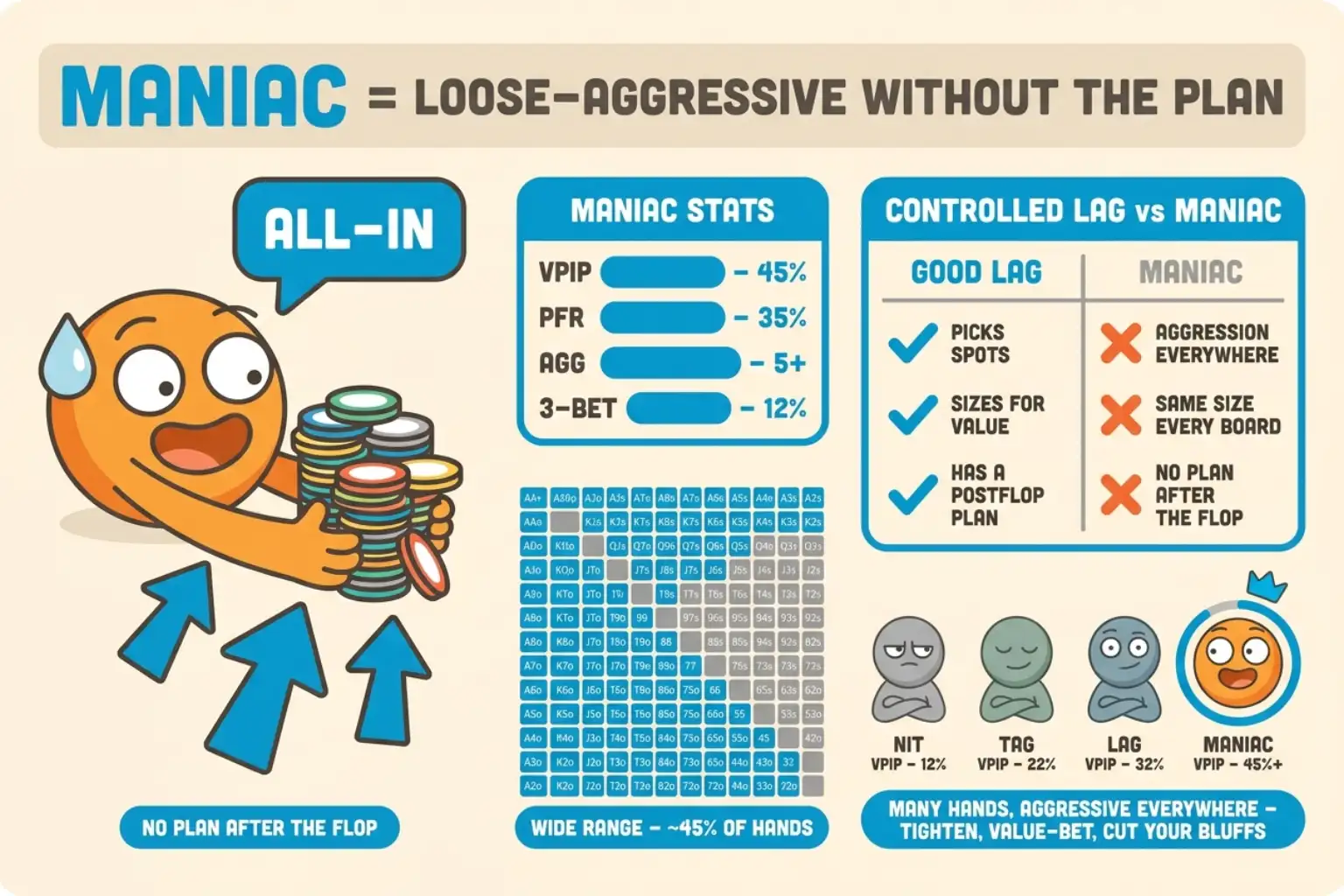
How a maniac differs from neighboring archetypes
Read every player on two axes at once: how often they enter the pot (loose vs tight) and what they do once in (aggressive vs passive). A maniac sits at the far end of both the loose and the aggressive axis, past where a controlled LAG stops.
- Maniac: very loose, very aggressive, no postflop plan. Same bet size on every board, fires rivers without a value-or-bluff story, treats every spot as a steal.
- LAG (controlled loose-aggressive): loose and aggressive, but with hand selection, sizing logic, and a plan for turns and rivers. Looks like a maniac for one orbit, plays nothing like one over a session.
- Aggressive regular: prefers betting and raising over calling, but keeps a tighter range than a LAG and balances pressure with value. Not a maniac and not always a LAG.
- TAG (tight-aggressive): few hands, aggressive when in. The mainstream solid-reg shape; the opposite of a maniac on the entry axis.
- Calling station: loose and passive. Same wide entry as a maniac, but checks and calls instead of raising. The opposite of a maniac on the action axis.
The two archetypes that get confused with a maniac are the controlled LAG and the aggressive regular. Both bring real aggression. Neither sits in the maniac band on the entry axis or in the no-plan-postflop pattern.
Related terms
Maniac vs LAG vs aggressive regular vs TAG
Stat bands below are HUD-community shorthand for 6-max NLHE cash, not formal definitions. Real players smear across the boundaries; the table is a reading tool, not a label gun.
| Player type | Typical VPIP | Typical PFR | Typical AGG | Postflop signal |
|---|---|---|---|---|
| Nit | 12 to 17 percent | 9 to 14 percent | 1.5 to 2.5 | Folds turns and rivers; rarely fires multi-street bluffs. |
| TAG | 20 to 24 percent | 17 to 21 percent | 2.0 to 3.0 | Selective barrels, value-weighted river bets. |
| Aggressive regular | 24 to 28 percent | 20 to 24 percent | 3.0 to 4.0 | Picks aggressive lines often, still changes plan with the runout. |
| LAG (controlled) | 28 to 35 percent | 22 to 28 percent | 3.0 to 5.0 | Wider range, planned barrels, selective bluffs. |
| Maniac (reckless) | 40 percent and up | 30 percent and up | 5 and up | Same size every street, fires rivers without a clear plan. |
| Calling station | 35 percent and up | 5 to 12 percent | 0.5 to 1.5 | Calls down with marginal hands; rarely raises. |
Read across one row and the style maps to a single counter-plan; jump rows and the counter-plan inverts. The most common mistake at the table is treating any aggressive opponent as a maniac because of one wild orbit. That misread is the single biggest source of bad hero calls against a controlled LAG or an aggressive regular.
When the maniac read matters most
The maniac label changes how you play back, so the read should clear a real bar before you act on it.
Where the maniac read pays attention:
- The same opponent has shown three or more hands at showdown that do not justify the line. Two of them with no pair and no draw on the river.
- Same bet size every street, every board, regardless of texture.
- Three-bets and four-bets that go to showdown with very weak holdings repeatedly, not once.
- An aggression factor that stays above 5 over a sample, not a 30-hand spike.
Where the maniac read backfires:
- One orbit of card-rush. A regular who picks up A-K, Q-Q, and 10-10 in three hands looks like a maniac and is not.
- A controlled LAG running good on a stretch of boards that hit their range. The aggression count climbs; the plan is still there.
- An aggressive regular fighting back at a passive table. Pressure in one session is not the maniac pattern.
- Tournament push-fold ranges that look like 50 percent VPIP because the format demands it.
A safer rule than the stat band: do not call something a maniac until you have seen at least one full session of repeated, plan-free aggression at showdown. Until then, the read is “very aggressive opponent, more data needed.”
Sample discipline: one wild orbit is not a maniac
The single most expensive mistake against this archetype is acting on too small a sample.
A few hands of pressure can land for any number of reasons. A regular three-bets you twice because the cards came in. A LAG fires turns on three boards in a row because the boards favored their range. A tournament short stack ships every hand for two orbits because the math says so. None of those are the maniac pattern, and none of them justify the wide hero-call ranges the label invites.
The pattern needs three things to lock in:
- Repeated showdowns that show no value and no plan. Not “they barreled rivers on three random hands”; “they showed up with king-high after firing three streets, then with seven-high the next time, then with bottom pair the time after.”
- Texture-blind sizing. A maniac fires the same number on a wet board, a dry board, and a paired board. A controlled LAG sizes the bluff differently on each.
- Stat persistence. The aggressive numbers hold up over a longer sample, not just the last twenty hands. A 30-hand spike can come from any source; 200 hands of the same pattern is harder to fake.
Until two of the three are present, treat the opponent as “an aggressive unknown” and avoid the wide hero-call lines a confirmed maniac read would justify.
Example: a tighter line versus a confirmed maniac
100bb effective, 6-max, $1/$2 NLHE cash. The cutoff has been at the table for two hours, opening 50 percent of hands, three-betting wide, and showing down weak holdings on rivers after firing all three streets. The maniac read is confirmed.
You are on the button with A♣Q♠. The cutoff opens to $8 (their default size every hand). The blinds fold to you.
The base play against a typical opener is a 3-bet for value, around $24. Against a confirmed maniac, the line that shows up in study material is different: just call. A maniac four-bet bluffs at a much higher rate than a regular, and a 3-bet here turns A-Q into a hand that has to face a 4-bet without a clear plan. Calling keeps their range wide, keeps you in position, and lets you play postflop where the maniac’s plan-free pressure can be answered with patience.
You call $6 more. The blinds fold. Pot is $19.
Flop: K♥ 9♣ 4♠. The cutoff bets $14 (their flat 75 percent c-bet size every board). Against a regular, A-Q is a clean fold here. Against a maniac who is firing every flop with their full opening range, A-Q has real equity against the air half of that range and the pot odds are reasonable. Call.
Pot is $47.
Turn: 5♦. The cutoff bets $35 again. The board is dry, no draws came in, and a maniac fires this card the same as any other. A-Q now has a decision: this is the spot where the controlled LAG slows down and the maniac does not. Against a confirmed maniac, A-Q calls; against a controlled LAG firing the same line, A-Q usually folds because the value half of their range is heavier here.
Pot is $117.
River: 2♣. The cutoff fires $90 into $117. A-Q is still ace-high. Against a typical opponent, this is a fold. Against a confirmed maniac whose third-barrel range at showdown has been plan-free bluffs more often than value, the call is closer than it looks. The decision hinges on the showdown sample more than on the hand: you have seen three rivers from this player with no pair, you have seen two with no draw, and the sizing has been identical on every board. Call.
The cutoff turns over 7♣ 6♥. Ace-high is good.
The same line played without the confirmed read is a leak. A-Q calling three streets versus a stranger is not the answer. The discipline lives in the sample, not in the aggression read alone.
Without that read, the standard answer is the one Poker Skill’s Check-Fold lesson teaches, where ace-high with no pair and no draw folds to a flop bet.
Common mistakes when facing a maniac
1) Confirming the read on too few hands
Three pots of pressure is not a maniac. The label needs repeated showdowns that show no plan, not just a few aggressive lines that happened to go the opponent’s way. The countermove for a maniac (call lighter, fold less, bluff into them less) is the wrong move for a controlled LAG who is just card-rushing. Wait for the showdowns to stack up before you change your plan.
2) Trying to out-aggro a maniac
The instinct after losing two pots is to fight fire with fire. Re-raising every open, four-bet bluffing wider, firing rivers as bluffs into them. A maniac calls or raises with a wider range than a regular does, so bluffing them is one of the worst plays available against the archetype. The book line is the opposite: tighten your starting range, value-3-bet thinner, and let their pressure run into your stronger holdings.
3) Sizing your value bets like the opponent is a regular
A confirmed maniac calls more, raises more, and folds less than a regular. Standard half-pot value sizes leave money on the table. The line that fits the read is bigger value sizes with strong hands and clearer value-heavy ranges throughout, not larger bluffs.
4) Treating a maniac and a controlled LAG as the same opponent
The aggression rate is similar; the postflop plan is not. A controlled LAG slows down on bad runouts, sizes the bluff differently on a wet board than a dry one, and folds turn check-raises with a clear share of their range. A maniac fires through the runout. Reading them the same way costs full stacks against the LAG, because their bluff frequency is much lower than the maniac’s.
5) Holding the maniac label too long
A player who tilted for two orbits, then settled into a normal pattern, is not a maniac anymore. Tilt is a temporary state; an archetype is a repeated one. Keep the read open: if the texture-blind sizing, the wide showdowns, and the constant pressure stop, the read should update with them. Archetypes are table reads from repeated behavior, not permanent identities.
FAQ
What is a maniac in poker?
A maniac is an extremely loose-aggressive player whose pattern stays loose and aggressive without the hand selection or postflop plan that a controlled LAG keeps in place. The shape shows up as a high VPIP (often 40 percent and up), a high PFR, an aggression factor above 5, repeated 3-bets and 4-bets with weak holdings, and texture-blind sizing on every board. The label only sticks once the same shape repeats across many hands and several showdowns; one wild orbit is not enough.
How do you spot a maniac at a poker table?
The cleanest tells are at showdown, not in the bet count. Watch for repeated showdowns where the opponent fires three streets with no pair, no draw, and no clear plan; identical bet sizes regardless of board texture; preflop 3-bets and 4-bets that turn over weak hands more than once. A high aggression factor on its own is not the read; a high aggression factor plus plan-free showdown hands is.
How do you play against a maniac?
Tighten your starting range, especially out of position. Value-3-bet a notch thinner because their calling range is wider than a regular’s, but do not 3-bet bluff much because they fold less and 4-bet more. Cut your own bluffs against them. Call down lighter than you would against a tight player only after the maniac read is confirmed across many hands; before the read is confirmed, treat them as an aggressive unknown and stick to your standard line.
Is every loose-aggressive player a maniac?
No. A controlled LAG enters a wide range and applies pressure on more streets than a regular, but pairs the aggression with selection, sizing logic, and a postflop plan. A maniac is the same surface shape with the discipline removed. The clearest separator is the river: a controlled LAG slows down on runouts that hurt their range; a maniac fires anyway.