


VPIP
VPIP (Voluntarily Put Money In Pot) is the percentage of hands a player chooses to enter preflop by limping, calling, or raising. It excludes forced blinds and free walks. VPIP measures how loose or tight a player is, not how skilled or aggressive they are.
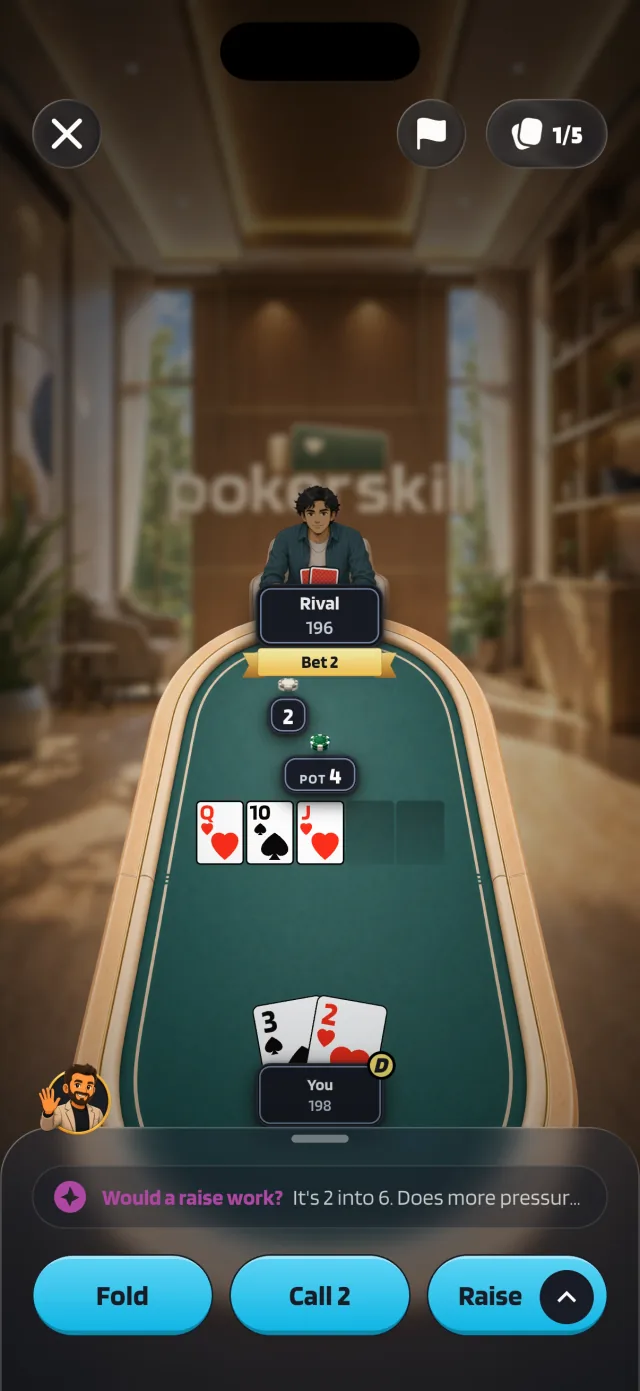
Practice this in Poker Skill. After a limp into your big blind, Coach Max in Practice vs AI can turn the question to how well the limper plays, because the spot turns more on the limper than on your cards.
Get the free appVPIP (Voluntarily Put Money In Pot)
What VPIP measures
VPIP is the percentage of hands where a player chooses to put chips in the pot before the flop. Limping, calling, completing the small blind after limpers, or raising all count. Forced blinds and a free walk in the big blind do not. If you voluntarily put chips in on 22 of 100 hands, your VPIP for that sample is 22.
For how VPIP pairs with PFR, the player-type map, and the gap read, see VPIP and PFR together.
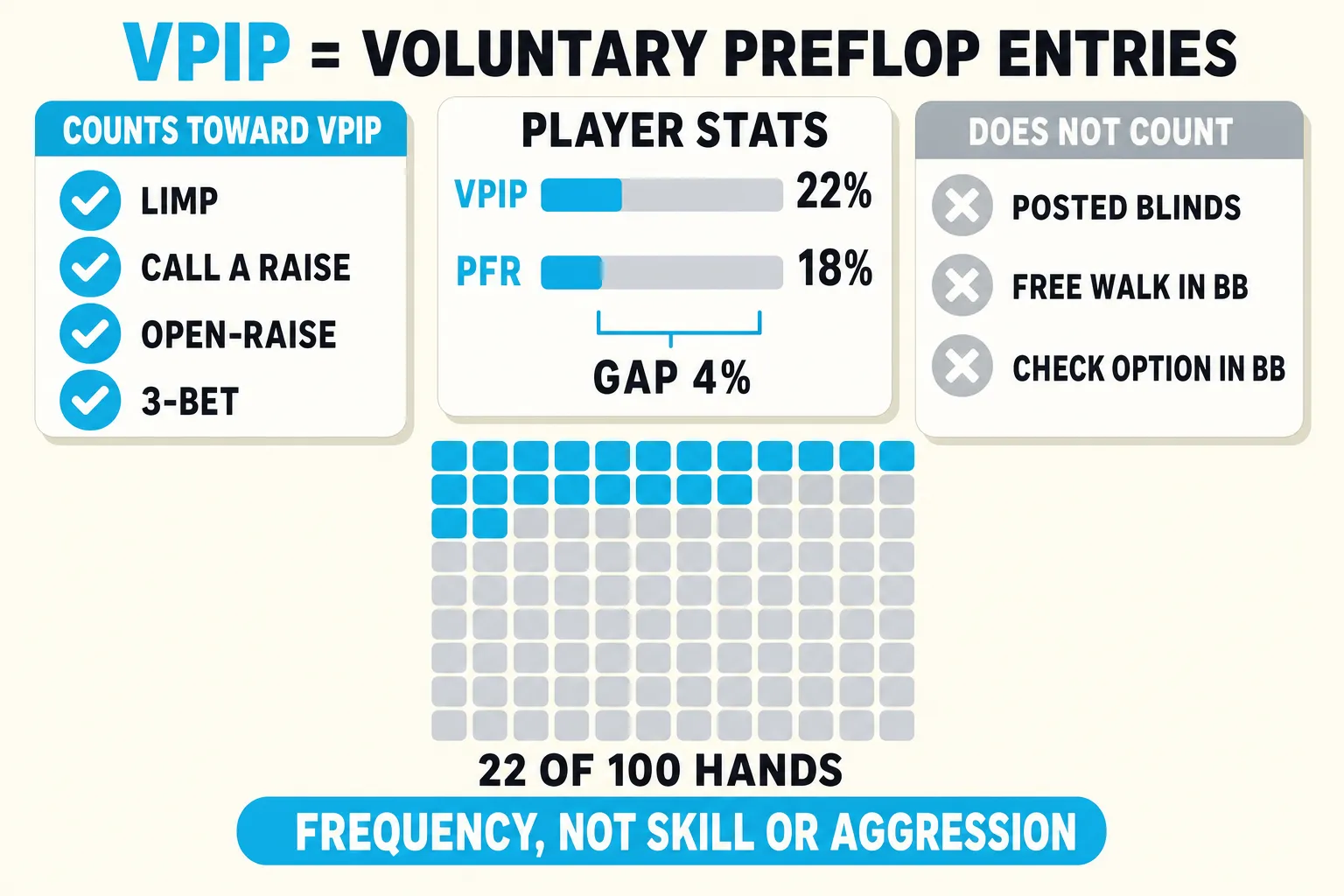
VPIP is a frequency measure, not a verdict. A 22 VPIP and a 32 VPIP can both be winning players in the right game with the right post-flop skill. The number tells you how often a player decides “this hand is worth playing”; it does not tell you what they do with that hand once the flop comes.
Related terms
- Villain: VPIP is usually the first stat you read on an opponent.
- Regular: most 6-max regs cluster in the low twenties.
- Nit: defined in part by an unusually low VPIP.
- Calling station: high VPIP, very low PFR, wide gap.
- Aggressive regular: higher VPIP, tight gap, raises most of what they play.
- Opener profile: the position-by-position view that VPIP collapses into one number.
VPIP vs PFR (and the gap between them)
Most player reads come from VPIP paired with one or two other stats. The closest sibling is PFR (preflop raise %), which counts only the hands a player enters by raising. PFR is always less than or equal to VPIP, because every raise is also a voluntary chip. The difference between the two is the VPIP/PFR gap, and it tells you how often the player limps in or flat-calls a raise.
| Stat | What it counts | What it tells you |
|---|---|---|
| VPIP | Every voluntary preflop entry (limp, call, raise, three-bet) | How loose or tight the player is |
| PFR | Only preflop raises (open-raises and three-bets) | How aggressive the player is preflop |
| VPIP/PFR gap | VPIP minus PFR | How often they call or limp instead of raising |
A small gap (about 3 to 5 points) usually points to a “raise or fold” reg who treats limping as a leak. A wide gap (8 points or more) points to a passive player who calls too much. The numbers most players quote are 6-max cash:
- 22/18: small gap, raise-or-fold regular.
- 24/12: wide gap; the player raises some hands but also flats a fair number.
- 35/8: wide gap, classic loose-passive station.
- 12/10: small gap, low volume; a tight reg who still respects aggression.
The gap is more diagnostic than either number on its own. Two players with VPIP 22 can have completely different ranges depending on where the PFR lands.
Reference ranges in 6-max cash
These bands are common reference points for 6-max NLHE cash. They are guidelines, not laws; every game is different.
| VPIP band | Profile | Notes |
|---|---|---|
| 0-15 | Nit / very tight | Often only premium pairs and big aces; easy to fold to. |
| 15-20 | Tight, solid | Cautious with speculative hands; common at higher stakes. |
| 20-27 | Standard reg | Typical balance for a competent 6-max player. |
| 27-35 | Active / loose-aggressive | Plays many hands; postflop skill required to make it work. |
| 35+ | Very loose | Usually exploitable unless the player is unusually sharp postflop. |
Two important caveats sit on top of those bands.
Position matters. VPIP averages across every position; the underlying reality is much more spread out. A solid 22-VPIP reg plays far fewer hands from under the gun than from the button. The aggregate hides the spread.
Table format matters. These bands assume 6-max. Full-ring tables (9 or 10 seats) push every band downward, because more players left to act means tighter starting ranges. A 22 VPIP at 6-max is normal; the same 22 VPIP at full-ring is loose-aggressive.
When this matters most
VPIP is most useful in the situations where you have to make a decision before you have any other information:
- The first time you face a preflop raise from a new opponent.
- Defending the big blind when you have no postflop history with the raiser.
- Evaluating whether to three-bet or flat versus an open from an unknown.
- Building a rough cluster (nit, reg, station, lag) within the first orbit at a new table.
It matters less when you already have a clear postflop sample on the player. By the time you’ve seen them barrel three streets twice and check-raise once, fold-to-cbet and aggression frequency carry more signal than the raw VPIP.
Example: same VPIP, different player
Two players sit at a 6-max $1/$2 table. Both show a VPIP of 22 over a few hundred hands. On the surface they look identical.
- Player A: 22/18, AF 2.5. Three-bet 8%. Fold-to-cbet 45%.
- Player B: 22/5, AF 0.6. Three-bet 1%. Fold-to-cbet 65%.
Player A is a textbook reg. They open most of their range, three-bet a healthy share, and barrel postflop at a normal rate. Bluff-cbets work at a roughly fair price; they will defend their range with backraises and floats.
Player B is a passive limper. They voluntarily enter the same number of pots, but almost all of those entries are limps and cold-calls. They three-bet only the top of their range, and they fold to most flop bets. Versus Player B, you can isolate limps wider, cbet more often on dry boards, and value-bet thinner. The VPIP told you nothing useful by itself; the gap and the supporting stats pulled the read apart.
Common mistakes when reading VPIP
1) Equating VPIP with skill
A higher VPIP does not mean a worse player and a lower VPIP does not mean a better one. There are winning regs at 16 and winning regs at 30. VPIP describes a style; the win rate behind it depends on hand selection inside the chosen range, position, and postflop play.
2) Trusting tiny samples
Twenty hands is a story, not a statistic. VPIP and PFR converge faster than most other reads, but a fresh seat with thirty-five hands is still mostly noise. Use early VPIP for a rough cluster (loose / standard / tight), not for fine-grained lines. The longer you sit, the more reliable the number gets.
3) Ignoring position
A single VPIP number averages every seat. If the read you need is “should I three-bet their cutoff open,” the position-specific stat is closer to the truth than the aggregate.
4) Forgetting table format and stake
Six-max bands do not transfer to full-ring or to heads-up. They also drift by stake. Recreational stakes often run looser at every band, while higher stakes compress toward 18-22. Adjust your mental thresholds to the game in front of you, not to a chart from a different format.
FAQ
What is a good VPIP for 6-max cash?
A common range for solid 6-max regs is roughly 20 to 27, with most winning players sitting in the low twenties. There is no single “good” number. What matters is whether the VPIP fits the player’s PFR, postflop aggression, and position-by-position frequencies. A balanced 22/18 and a balanced 26/22 can both be winning profiles.
What is the difference between VPIP and PFR?
VPIP counts every voluntary preflop entry: limps, calls, open-raises, and three-bets. PFR counts only the hands the player entered by raising. PFR is always less than or equal to VPIP. The gap between them is the share of hands the player limps or flat-calls, which is one of the cleanest passive-versus-aggressive signals you can read from a HUD.
How many hands do you need before VPIP is reliable?
VPIP and PFR are among the fastest-converging stats because they fire on every dealt hand. A few hundred hands gives a reasonable cluster read, and a few thousand hands gives a stable number. Extreme tendencies show up faster: a player who voluntarily enters thirty-five of their first fifty hands is almost certainly very loose. Soft, balanced styles need the larger sample before you can call the read settled.