


Weak-Tight
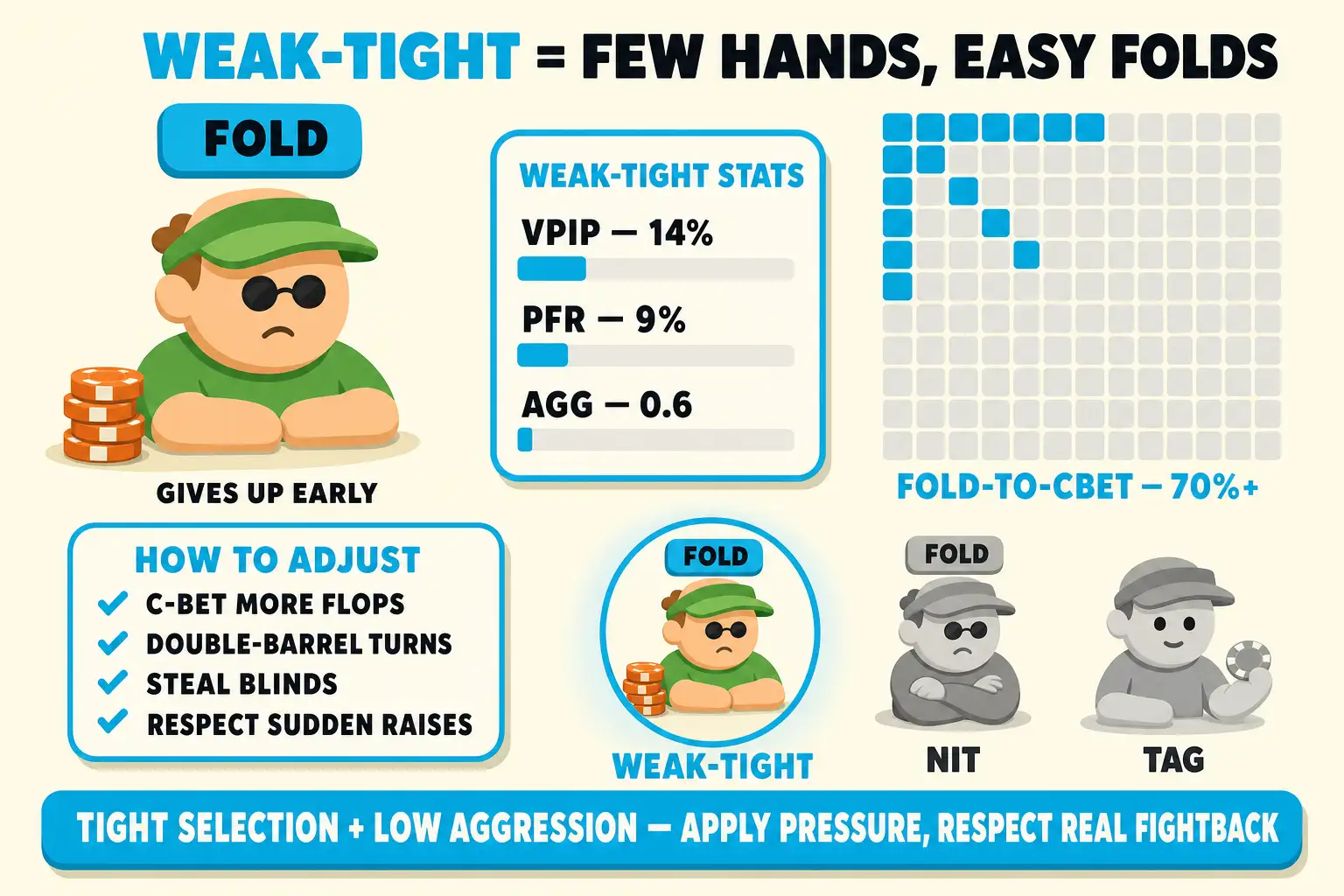
Weak-tight is a player-read shorthand for a tight, low-pressure style: the opponent enters few hands, then gives up too easily once a pot starts heating up. Bets, raises, or any sudden resistance push them off most of their range. The label describes a profile, not a person — the same opponent can show up weak-tight in one session and play very differently in another.

Practice this in Poker Skill. A wet multiway flop is no place to bluff even a weak-tight player, and the Multiway Continuation Bets lesson checks one three-way, because bets there get called too often.
Get the free appWeak-Tight: tight starting hands, soft once a pot starts
What weak-tight means
Weak-tight is a player-read shorthand for a tight, low-pressure style: the opponent enters few hands, then gives up too easily once a pot starts heating up. Bets, raises, or any sudden resistance push them off most of their range. The label describes a profile, not a person — the same opponent can show up weak-tight in one session and play very differently in another.
In 6-max no-limit cash, the surface stats often look respectable — a low VPIP and a low PFR — and that is what masks the leak. The hands that do come in fold more often than they should once an opponent shows interest, especially to a c-bet, a turn barrel, or a sudden raise. The selection is fine; the follow-through is not.
Related terms
- Nit: the tightest neighbor — even fewer entries, but the postflop posture overlaps with weak-tight in many spots.
- TAG: same tight selection, very different follow-through; a TAG keeps firing where a weak-tight player gives up.
- Tight-first: the discipline-first study posture, not the same as the leak — tight-first is a learning frame, weak-tight is a postflop tendency.
- Aggression factor: the postflop number that exposes weak-tight; values near or below 1.0 with low VPIP point at the read.
- VPIP: the entry frequency, low for both nits and weak-tight players.
- PFR: the preflop-raise frequency, also low here, often hugging VPIP.
- Player read: the broader frame this shorthand sits inside.
- WTSD: the went-to-showdown stat that tends to run low for weak-tight players, since they fold before showdown.
Weak-tight versus neighboring archetypes
Weak-tight reads sit in the tight half of the VPIP axis and the passive half of the aggression axis. The nearby archetypes share one half each.
| Archetype | Tight or loose | Aggressive or passive | Quick read |
|---|---|---|---|
| Weak-tight | Tight | Passive (folds too often) | Few entries, then folds the moment a hand develops. |
| Nit | Very tight | Passive | Almost no entries; folds nearly everything; rare aggression usually means a real hand. |
| TAG | Tight | Aggressive | Tight selection, but keeps firing on flops and turns. |
| Calling station | Loose | Passive (calls too often) | Loose selection, then refuses to fold once entered. |
A weak-tight read and a nit overlap on entries and on showdown frequency. The split is where you find them: a nit is missing from most pots before the flop, while a weak-tight player enters more pots but then disappears on flops and turns. A weak-tight read and a TAG share the entry profile and split on follow-through: a TAG c-bets, double-barrels, and three-bets at healthy rates, while a weak-tight player checks back, calls one street, and lets pots go on the next.
The same opponent can drift between these labels across stakes and game types. Treat the read as a working hypothesis, not a permanent tag.
Stat fingerprint of a weak-tight read
These reference bands describe the shape; they are not laws. Numbers shift with sample size, table type, and the player’s day.
| Stat | Typical weak-tight band | What it points at |
|---|---|---|
| VPIP | 12 to 18 | Few hands enter the pot; selection is tight. |
| PFR | 8 to 14 | Even fewer hands come in raised; the gap to VPIP is small. |
| Aggression factor | 0.5 to 1.2 | Calls outpace bets and raises postflop. |
| Fold to flop c-bet | About 60 to 75 percent | The c-bet alone wins many pots. |
| Fold to turn double-barrel | Often 55 percent or higher | A second barrel keeps closing pots. |
| WTSD | Low, often under 22 percent | Hands rarely reach showdown. |
Two clues line up. First, aggression factor sits below the TAG band of about 2.0 to 3.0; calls and check-folds dominate the postflop log. Second, fold-to-c-bet runs high relative to a TAG (usually around 50 percent) or a nit (usually closer to 60 to 70 percent for both, though a nit often defends less because they entered with weaker hands far less often).
If the live stats are not visible, which is most of the time, the read still forms quickly. Two or three orbits of “raise, c-bet, take it down” against the same opponent is enough to start treating the seat as weak-tight until shown otherwise.
When the weak-tight read matters most
The label earns its keep in the spots where pressure is cheap and information is thin:
- A flop continuation bet on a board that misses your opponent’s flatting range — Q♠ 7♥ 4♦ after a button raise versus their big-blind defense, for example.
- A turn double-barrel when the runout shifts the board texture away from their likely hands — an A♠ overcard turn after they called a flop bet on 9♣ 6♣ 3♦.
- A river bluff into a check-check turn, where the seat had multiple chances to show strength and never did.
- Blind steals from late position. A tight-passive defender is hard-pressed to play back, so a wider open works.
- Three-bet bluffs against a small opener from the cutoff or button, especially with hands that block their value range.
The label matters less in spots where folding feels right anyway. A four-way limped pot on a wet, connected board does not become a great bluff because one of the four is weak-tight. Apply pressure where pressure is cheap; do not invent it.
Example: same low VPIP, different player
Two players sit at a 6-max $1/$2 cash table. Both show VPIP 14, PFR 10 over a few hundred hands. The preflop line looks identical.
- Player A: 14 / 10, AF 2.4, fold-to-c-bet 50 percent.
- Player B: 14 / 10, AF 0.6, fold-to-c-bet 72 percent.
Player A is a tight, aggressive seat. Open from the cutoff with A♣ K♠, get called from the big blind, and a flop of 9♥ 7♣ 4♦ goes c-bet, give up. A turn 2♣ runout with a double-barrel runs into too many calls and a few check-raises. They three-bet J♠ J♣ for value, and they peel turns when they belong. Their tight selection survives because their postflop play matches it.
Player B is a weak-tight read. The same A♣ K♠ open gets called by the big blind. Flop 9♥ 7♣ 4♦, c-bet, fold. Open Q♥ Q♦ from the cutoff, get flatted, c-bet a J♠ 6♦ 3♠ flop, take it down. Turn double-barrels close most of the remaining hands without protest. Their preflop chart looks fine; their willingness to fight for pots is not there.
Same VPIP and PFR, two very different seats. The preflop counts alone could not split them. The aggression factor and the fold-to-c-bet line did.
Common mistakes when reading weak-tight
1) Calling the read on one orbit
Tight starts happen for many reasons: a cold deck, a new sitter, a focused mood. One orbit of folds is not a profile. Wait until a few c-bets and a turn or two of pressure have actually closed a pot before locking in the label.
2) Treating weak-tight as an automatic bluff license
Pressure pays against the right opponent on the right board. Weak-tight does not mean “any river bluff works.” Boards that connect with their flat range, scary low-card runouts where your story makes no sense, and three-way pots where someone else can play back — those are not free spots.
3) Confusing weak-tight with a nit
Both are tight and both fold often. The split is what they entered with. A nit shows up with a narrow, premium-heavy range and folds the rest of their entries because the rest never came in. A weak-tight player enters a wider band of speculative hands, then folds them because the hand did not flop big. The bluff windows look different: nits give up fewer pots after entering with their tightest hands, while weak-tight players give up more pots in the spots where they flatted preflop.
4) Treating the label as permanent
A “weak-tight” tag from yesterday’s session does not freeze the seat in place. Players adjust, bankrolls change, mindsets change. Re-check the read every session, and let recent postflop evidence overwrite the older label when the two disagree.
5) Ignoring the rare moment they fight back
When a weak-tight player suddenly check-raises, leads into the preflop raiser, or fires three streets, the read should flip on the spot. Their range for taking that line is narrow and value-heavy. The same player who folded two flops in a row is now telling you a real story; respect it.
FAQ
How is weak-tight different from a nit?
Both run with low VPIP and low aggression, and both fold a lot. The split is what they enter with and how those pots end. A nit plays a tighter, premium-anchored range, so most of their entries reach showdown or end with a value bet of their own. A weak-tight read plays a wider speculative range, then folds the rest of those entries the moment a flop or turn does not cooperate. Pressure works against both, but weak-tight gives up more pots in places where a nit was never in the hand at all.
How is weak-tight different from a TAG?
Same tight selection on entries, very different postflop posture. A TAG keeps firing — c-bets, double-barrels, three-bet bluffs at a healthy rate — while a weak-tight read checks back and lets pots go. The clearest divider is aggression factor: a TAG sits around 2 to 3, a weak-tight read sits closer to 0.5 to 1.
Can a player look weak-tight at one stake and not at another?
Yes. The same opponent can run weak-tight in a tougher game where their reads are thin and aggressive elsewhere when the table is softer. Stake, table dynamics, and session length all change posture. The label is a working read on this seat, this session, not a verdict on the player.
What stat lines should I trust before locking in the read?
Two preflop counts and at least one postflop number. VPIP and PFR alone cannot split a TAG from a weak-tight seat. Pair them with aggression factor and fold-to-c-bet before adjusting your line. If only the preflop numbers are visible, treat the read as a guess until a postflop sample lands.