


TAG
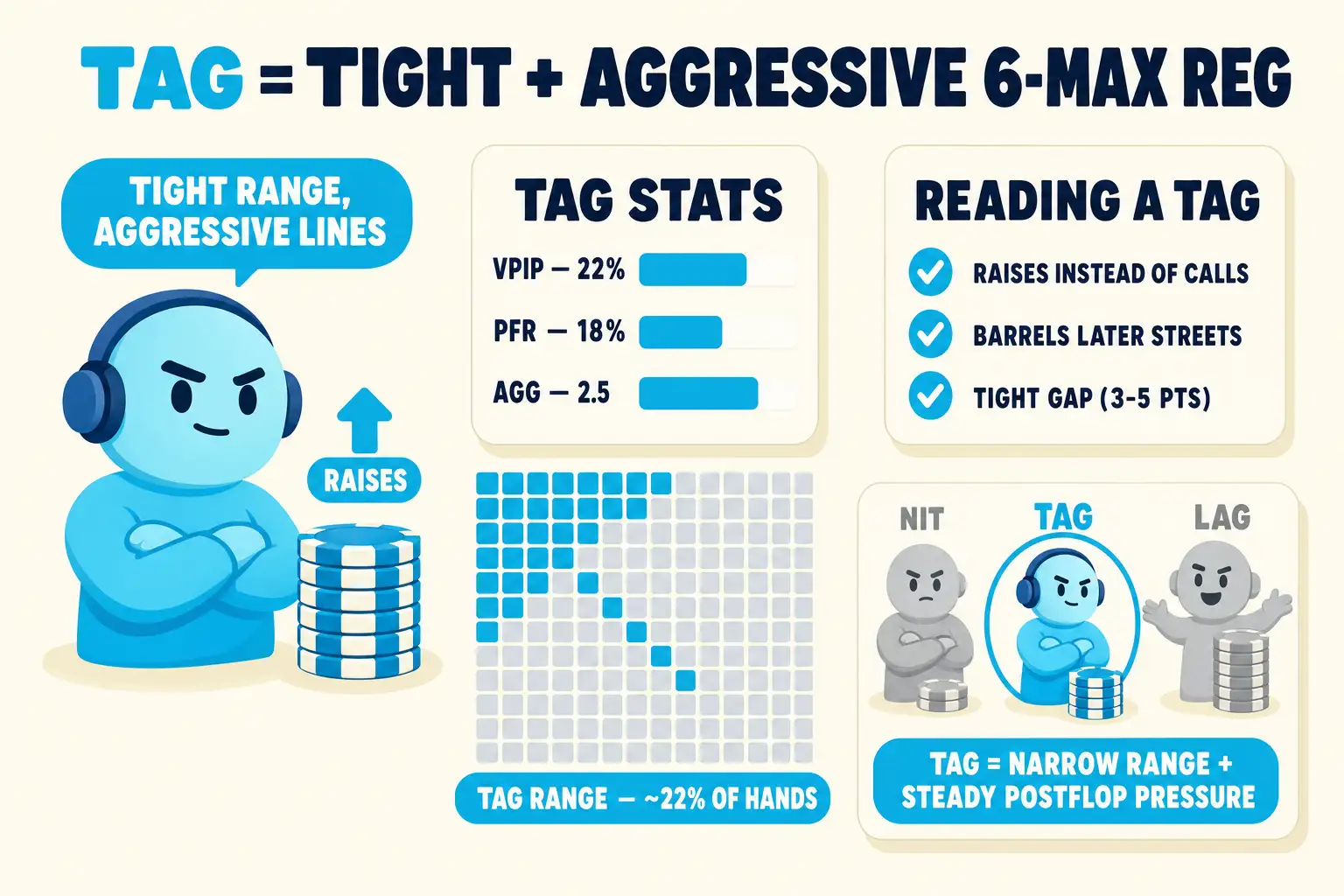
TAG (tight-aggressive) is a player profile that enters fewer hands than average but raises or bets when they do enter. Tight selection plus active aggression is the textbook 6-max regular shape, often quoted as 22/18 with an aggression factor around 2 to 3.
Practice this in Poker Skill. The aggressive half of the style is what the turn lessons work on, from Good Barrel Cards on when to keep firing to Give Up on Purpose on when to stop.
Get the free appTAG (tight-aggressive): the standard 6-max regular profile
What a TAG is
TAG stands for tight-aggressive. A TAG plays a smaller share of hands than average, then attacks with raises and bets when they do enter the pot. Two halves, both required: the selection is tight, the action is aggressive. The profile sits between a nit, who is tight but mostly passive, and a loose-aggressive player, who is aggressive but enters far more pots. In 6-max no-limit cash, TAG is the default shape most coaching content describes when it talks about “a solid reg”.
Related terms
- Nit: tight selection without the aggression — the closest contrast on entry frequency alone.
- Aggressive regular: a neighboring profile that leans further into postflop aggression.
- Regular: the broader category most TAGs belong to.
- Calling station: the opposite of TAG on both axes — loose and passive.
- VPIP: the tightness axis a TAG sits on.
- PFR: the aggression axis a TAG sits on.
- HUD: the on-screen readout where you decode TAG status in real time.
TAG vs neighboring archetypes
Most player labels lock into place once you read a player on two axes at once: how often they enter (loose vs tight) and how often they raise or bet versus call or check (aggressive vs passive). TAG is the tight-and-aggressive corner.
| Archetype | Tight or loose | Aggressive or passive | Quick read |
|---|---|---|---|
| TAG | Tight | Aggressive | Plays a narrow range, raises and bets when entering. |
| Nit | Very tight | Mostly passive | Folds nearly everything; rarely fires multiple streets. |
| LAG (loose-aggressive) | Loose | Aggressive | Wide range, frequent c-bets, double barrels, bigger bluff frequency. |
| Calling station | Loose | Passive | Calls a lot, raises a little, fires fewer bluffs of their own. |
A TAG and a LAG share the aggression habit; the divider is range width. A TAG and a nit share the tight selection; the divider is what they do once a hand starts. The same player can be a TAG at one stake and look like a nit at another if their selection narrows without their aggression dropping.
Reference stat lines for a 6-max TAG
Books and HUD writeups quote a few common bands for a 6-max NLHE cash TAG. These are reference points, not laws.
| Stat | Typical TAG range | What it means |
|---|---|---|
| VPIP | 18 to 25 | Voluntarily entered hands, capped well below average. |
| PFR | 14 to 22 | Almost every voluntary entry comes in as a raise. |
| VPIP/PFR gap | About 3 to 5 | Limps and flat-calls are rare. |
| Aggression factor | About 2.0 to 3.0 | Bets and raises clearly outpace calls postflop. |
| 3-bet | Around 5 to 9 percent | Healthy three-bet share preflop. |
The 22/18 line, with an aggression factor near 2.5, is the textbook anchor. Tighter shapes (for example 18/15) still read as TAG when the gap stays narrow and the aggression factor stays at or above 2. Once the aggression factor drops toward 0.5 or 1.0 at the same VPIP and PFR, the player has slid into tight-passive instead. Once VPIP climbs into the high twenties or thirties with the gap holding, the player has crossed into LAG.
Position changes the picture more than the aggregate suggests. A TAG with a 22 VPIP often plays under 12 percent under the gun and over 35 percent on the button. The single number averages those spots out.
When this matters most
Reading TAG status helps most in spots where the early-table evidence is thin and the postflop sample has not landed yet:
- The first preflop raise from a new opponent, when you have to pick fold, call, or three-bet with little else to go on.
- Defending the big blind versus a stranger who opens from a steal seat.
- Choosing a c-bet plan after a TAG flats your raise from the button.
- Sizing a river bluff into a TAG who has called twice already; their calling range is narrower than a station’s, so blockers and runout matter more.
It matters less once you have postflop frequencies on the player. After fifty hands of seeing them check-raise turns, fold to triple-barrels, or hero-call light, those reads carry more signal than the raw archetype. Use the TAG label as a starting frame, not a ceiling.
Example: same 22/18, different player
Two players sit at a 6-max $1/$2 cash table. Both show VPIP 22 and PFR 18 over a few hundred hands. The aggregate stats look identical.
- Player A: 22 / 18, AF 2.5, fold-to-cbet 45 percent.
- Player B: 22 / 18, AF 0.5, fold-to-cbet 65 percent.
Player A is a textbook TAG. They open the same hands, but they keep firing postflop. Open from the cutoff with A♣K♦, miss a 9♥ 7♠ 4♦ flop, and they still c-bet. Pick up a J♠ on the turn and they double-barrel often enough that Player B’s typical defense fails. They check-raise turns, three-bet their best Q♥Q♦ and J♠J♣ holdings preflop, and apply pressure on rivers when the runout favors their range.
Player B is tight-passive. They opened the same A♣K♦, but they check the 9♥ 7♠ 4♦ flop and give up a lot of pots they could have won. They flat raises with K♠Q♠ instead of three-betting. They almost never check-raise. The same VPIP/PFR line was telling you very different stories. Aggression factor and fold-to-cbet pulled the read apart.
The lesson sticks: VPIP and PFR alone do not separate a TAG from a tight-passive player. Pair the preflop counts with at least one postflop stat before locking in your line.
Common mistakes when reading TAG
1) Treating tight as automatically winning
A 22 VPIP with weak postflop play still creates leaks, just as a 32 VPIP with weak postflop play does. TAG describes a style, not a result. Plenty of small-stakes players sit in the TAG band and still give up too much value, usually by overfolding turns, calling rivers too lightly, or failing to three-bet a balanced share preflop.
2) Confusing TAG with nit
Both play few hands, so the surface looks similar at the start of a session. The split shows up the moment a hand develops. A TAG keeps firing; a nit lets pots go. If the player you tagged as TAG check-folds three turns in a row, they are probably a nit and your bluff frequency against them should climb.
3) Confusing TAG with LAG
Both attack postflop, so a few aggressive hands in a row can look like the same archetype. The split is range width. A LAG enters far more often, three-bets light, and runs a higher bluff frequency. Misreading LAG as TAG inflates your hero-call instinct on rivers and costs you stacks against a player who is genuinely betting more bluffs.
4) Ignoring position spread
A single VPIP number averages the seats. The same TAG can play 8 percent under the gun and 50 percent on the button. If your decision is “should I three-bet their cutoff open” or “is the small blind worth defending versus their button steal,” the position-specific frequency is closer to the truth than the aggregate label.
FAQ
What VPIP and PFR count as TAG in 6-max cash?
The textbook anchor most books quote is around 22 VPIP and 18 PFR with an aggression factor near 2.5. A wider band of roughly 18 to 25 VPIP and 14 to 22 PFR still reads as TAG provided two things hold: the gap between VPIP and PFR stays narrow (about 3 to 5 points), and the aggression factor stays at or above 2. Outside those bands, the player is sliding toward nit, LAG, or tight-passive instead.
How is TAG different from LAG?
TAG and LAG share the aggression habit; the difference is range width. A TAG plays a smaller share of hands and brings the same aggressive postflop style to that narrower range. A LAG plays a wider share — VPIP often in the high twenties or low thirties — and runs a higher bluff frequency on multiple streets. TAG bluff lines are more selective and more value-weighted; LAG bluff lines fire more often and earlier. The two profiles win in different games and against different opponents.
Can a beginner play a TAG style?
Yes, and most coaching curriculums recommend starting there. The TAG playbook reduces the number of marginal preflop spots a beginner has to navigate, since most hands fold before the flop. The aggression half is harder than the selection half — a beginner can pick up tight ranges quickly but takes longer to learn when to keep firing on turns and rivers. The shortcut: tighten your starting hands first, then add aggression once you have a feel for which boards favor your range.