


HUD
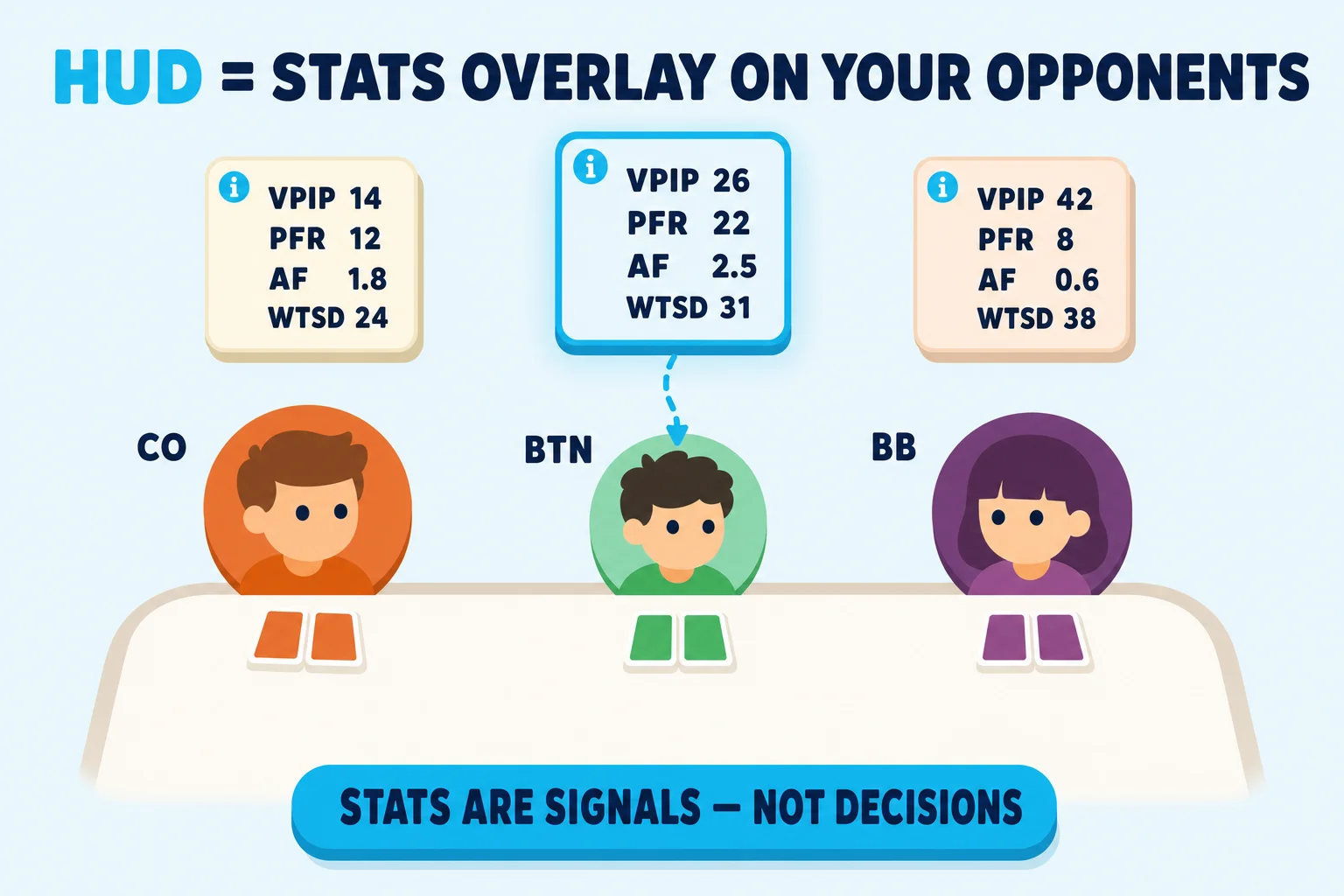
A HUD (Heads-Up Display) is an overlay for online poker that shows tracked stats next to each opponent: VPIP, PFR, aggression, fold-to-c-bet, and others. Treat the numbers as signals about tendencies, not as decisions on their own. Sample size, context, position, and site rules all change what a HUD is actually telling you.
A calling station, the profile a HUD shows as a wide gap between VPIP and PFR, gets its own row in the 3-betting table on Poker Skill’s preflop charts: value hands only, and no bluffs.
HUD (Heads-Up Display): the online opponent-stats overlay
What a HUD is and what it shows you
A HUD, short for heads-up display, is a software overlay used in online poker. It reads the hand-history files saved by the poker client, computes a set of statistics for every player you have data on, and prints those numbers next to each seat in real time while you play. You glance at the badge near a name, you see something like 22 / 18 / 2.4, and that is shorthand for that opponent’s tendencies across hundreds or thousands of past hands.
A HUD does not decide for you. It is a faster, more accurate version of the notes a careful player would keep by hand. Most numbers on it are frequencies: how often this opponent does a specific thing in a specific spot. Those frequencies have to be interpreted alongside position, board, stacks, and your own read. The most useful HUDs are configured so that one quick glance produces a profile, not a calculation.
Related terms
- Player read: the broader skill a HUD supports.
- Exploitative deviation: the adjustment a reliable HUD read can justify.
- Population tendency: the pool-level version of stat-based reads.
- Frequency: the math behind every HUD number.
- Nit: a common low-VPIP, low-PFR profile.
- Aggressive regular: a common high-aggression profile.
A typical seat block carries five or six numbers:
- VPIP (Voluntarily Put money In Pot). The percentage of hands a player puts chips in preflop other than the blinds. Tells you how loose or tight they are before the flop.
- PFR (Pre-Flop Raise). The percentage of hands they raise preflop, either as the opener or as the 3-bettor. Tells you how aggressive their preflop entries are.
- AF (Aggression Factor). The ratio of bets and raises to calls across all postflop streets. Tells you whether they pressure pots or mostly call.
- Fold to C-bet. How often they fold to a flop continuation bet after calling preflop. Tells you whether c-bet bluffs get folds often enough.
- WTSD (Went To Showdown). The percentage of flops seen that reach showdown. Tells you whether they get to the river often or fold out early.
Most HUDs are customizable. Some grids have ten stats per seat, others stop at four. The rule of thumb is to keep only what you’ll actually read in two seconds; everything else is decoration.
How to read VPIP and PFR together
These two are the front of the HUD for a reason: they tell you most of what you need to know about an opponent’s preflop game with one glance. Read them as a pair, not as separate numbers.
The gap between VPIP and PFR is the part that does the work. A player whose VPIP and PFR are nearly equal almost never calls preflop; they raise or fold. A player with a big gap calls or limps a lot. For 6-max cash at 100bb stacks, common bands look like this:
| Profile | VPIP | PFR | Gap | What it points at |
|---|---|---|---|---|
| Nit | 8-15 | 6-12 | small | folds almost everything; only continues with premiums |
| Tight regular | 18-22 | 16-20 | 2-5 | balanced opener, raise-or-fold style |
| Aggressive regular | 22-27 | 20-25 | 2-5 | wide opens, light 3-bets, applies pressure |
| Loose-passive (“calling station”) | 30-45 | 8-15 | wide | limps and calls way too much, rarely raises |
| Maniac | 40+ | 35+ | 2-5 | raises and reraises constantly, exploitable but dangerous in the moment |
Then layer AF on top. Two players can share the same VPIP and PFR but play wildly different postflop. A 22/18 with AF 0.5 sees flops and gives up, drifting to showdown with weak hands. A 22/18 with AF 3.0 fires multiple barrels, double-barrels missed flops, and runs over passive opponents. The preflop block looks identical; the postflop experience is opposite.
Position context matters too. VPIP and PFR are global numbers: they smear opens from the button into limps from the small blind. If your HUD shows position-filtered stats (RFI from CO, RFI from BTN), use those instead for position-specific reads.
When HUD reads matter most
HUDs earn their keep when the opponent is online, the sample is real, and the spot rewards being right about a frequency rather than a single hand.
- Multi-tabling cash and large-field MTTs. When you can’t watch every seat in detail, a HUD compresses dozens of orbits of observation into a glance.
- Repeat opponents at the same stake. The first 200 hands on a player are noisy; the 2,000th hand is when the numbers start telling the truth.
- Thin spots near indifference. Bluff catchers, river bluffs, light 3-bets: a fold-to-c-bet of 70 versus 45 changes the right call on its own.
When HUDs matter less:
- Live poker. No client, no hand history, no overlay. Profiling still works, but with notes and observation, not numbers.
- First time at a table. The sample is too small to trust; you’re better off reading the action than the badge.
- An opponent you can already see clearly. When a population-level read and direct observation already point the same way, the HUD just confirms.
- Spots where the right play is already locked. You don’t need a HUD to fold bottom pair to a 3-bet; spending the glance is wasted.
Worked example
You are on the button at 100bb. The cutoff opens. You glance at his badge.
24 / 21 / AF 2.6 / Fold to C-bet 38 / WTSD 31 - over 4,200 hands
You’re holding A♠5♠. The numbers tell you a few things at once.
The 24/21 with a 3-point gap is a wide, raise-or-fold opener: a real regular, not a recreational player. AF 2.6 is normal for an active regular; he barrels when he should. Fold-to-c-bet 38 is the line that jumps out: when he calls before the flop and faces a flop bet, he gives up only 38 percent of the time. That’s stickier than average. WTSD 31 is high, which means he gets to the river a lot and calls down with marginal hands rather than folding turns.
The right preflop play here mixes 3-bet and call. The HUD nudges you toward a mixed strategy that leans more toward calling: a stickier opponent on the flop is harder to bluff, so the value of a polarized 3-bet drops. If you do 3-bet, you should plan to value-bet thin on rivers and bluff less, because his fold-to-c-bet and high WTSD say he’ll show up at showdown with stuff like third pair and ace-high.
A 4,200-hand sample is enough to trust those numbers in this spot. If the same panel sat on top of a player you’d seen 80 hands of, you’d treat the badge like a hint rather than a read.
Common mistakes
1) Trusting a tiny sample
Stats from 50 or 100 hands look like stats but aren’t. A run of decent cards lifts VPIP into “loose” range; a cold run drops it into “nit” range. As a rough rule, it takes thousands of hands before VPIP and PFR fully settle. AF and fold-to-c-bet settle more slowly, and rare events (3-bet, 4-bet, river overbet) need much more data. If the sample is small, treat the badge as a working hypothesis, not a verdict.
2) Treating one stat as a decision
A 100 percent flop c-bet number looks exploitable until you notice the opponent only plays 2 percent of his hands preflop. He c-bets every flop because he arrives with overpairs and sets, not because he’s bluffing. Stats are interrelated; a single number, ripped out of context, will sell you the wrong story. Read the panel as a profile.
3) Forgetting site rules and live-poker reality
HUD legality is a site-by-site question, not a one-time setting. Some operators ban third-party trackers entirely. Others allow tracking but ban real-time assistance, which can include certain HUD features (in-hand solver lookups, equity displays, GTO charts). Live games run no HUD at all: the data simply doesn’t exist. Check the terms of service of the site you actually play on, and never use any tool that the site prohibits. A banned tool can end your account, not just a session.
4) Letting the HUD outvote your eyes
A player on tilt does not match his HUD. A grinder running well ignores his usual ranges. An opponent who has decided to attack you is rewriting the numbers in real time. One betting line can outweigh the whole panel, too: an under-the-gun limper who re-raises your raise is telling you he holds a big hand. Poker Skill tests that read with K♦ Q♠, a hand worth the first raise that has to fold to the second. A useful rule: when your direct read disagrees with the HUD, your read wins. The badge tells you what they have done; the table tells you what they are doing right now.
FAQ
Are HUDs allowed in online poker?
It depends on the site. The major operators publish a list of approved tools and a list of prohibited ones, and they update those lists regularly. Some sites, particularly anonymous-table and recreational-focused rooms, block third-party trackers and HUDs outright. Others allow trackers but draw a line at real-time assistance. The only correct answer is to read the terms of service of the site you actually play on before you install anything. A HUD that gets you banned is worse than no HUD at all.
How many hands do I need before a HUD stat is trustworthy?
VPIP and PFR start to look real around 1,000 to 2,000 hands and stabilize past that. VPIP gets a chance every hand and settles fastest, yet even it stays loose early: over 200 hands, a player who really plays 25% of his hands shows a VPIP between 19% and 31% about 19 times in 20. AF settles more slowly, because only the hands that see a flop feed it. Stats that count rare events (3-bet percent, 4-bet percent, fold-to-river-bet) need much larger samples; treat them as ranges, not point estimates, until you have several thousand hands on the player. Below 200 hands, the badge is a working hypothesis and nothing more.
Can I use a HUD in live poker?
Not literally. There is no client, no hand history, and no overlay to attach to a live table. What is portable is the profiling habit. You can sort opponents into the same categories a HUD would (tight or loose, passive or aggressive), keep notes on repeat opponents, and watch position and sizing patterns the same way you would read a stat panel. The shorthand changes; the underlying read does not.