


Tell
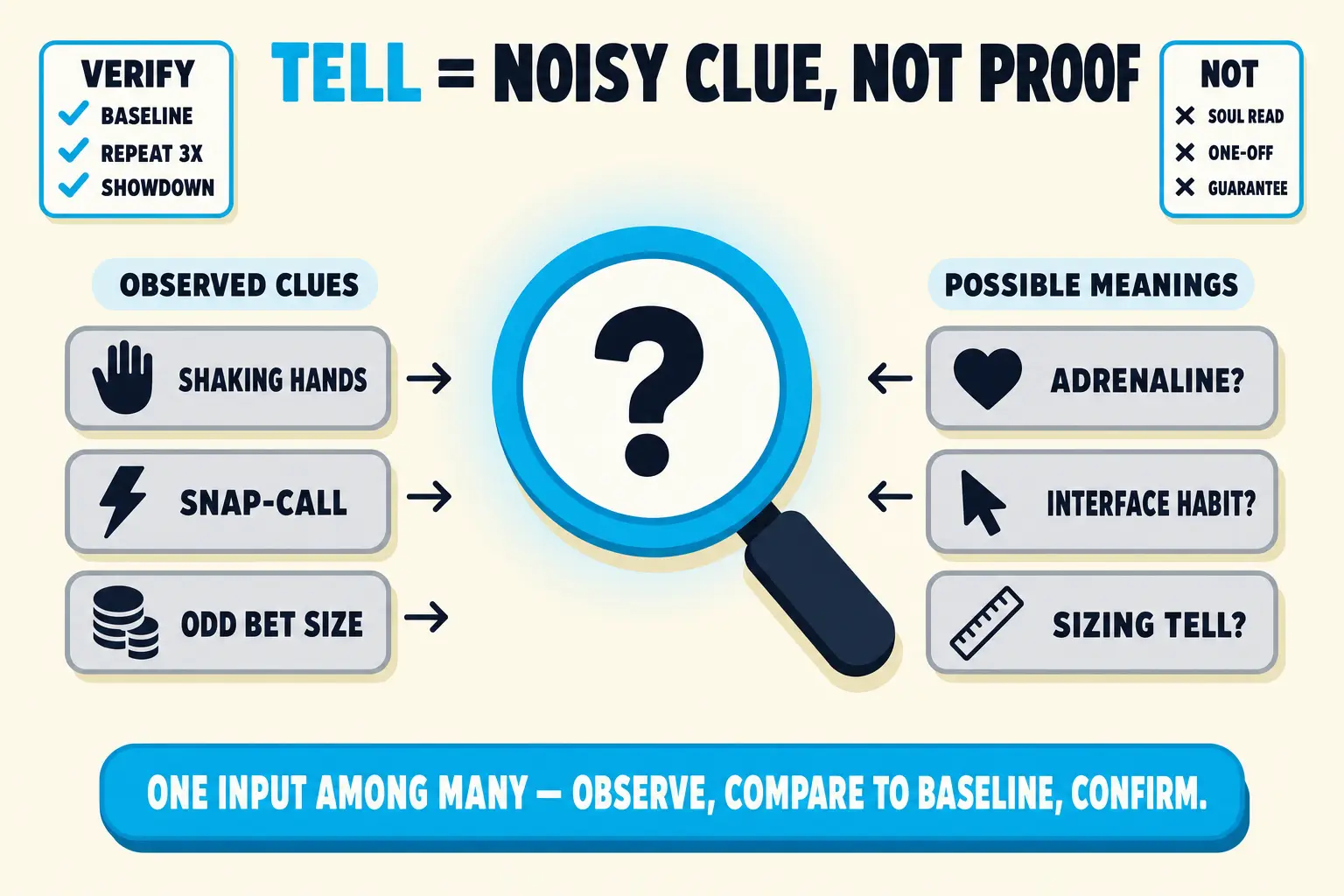
A tell is a physical, behavioral, timing, or betting cue that may reveal information about an opponent's hand strength, confidence, or decision process. Tells are noisy. Treat any single observation as a hypothesis until you have a baseline, repeated occurrences, and ideally a showdown that confirms the pattern.
Tell: a single noisy clue about an opponent
What a tell is
A tell is a cue from an opponent that may carry information about their hand strength, confidence, or decision process. The cue can be physical (shaking hands, posture shift, tightened jaw), behavioral (talking when they usually go quiet, reaching for chips before the action), timing-based (a snap-call, a long tank), or betting-based (a bet size that does not match their usual line). A tell is not proof. It is one input that, when stacked with other evidence, may shift the odds you assign to a range.
Related terms
- Player read: the broader inference about a specific opponent. A tell is one input into a read; a read is the running picture you build across many inputs.
- Table image: the perception other players have of you. Tells flow the same direction as a read; table image flows the opposite direction.
- Population tendency: a pattern that holds across the field, not specific to one opponent. A “snap-call from the big blind” can be a tell on one player, a population tendency across the pool, or both.
- Showdown and Showdown value: the only place a tell gets cleanly confirmed. If their cards never face up, a tell stays unproven.
- Bluff, Value bet, Bet sizing: the action categories tells most directly affect.
- HUD: the online substitute for live tells, summarizing betting-pattern cues into stats.
- TAG, LAG: archetype labels that frame what a “normal” baseline for a given opponent is likely to look like.
Tell vs neighboring concepts
Five concepts get blurred together. Each one points somewhere different.
| Concept | What it is | Direction | Confidence |
|---|---|---|---|
| Tell | A single observed cue about an opponent | Inward at one player | Low until verified |
| Player read | The running inference built from many cues | Inward at one player | Medium and growing |
| Table image | The picture opponents have of you | Outward, them about you | Medium and sticky |
| Population tendency | A pattern shared by the field | Aggregate, the whole pool | Stat-driven |
| Timing tell or sizing tell | A specific kind of tell | Inward at one player | Same low-until-verified bar |
Tells feed reads. A read is a tell that has been confirmed enough times to act on without flinching. Population tendency is the field-wide version of the same idea. Table image is what your opponents are doing to you in the same loop.
Why tells matter in real hands
A tell only matters when the next decision depends on it. If you already have a snap-call or a snap-fold, do not invent a tell to second-guess yourself.
Poker Skill’s lessons train those clear calls and folds first, as in Check-Fold, where two pair calls a bet and six-deuce with no pair or draw folds.
The spots where a small tell can move a decision:
- River bluff-catching with a medium hand. A confidence cue (steady hands, calm voice, no rush) on someone whose bluffs usually leak nerves shifts you toward folding. A nervous cue on a usually-calm player shifts you toward calling.
- Choosing a thin value-bet size. A snap-call habit on the previous street tells you the opponent will probably call the next bet too, so you size up.
- Deciding whether to triple-barrel. A bet sizing tell on the turn — they always pot when they are weak and capped — opens the door to a big river shove.
- Defending the big blind versus a regular. A timing pattern on their open (instant from late position, longer from middle) hints at which range you are facing.
A tell that has nothing to do with the spot in front of you is a curiosity, not a decision input.
How to verify a tell before you trust it
The big mistake players make is acting on the first observation. A tell is data, not a verdict. Three steps turn a hunch into something you can actually use.
- Get the player’s baseline first. How fast do they normally bet? How big is their usual c-bet? Where do they hold their hands when they are not in a hand? You cannot spot a deviation if you have no normal to deviate from.
- Want repeats. One snap-call on the river is noise. Three snap-calls in similar spots, all turning over middling pairs, is a pattern. Until then the cue is a candidate, not a tell.
- Confirm at showdown. The only place hidden cards get exposed is showdown. When their cards face up, ask whether the cue you saw earlier in the hand actually correlated with the strength they showed. No showdown, no confirmation.
A tell that fails any of these three steps is still useful. It tells you what to watch for next time. It just is not yet ready to drive a fold or a hero call.
Common confusion
Treating a tell as a verdict
The classic leak. You see one shaky hand, you call off your stack, they show you the nuts. A tell is a small probability shift, not a final answer. If your decision needed the tell to be 100% right to make sense, the decision was bad before the tell was even available.
Single-spot tells
Most cues that feel like tells in the moment are not. Shaking hands can mean adrenaline from a strong hand, adrenaline from a bluff, or three coffees and a draft beer. A long tank can be a difficult decision with a strong hand or a difficult decision with a marginal one. The cue is real. The interpretation is the noisy part.
Confusing tells with population tendencies
When everybody at the stake snap-calls a min-raise from the big blind, the snap-call is a population tendency, not a tell on the one player who just did it. Use population tendency for the default plan; use a tell to flag a player who deviates from it.
Online “tells” from the interface
A snap-call online can be a real timing tell. It can also be the interface, a pre-bet button, multi-tabling, or a disconnect. Treat online cues as lower-confidence than live cues by default and lean on bet sizing patterns and HUD-style stats more than on raw timing.
Generating tells from a single dramatic hand
Players latch onto whatever they saw in the last big pot and apply it forever. A villain who was nervous while running a bluff in a four-bet pot might be perfectly composed in a single-raised pot. Do not generalize across very different stakes of pressure on the same opponent.
Worked example
You are nine hands into a $1/$2 6-max cash game with a stranger seated to your left. The first big hand of the session, the stranger opens the cutoff and you flat the button with 6♠ 6♣. The flop is K♥ 9♣ 4♣. They c-bet half pot fast. You call. The turn is the 6♦. They check. You bet half pot. They tank for fifteen seconds, sigh, and call. The river is the 2♥. They check. You bet half pot. They tank again, almost the same length, then call. They show K♣ J♣ for top pair, missed flush. You drag the pot.
What just happened is data, not a tell yet. You have one observation: this player tanks before calling on the turn and the river with a strong-but-not-monster hand. Pencil it in.
Three orbits later, the same opponent opens hijack and you defend the big blind with A♠ 9♦. Flop A♣ 8♥ 5♥. They c-bet a third pot fast. You call. Turn 4♠. They bet two-thirds pot fast — no tank this time. You think. The earlier tank cue was on a check-call line; this is a fast lead on a turn after a small c-bet. The pattern is different enough that you do not lean on the earlier observation. You call cautiously.
Two more orbits and the same villain opens, you defend the blind, the turn comes around, and they tank for fifteen seconds and call your half-pot bet. River is a brick. They check. You bet half pot. They tank again, almost identical timing, and call. They show second pair.
Now you have three same-shape observations of the long pre-call tank correlating with a one-pair calling hand. The next time you see that tank in a similar spot, you can size up your river value bet because they are probably never folding a pair after that physical-tell-style tank. You still are not bluffing into the pattern. The tell is “they call wide here,” not “they fold to pressure.”
That is the lifecycle. One observation, one repeat under similar conditions, one showdown that lines up. After three of those, you have a working tell on this opponent for this exact line.
Practical use checklist
- Before you act on a cue, name it. “He sighed before calling” is too vague. “He sighed and physically pushed chips slowly across the line” is something you can compare to next time.
- Compare the cue to the player’s baseline, not your idea of normal.
- Wait for repeats. A single observation is a hypothesis.
- Lean on showdowns to confirm. No showdown means the tell stays unverified.
- Use the tell to size or to bluff-catch, not to pretend you have certainty.
- Online, downweight timing cues and lean on bet sizing patterns and stats.
FAQ
Are live tells useful at small stakes?
Yes. Recreational live players leak more than online players because they are not used to controlling their behavior at the table. The tells are also less consistent, so verification matters more. Treat what you see as low-confidence evidence and look for repeats.
Do online tells exist?
Yes, but the surface is different. Without faces or hands, the cues collapse to bet sizing, action speed, line consistency, and HUD stats. A snap-call is the most common online cue, and it is also the most contaminated by interface habits and multi-tabling. Bet sizing cues are usually higher-quality online than timing cues.
What is the difference between a tell and a player read?
A tell is one observation. A player read is the running inference you have built across many observations. A read is what a tell turns into after enough verified repeats. Reads drive plans; tells flag candidates.
Should I try to give off false tells?
Most players are not watching closely enough for a manufactured tell to land cleanly, and the cognitive cost of running one is high. Spend that energy on noticing your own real tells and dampening them. Controlling what you actually leak helps your decisions more than any deliberate fake.
How is a tell different from a population tendency?
A tell is about one player at this table. A population tendency is about the field at this stake. The same behavior (snap-calling a min-raise from the big blind) can be a population tendency across the pool and not a tell on any individual. When in doubt, default to the population read and only override it with a tell once you have repeats and a showdown.