


Table Image
Table image is the way opponents perceive your style based on what they have seen you do: hands shown at showdown, bet sizes, the speed of your actions, and how often you've recently entered or folded. It is opponent-facing perception, not your real strategy. Understanding the image you've built helps you predict how the table is likely to respond to your next bet, raise, or fold.
Table Image: what the table thinks you are
What table image means
Table image is the perception other players have of your style, built from the actions they have seen you take at this table. The inputs are visible: hands you have shown at showdown, the bet sizes you have used, how long you took to act, and the share of recent hands you have entered, folded, or contested. Table image is opponent-facing. It does not have to match your true strategy. A solid TAG can look like a calling station for forty minutes if every showdown they are dragged into goes the wrong way, and a wild player can look like a nit if their last three orbits were folds.
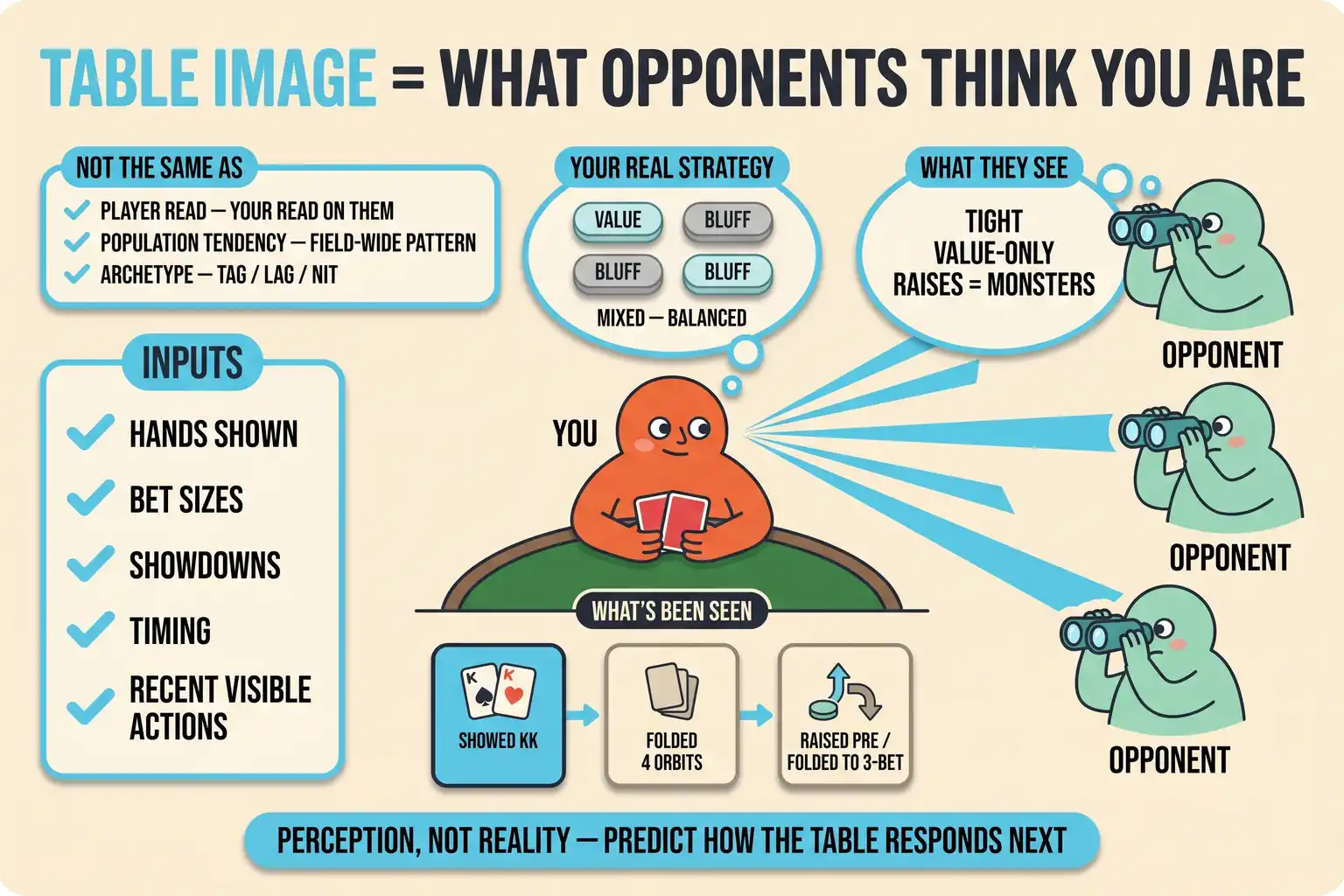
Related terms
- Player read: your read on a specific opponent (the inverse direction of table image).
- Population tendency: a pattern across the whole field, not specific to you or your table.
- TAG, LAG, Nit, Calling station: archetype labels opponents may snap your image to.
- Bluff and Value bet: the two action categories your image most directly affects.
- Showdown: the single biggest input into the image others are forming.
Table image vs neighboring concepts
The four labels around table image get mixed up often. Each one points in a different direction.
| Concept | Whose perception | About whom | Built from |
|---|---|---|---|
| Table image | Opponents’ perception | You | What they’ve seen you do at this table |
| Player read | Your perception | One specific opponent | What you’ve seen them do at this table |
| Population tendency | Aggregate perception | The field at this stake or pool | Many hands across many tables |
| Archetype label (TAG, LAG, nit, calling station) | A summary tag | A single player | Stat-band shorthand applied to a read |
Table image and player read run in opposite directions. The same actions feed both. If you are the only player at the table who has watched the seat-six villain triple-barrel into a paired board with seven-high, you have a player read on them. The rest of the table only knows seat six showed down a missed bluff. They have a table image of the same player, not a read.
Population tendency is wider still. It describes patterns the field shares regardless of who is at this table — for example, “low-stakes players overfold to river overbets.” Your table image is local. Your image at this table can drift far from the population in the same session.
How table image gets built
Opponents do not have access to your hole cards or your strategy. They build their image of you from a small list of visible signals.
- Hands you have shown at showdown. The biggest input. Showing a thin value bet with second pair, or showing a triple-barrel bluff that got called, both move the image hard.
- Bet sizes. Consistent half-pot c-bets read differently from frequent overbets, and very small probes (block bets) read differently again.
- Showdown frequency. A player who reaches showdown often is read as a calling type; a player who never does is read as a folder or a bluffer depending on who took the last bet.
- Timing. Snap-bets and snap-calls feel different from long tanks. Repeat patterns shape the image more than any single tank.
- Recent visible action density. Folding for four orbits and then raising looks tight. Raising five hands in a row looks loose.
- The two or three big pots they actually remember. Most players overweight the most recent and most dramatic hand they saw you in.
The image is sticky once formed. Players update slowly, and most update only after a showdown that contradicts the picture they had.
When table image matters most
Knowing the image you have built helps in any spot where the next decision depends on how the table will respond.
- Choosing a river bluff size after a runout that favors your range. A tight image gets more folds; a loose image gets called lighter.
- Deciding whether to thin-value-bet a medium hand. A loose-aggressive image gets paid wider.
- Three-betting a steal. A passive image makes the steal more likely to fold; a fighty image makes a four-bet more likely.
- Defending the big blind versus a regular who has watched you fold for an orbit. Their range to attack you widens.
- Sizing up after showing down a strong hand. Fresh tight image, room to bluff bigger.
- Sizing down after showing a missed bluff. Fresh loose image, lean on value bets and skip the next bluff.
It matters less when you are playing a stranger who has not been at the table long enough to form a picture, or when the pot you are deciding has no future-game weight (short-stacked all-in pots, for example).
Poker Skill’s lessons deal every hand fresh, with no history for an opponent to read, so they train the strategy underneath an image rather than the image itself.
Common confusion
Confusing table image with your real strategy
The whole point is the gap. Your real strategy can be a balanced TAG line; if the only hands the table has seen you show are bluffs, your image is loose-aggressive whether you like it or not. Plan your next move from how they will respond, not from what you actually are.
Confusing table image with a player read
Player read points outward at one opponent. Table image points inward at you, through their eyes. Keeping them straight matters because each one drives a different exploit. A read tells you which villain to thin-value-bet. An image tells you which size and line will get a fold.
Confusing table image with archetype labels
TAG, LAG, nit, and calling station are stat-band shorthand for a player’s overall style across many sessions. Your table image at this table can be very different from your archetype label. A long-term TAG can sit at a table for an hour with a loose image because every visible action of theirs has been wider than the average TAG line.
Treating image as static
Image moves every showdown. A single big shown hand can flip it. Re-check what the table has actually seen you do over the last twenty minutes before assuming the image you remember is still the image they have.
Worked example
You are in a 6-max $1/$2 cash game, fifty hands deep at the same table.
- Twenty minutes ago you showed K♠K♦ at showdown after value-betting all three streets. Three players still at the table saw it.
- You then folded for four straight orbits. Two opens you raised got folded around to you preflop, no postflop play.
- The last visible hand you played, you opened the cutoff, c-bet a Q♥ 7♣ 4♦ flop, double-barreled an offsuit ten on the turn, and the big blind folded.
You have not shown a missed bluff. You have not shown down a thin value hand. The table has seen one big premium and one barreling line that ended without a showdown. Your image right now reads tight and selective with a dose of postflop pressure.
Now you open the button with 6♣ 5♣ and the small blind, who saw all of those hands, three-bets you. The image you have built is not your strategy. Your underlying range is wide on the button and your defending plan is normal. But the small blind is using your image to widen their three-bet bluff range against you, because tight-imaged players fold preflop more than population. A flat-call to keep position is more attractive than a four-bet bluff in this exact spot, because a four-bet bluff fights against the image you’ve banked instead of using it.
Three orbits later you show down a 9♠ 9♣ that lost a small pot to A♠Q♦ on a queen-high board. You called turn, called river. You did not raise. The image just shifted. Now the same small blind sees a tight player who will call thin. The four-bet bluff stops being attractive and the thin value bet starts being attractive instead. Same player, different image, different plan.
Practical use checklist
- Track the two or three hands the table has actually seen you in. The rest is noise.
- Recheck your image after every showdown you took part in.
- Use a tight image to bluff bigger and fold less from the blinds.
- Use a loose image to value-bet thinner and skip the next planned bluff.
- Do not confuse your image with your strategy or your archetype.
FAQ
How is table image different from a player read?
Direction. A player read is your inference about an opponent. A table image is the table’s inference about you. The two run on the same kind of evidence, just pointed the opposite way.
How long does a table image last?
It lasts as long as the table remembers the action. At a table where most players have stayed for an hour, the image can hold for thirty to forty hands. New seats reset their share of the image to zero. A single big showdown can move the image faster than ten quiet hands can.
Does online play have a table image?
Yes, but the inputs shift. Without physical timing or body language, the visible signals collapse to bet sizes, action speed (snap vs. tank), and the showdowns that get hand-history-replayed. Online image moves faster because tables turn over faster, and slower because most pots end without a showdown to anchor the picture.