


Calling Station
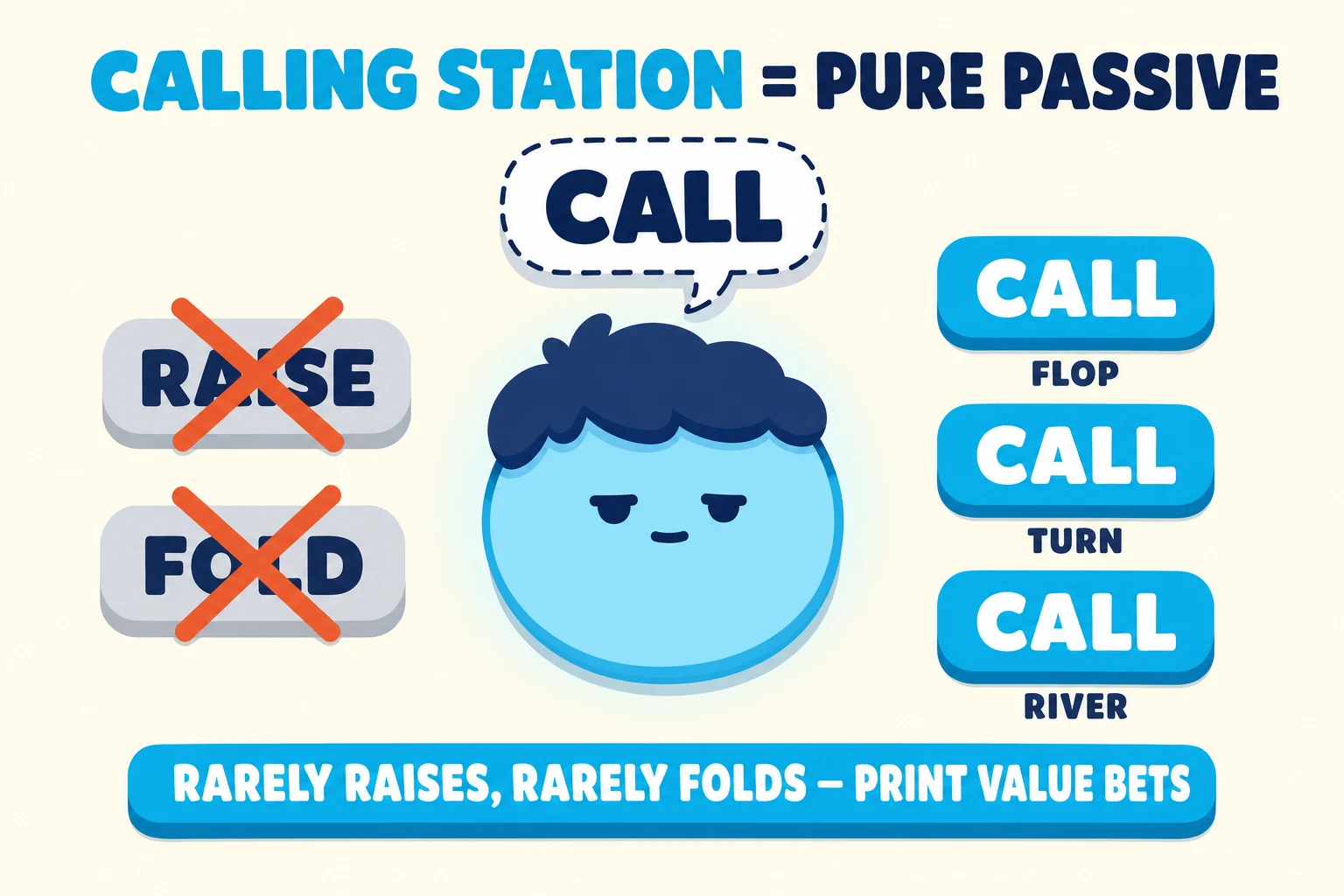
A calling station is a highly passive player who calls bets frequently instead of raising or folding. They rarely bluff (a bluff is a bet with a weak hand meant to make opponents fold) and often hang on to marginal holdings. Their extreme passivity hands initiative to others, letting opponents extract value from strong and mediocre hands.

Practice this in Poker Skill. Value betting into hands that won’t fold is a drill in the betting lessons, where K♣ 8♣ bets on 8♥ 4♦ 2♠: smaller pairs and stubborn high cards still call on a board that low.
Get the free appCalling station
What a calling station is
A calling station is a passive player who calls bets often instead of raising or folding. They rarely bluff, they hang on to marginal holdings, and their passivity hands initiative to whoever is willing to keep firing. Strong and mediocre value hands all play better against them than they would against an average opponent.
For example, in a $1/$2 cash game a calling station might call a preflop raise with K9, call a continuation bet on a J-7-2 flop, and then call a river bet on a paired board, all without raising or folding even when they are obviously behind.
How to spot a calling station quickly
A few orbits is usually enough.
- Habitual calling: they call far more often than they raise. Flat-calling your open with a wide range is the loudest tell.
- No aggression: they check and call later streets instead of firing bluffs or check-raising. Aggression frequency stays near zero.
- Rare folds to value bets: they call down weak pairs and draws rather than folding.
A six-hand snapshot: they call three flop bets, check two turns, and call two rivers. No raise, no fold to a value bet, no light bluff. That’s the profile.
Key characteristics and table effects
- Passive approach: checks and calls dominate. Bluffs lose money against them because the fold equity isn’t there.
- Predictability: a flop call usually means some kind of holding, not a pure float, because they don’t pure-float.
- Low fold equity: with bluffs out of the picture, hands that are only modestly ahead are worth value bets you wouldn’t make against an average opponent.
When a calling station sits to your left, you can’t easily push weaker players off pots through them. Pivot to value-heavy lines.
Strategic implications in No-Limit Hold’em
No-limit lets you pick any size up to your stack, which amplifies the calling station’s leak. Big value bets extract bigger losses because they so rarely fold.
- Value betting (betting when you expect to be ahead and get paid) becomes the main weapon.
- Thin value bets, small-to-medium bets with a marginal edge, often pay because they call almost everything.
- Bluffing into them is usually unprofitable, and multi-street bluffs are worse, since each call burns more of your bluff budget.
For example, with T♠T♦ on A♣9♣3♦, a calling station will often call a half-pot turn bet and a two-thirds-pot river bet. Those sizes print against the wide range they show up with.
How to exploit a calling station
- Lean into value: bet strong and medium-strength hands instead of slowing down for “pot control.”
- Size to extract: half to three-quarters pot is the workhorse range. Tiny bets invite odd calls; very large overbets sometimes break the spell. Test occasionally.
- Cut bluffs: skip multi-street bluffs. Save bluffs for opponents who actually fold.
- Keep lines simple: straightforward value lines. Skip fancy check-raises and tricky turns.
- Stay disciplined: don’t stack off with marginal hands just because they call. They also do not fold their best hands.
Quick checklist
- Track calls, raises, and folds to confirm the calling-station profile.
- Prioritize value bets over bluffs; size to extract, not to intimidate.
- Don’t bluff into them; reserve bluffs for other opponents.
- Exploit predictability: simplify lines and focus on thin value on later streets.
- Beware overcommitting with marginal hands despite their calling tendencies.