


Calling Station Profile
A calling-station profile is the evidence bundle (notes, HUD numbers, and showdown receipts) that earns an opponent the calling-station label: high VPIP, low aggression, low fold-to-cbet, high WTSD, and a habit of paying off across streets with marginal hands. The profile is the receipts; the label is what you do with them.
Calling Station Profile
What a calling-station profile is
A calling-station profile is the evidence bundle that justifies tagging an opponent as a calling station. It is a small dossier built from notes, HUD numbers, and showdown receipts: high entries, low aggression, reluctance to fold once they see a flop, and a habit of arriving at showdown with marginal holdings. The profile is the receipts. The label is what you do with the receipts. One loose call does not earn the tag; the same shape, repeated across streets and across hands, does.
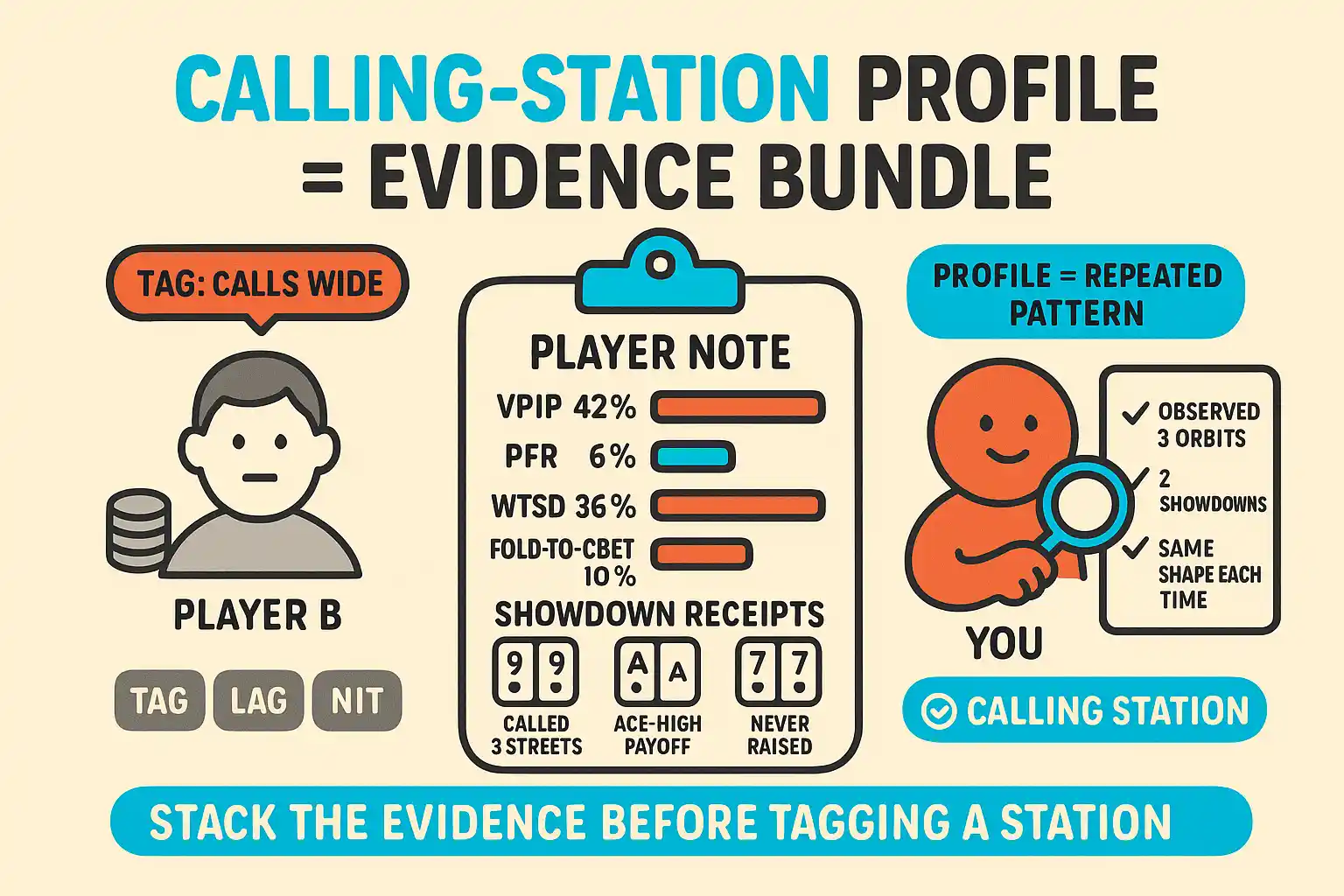
Profile vs the calling-station label
People use “calling station” two different ways: as a quick label and as the receipts behind it. The profile is the second sense. The distinction matters because the label is cheap to apply and easy to misapply.
- The calling station is the archetype name. The profile is the evidence bundle that justifies attaching the name to a specific opponent.
- A sticky caller overlaps but is narrower. Sticky callers refuse to fold once involved. A calling-station profile is broader: loose entries, low aggression, low fold-to-cbet, and high showdown frequency together.
- A player read is the general process of turning observation into a usable note. The calling-station profile is one specific output of that process.
- A population tendency is a habit shared across the field. A calling-station profile is one opponent.
What goes into the profile
Treat the profile as a small dossier with two halves: the stat block and the behavioral receipts. Either half alone is half a profile.
Stat block, with the usual sample-size caveats:
- VPIP high. They enter pots wide.
- PFR low. They prefer to call rather than raise preflop.
- Aggression factor low. Postflop, they call far more than they bet or raise.
- WTSD high. They reach showdown often, even after seeing the flop.
- Fold-to-cbet low. Once they have called preflop and seen a flop, they keep calling.
Behavioral receipts, watched directly at the table:
- Calls flop, turn, and river with second pair, weak top pair, or a marginal draw.
- Rarely 3-bets preflop. Rarely check-raises postflop.
- Shows down weak holdings and is willing to lose chips with them rather than fold.
Neither half is a verdict by itself. A 42% VPIP without showdown receipts could be a one-session heater, tilt, or a short sample. Three loose showdowns without a stat baseline could be variance. The profile is the overlap.
When the profile is real
Tag a calling-station profile only after you have seen the same shape across enough hands that variance is unlikely to be the explanation. In a 6-max cash session at roughly 100bb deep, a working bar is two or three orbits of postflop play with at least one or two showdowns confirming the loose-passive pattern. In a tournament, account for stack depth and ICM pressure shifting how anyone plays.
The profile is also not permanent. Players tilt and loosen up further. Players study and tighten up. Stack depth changes everything. Re-check the profile next session before relying on it.
Example: building the note
Three orbits in, you watch Player B at a 6-max cash table:
- UTG limp, then a flat call against a button 3-bet with a wide range. Showdown a hand later: K9 offsuit.
- Calls a half-pot flop cbet on Q-7-3 with second pair, calls a turn cbet, calls a small river bet. Shown a better hand. Loses the pot.
- Three hands later, calls flop and turn with ace-high and a backdoor draw. River bricks. Calls a small bet. Shown top pair.
- Across the same orbits, never 3-bets and never check-raises.
That is a calling-station profile. The note in your tracker reads something like: “calls flop and turn with marginal pairs and ace-high; rarely raises; rarely folds to small or medium bets; willing to show down weak hands.” The next time the spot comes up, you act on the note rather than guessing.
How to use the profile in real hands
The profile is most useful for two adjustments:
- Choose clearer value-heavy lines. Bet your made hands across streets at sizes the profile reliably calls. Stations call thin. They do not punish thin value the way a balanced regular does.
- Reduce unsupported bluffs. The profile predicts low fold equity, so multi-street bluffs without strong equity backups are weak choices. Save bluffs for spots where you have a real draw or a meaningful blocker, and prefer single-street pressure over three-barrel lines.
The bluffs worth keeping have outs behind them, and Poker Skill’s C-Bet Capstone bets A♠ Q♠ big on J♠ 10♠ 4♣ for exactly that reason: fold equity now, outs when called.
Two smaller adjustments help too:
- Trust your bluff-catchers a little more on later streets. The profile says they show up with weak holdings, so a medium-strength hand that beats most of their value range is a real bluff-catch.
- Do not overcommit on marginal hands just because they call light. A weak ace is still a weak ace, and stations occasionally show up with a real hand. The profile improves your line selection; it does not turn second pair into a stack-off.
Common mistakes when building the profile
- Tagging from one loose call. One spot proves nothing. The same shape, across streets and across hands, is the bar.
- Logging VPIP without WTSD. A wide preflop range with normal postflop play is a different profile from a wide preflop range that drags every flop to showdown.
- Mixing profiles. A station and a sticky caller are related but not identical. So is a LAG, who shares the loose entry but has high aggression rather than low. Pick the label whose receipts you actually have.
- Treating the profile as durable. Profiles drift between sessions and as stacks change. Re-confirm before relying on it again.
- Using the tag as license to fire huge bluffs to “make them fold this once.” A station occasionally folds. The profile says do not lean on it.
Calling-station profile vs other archetype profiles
Most player profiles compress into two axes: how often someone enters a pot, and how often they bet or raise versus call or check.
- TAG is tight and aggressive. The opposite of a station on both axes.
- LAG is loose and aggressive. Same loose entries as a station, opposite postflop posture.
- Nit is tight and passive. Opposite entry, similar passivity once involved (though for very different reasons).
- Calling station is loose and passive. Wide entries, low aggression, high WTSD, low fold-to-cbet.
If your note for an opponent does not pin them on both axes with receipts, the profile is incomplete.
Quick checklist for tagging a calling-station profile
- See multiple loose calls across multiple streets, not just preflop.
- Confirm with at least one or two showdowns of marginal hands.
- Cross-check the stat block: high VPIP and WTSD, low aggression factor, low fold-to-cbet.
- Note the stake, format, and stack depth where you saw it.
- Plan two adjustments before the next session: clearer value-heavy lines, fewer unsupported bluffs.
- Re-confirm the profile next session. Do not assume it is permanent.