


Sticky Caller
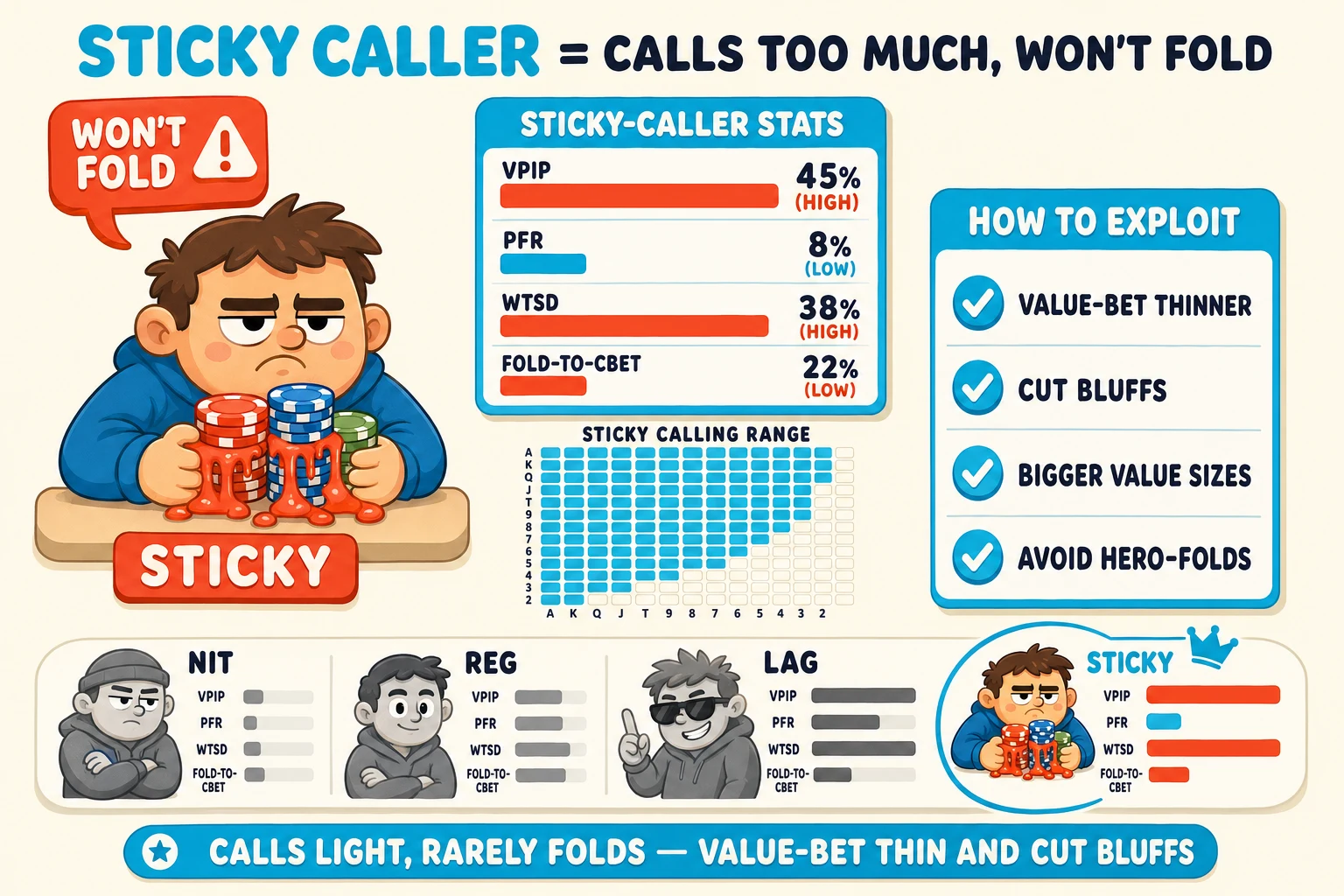
An opponent who calls bets too freely and rarely folds under pressure. They pay off with second-best hands, so value-bet wider, bluff less, and let position do the work.

Practice this in Poker Skill. The Value Betting lesson practices the wider value bet, with top pair and a king kicker betting even on a paired board because worse queens still pay it off.
Get the free appSticky Caller - How to Spot and Exploit Players Who Won’t Fold
What is a Sticky Caller?
A sticky caller habitually calls bets and rarely folds under pressure. In No-Limit Hold’em, where any chip can be at risk on any street, that tendency leaks chips fast and becomes one of the easier player types to exploit. Sticky callers often pay off with second-best hands, so the right adjustment is wider value bets, fewer bluffs, and bigger sizing on the streets where they tend to call anyway.
Example: You hold Q♠Q♦ on K♣9♠3♦. A sticky caller will often call your river bet with Kx or a weak pair, allowing you to collect value with the better hand.
Note: “Value-bet” means betting expecting worse hands to call. “Fold equity” means the chance your bet makes opponents fold.
How to Recognize a Sticky Caller at the Table
Watch for fast reads and repeated patterns, not one-off actions.
- Frequent calls across streets. They call flop, turn, and river with medium-strength holdings.
- Shows marginal hands at showdown or calls big bets despite missing the board.
- Reluctant to fold to pressure, even when the board and betting line suggest they are behind.
Example read: Over three hands, an opponent calls a large turn bet with no pair and later shows a single pair. That pattern signals they’ll pay to see more cards.
Value-Betting Strategy vs Sticky Callers
Shift toward value-betting when you face a sticky caller.
- Bet for value more often with made hands and strong marginals they will call.
- Build bigger pots with clear winners, since sticky callers tend to pay off rather than fold.
- Keep your betting range heavy on hands that can legitimately reach showdown to avoid being called down by worse.
Example line: You flop top pair with a good kicker. Bet the flop and turn for value instead of checking to induce bluffs.
When and Why to Avoid Bluffing
Sticky callers reduce your fold equity, making bluffs less effective and more costly.
- Reduce bluff frequency; they’re unlikely to fold to pressure.
- Bluff only with real extra equity, backdoor draws or blockers that improve your showdown chances.
- Prefer single-street, low-commitment bluffs when fold equity might still exist.
Example: If a sticky caller routinely calls small river bets, avoid large river bluffs; they’ll likely call you down.
Bet Sizing and Pot Control Against Sticky Callers
Adjust sizes to extract value without overcommitting.
- Size bets large enough to be called by worse hands, but avoid committing with marginal holdings.
- Don’t bloat the pot with one-pair hands unless you’re ready to commit; escalate pot size with clear equity advantage.
- Remember No-Limit rules: any bet can equal a stack, so careless sizing destroys otherwise good lines.
Example: With two pair on a draw-heavy board, build the pot. With a single pair and uncertain reads, keep the pot manageable.
Using Position to Exploit Sticky Callers
Position is one of your biggest advantages; use it to control pots and extract value.
- Acting last lets you control pot size and apply pressure based on their calling tendencies.
- In position, favor straightforward value lines and extract calls on favorable runouts.
- Out of position, tighten your value range and avoid large pots with marginal holdings.
Example: On the button, bet thin for value into a sticky caller and use their repeated calls to extract more across streets.
Quick checklist
- Identify sticky callers by repeated calls and reluctance to fold.
- Default to value betting and reduce bluff frequency.
- Use position and careful bet sizing to extract without overcommitting.