


Straddle
A voluntary blind raise posted before cards are dealt, almost always twice the big blind from Under the Gun. Functions as a third blind, doubles the effective stakes, and the player to the straddler's left acts first preflop.
Straddle: a voluntary third blind in live cash
What a straddle is
A straddle is a voluntary blind raise posted before cards are dealt, almost always twice the big blind, almost always from Under the Gun. It functions as a third blind and effectively doubles the stakes of the hand. The straddler keeps a live option to raise when action returns to them, and the player to the straddler’s left acts first preflop. Straddles are mostly a live cash phenomenon, and house rules differ on whether they are allowed and which seats can post one.
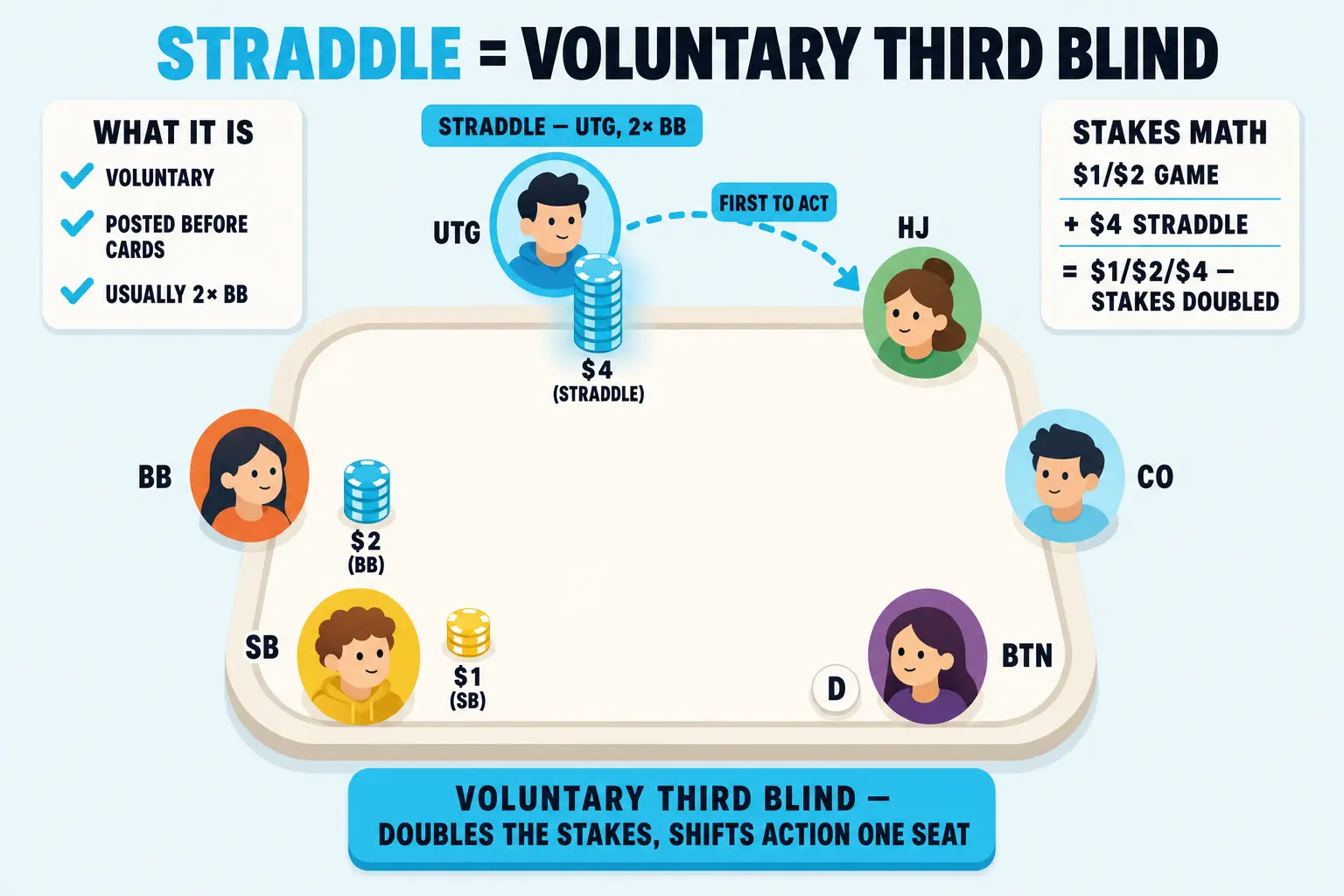
The defining traits are simple: voluntary (the straddler chooses to post), blind (chips go in before any cards are dealt), and live (the straddler can raise when action returns). In a $1/$2 game, an UTG straddler posts $4. The hand now plays as a $1/$2/$4 game for that one hand, with $7 of forced money already in the pot before anyone looks at a card.
Straddle variants: UTG, Mississippi, and button
The most common variant is the UTG straddle, posted by the player immediately to the left of the big blind. Some rooms also allow a Mississippi straddle, which can be posted from any seat and most often from the button. A button straddle is the specific button-seat case of the Mississippi straddle.
| Variant | Where it’s posted | First to act preflop | Last to act preflop |
|---|---|---|---|
| UTG straddle | Seat left of the big blind | Seat left of the straddler | Straddler |
| Mississippi straddle | Any seat (room-dependent) | Seat left of the straddler | Straddler |
| Button straddle | The button | Small blind | Button (the straddler) |
House rules are not universal. Some rooms allow only UTG straddles, some allow Mississippi and button straddles, some forbid straddles entirely. Most online apps, including the Poker Skill practice surface, do not offer a straddle action at all. Ask the floor or read the room’s posted rules before assuming a variant is allowed.
How a straddle doubles the stakes
An UTG straddle works as a third blind that more than doubles the stakes. The math is direct. In a $1/$2 cash game with a $4 UTG straddle:
- Forced money before any voluntary action: $1 (SB) + $2 (BB) + $4 (straddle) = $7.
- Without a straddle that figure would be $3.
- A standard $200 buy-in at $1/$2 is 100 big blinds. With the straddle on, that same $200 plays at the $4 straddle as a 50-straddle-blind stack.
Effective stack depth measured in the new “big blind” (the straddle) is roughly half what it was. Most players miss that part. The doubled stakes change the stack-to-pot ratio on every street, push more hands into commitment territory, and turn the average 100bb cash spot into something closer to a tournament-depth decision.
How preflop action order changes
With an UTG straddle on, the betting order shifts one seat clockwise. The seat immediately to the straddler’s left is now first to act preflop. Action proceeds clockwise from there, around to the small blind, the big blind, and finally back to the straddler.
Because the straddle is live, the straddler is not yet committed at $4. They get last action on the first betting round and can raise if they choose. That is the same option the big blind normally has, shifted one seat earlier.
A few practical consequences:
- The original UTG seat is no longer first to act in a straddled hand. The straddler took that obligation.
- The straddler can check their option if no one raises, the same way a big blind does in a limped pot.
- In a Mississippi or button straddle, the rules flip further. The small blind acts first, and the button straddler waits to act last preflop.
How to adjust your ranges when a straddle is on
The instinct to “loosen up because there’s more dead money” is the wrong instinct in straddled pots. The doubled stakes mean your effective stack is shallower in the relevant unit, the SPR on every street is lower, and post-flop mistakes are bigger relative to your starting stack.
Reasonable adjustments at a 100bb cash buy-in:
- Tighten your opening range from every seat that is not the straddler. The pot odds look attractive, but the position-out-of-position penalty is the same and stacks are shallower.
- Size your opens in straddle-blinds, not original-big-blinds. Most rooms treat the straddle as the new big blind for raise-sizing rules. A standard 3x open is 3x the straddle, not 3x the original BB.
- Defend the original blinds tighter, not wider. The straddle sits between you and the rest of the table; a raise behind the straddle is already a raise into a doubled pot.
- Don’t reflexively 3-bet the straddler. A live straddler often has a wider preflop range than UTG, but they get last action and the implied odds of position carry through to the flop.
Poker Skill’s raise-or-fold lessons teach the unstraddled version of these ranges, six-handed at 100 big blinds, which is the starting point item 1 tightens.
Common mistakes with and against the straddle
- Straddling without a plan. The most common amateur pattern is to straddle and then iso-raise a limped field with a wide range. Regulars see it coming and let the straddler bloat pots out of position.
- Treating doubled stakes like normal stakes. A 100bb cash buy-in plays as 50 straddle-blinds. Players who keep stacking off in 100bb-cash spots often commit too light at the new SPR.
- Defending the original small blind and big blind too wide. Extra dead money in the middle is real, but you are still out of position to several seats and the straddle has already squeezed your stack-depth math.
- Assuming a universal house rule. UTG straddle in one room does not mean Mississippi straddle in the next. Ask the floor before posting.
Quick checklist
- A straddle is a voluntary blind raise posted before cards are dealt, almost always 2x the big blind from UTG.
- It works as a third blind, doubles the stakes, and roughly halves your effective stack in straddle-blinds.
- The seat to the left of the straddle acts first preflop; the straddler keeps last action and a live raise option.
- House rules vary. Confirm whether straddles are allowed and which seats can post before sitting down.
- Tighten ranges in non-straddle seats and size your opens in straddle-blinds rather than original-big-blinds.