


Open-Raise
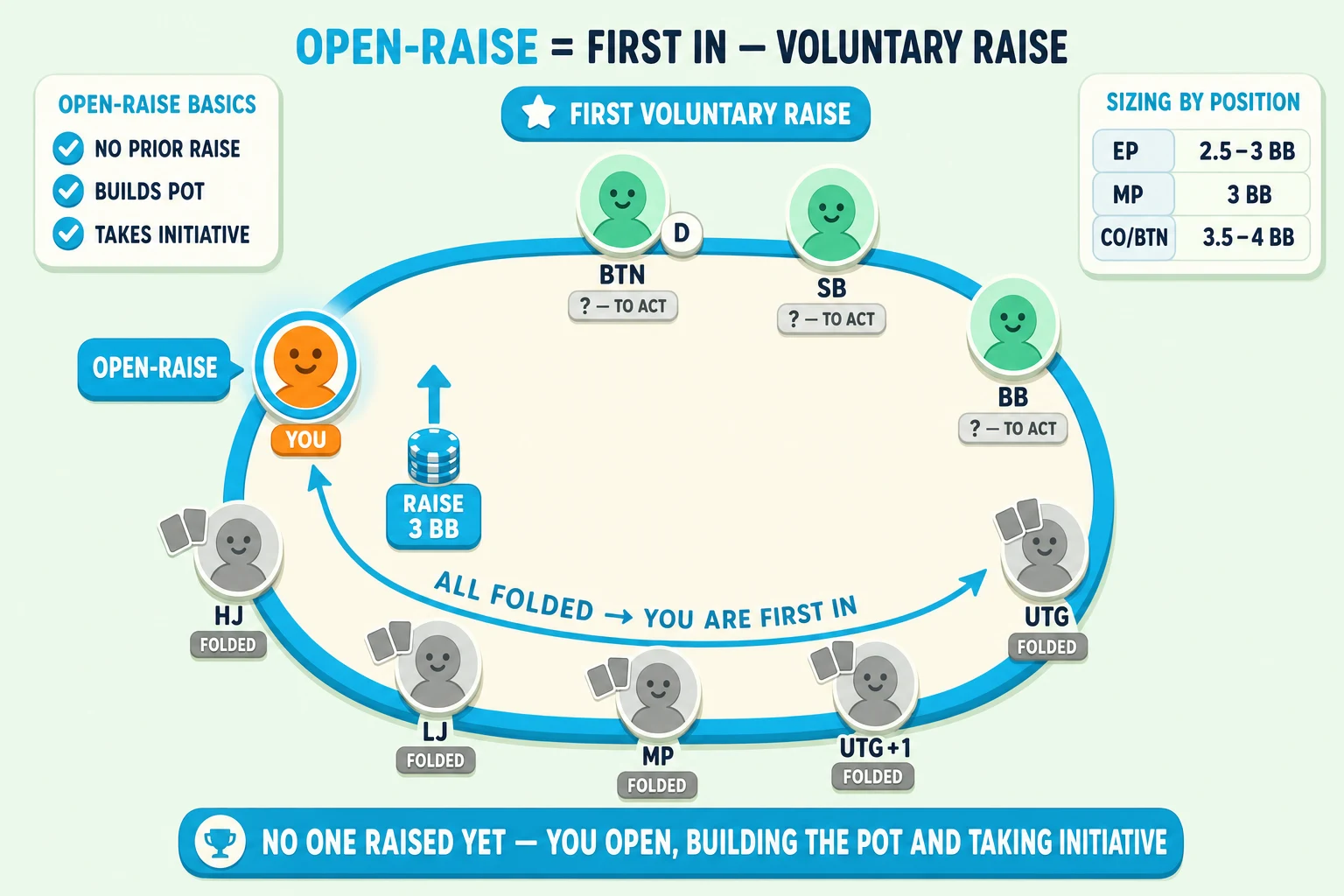
An open-raise is the first voluntary pre-flop raise after the blinds are posted, made when everyone before you has folded. It builds the pot, seizes initiative, and shapes how many opponents you face.
Practice this in Poker Skill. When the action folds to you on the button in the Button: Raise or Fold lesson, 5♠ 5♥ is an open-raise, since pocket pairs are opens from that seat.
Get the free appOpen-Raise in No-Limit Texas Hold’em
What an open-raise is
An open-raise is a raise made first in, when everyone before you has folded preflop. It builds the pot, seizes initiative and shapes how many opponents you face.
Example: In a $1/$2 game, under-the-gun opens to 3× BB ($6), making an open-raise. That bet builds the pot and reveals information about the raiser’s range.
Open-raising also defines your pre-flop range and game plan. Consistent opens help build the pot with premium hands, narrow the field and maintain ambiguity between value hands and bluffs.
Open-raise sizing
Start from one default size. Open sizes are quoted in big blinds (BB), the larger posted forced bet.
- Standard baseline: about 3× BB for open-raises.
- Early position (EP): about 3× BB.
- Late position (LP), near the Button: the same size or a little smaller, because you will usually play the pot in position.
Why keep sizing consistent
Keep open-raise sizes consistent across hand strengths to avoid giving away information. If you vary raise size by strength, opponents can deduce holdings and exploit you. Consistency preserves ambiguity between value hands and bluffs, making your strategy harder to counter.
Constructing your open-raise range by position
Build tighter ranges in early seats and widen them later.
- Early position: open the tightest range, built from pairs, strong aces, broadways and a few suited connectors.
- Middle and late positions: add more suited cards, connectors and hands with post-flop playability.
- Prioritize suitedness and connectedness when widening ranges; those hands play better post-flop and realize equity more often.
Example: From EP open AK, AQ and every pocket pair; on the Button add KJo, 87s and smaller suited aces. T♠ T♥ and A♥ Q♥ open under the gun in Poker Skill’s seat lessons, and from the cutoff A♦ 9♦ and K♠ Q♦ join them.
Adjusting open-raises to table dynamics and stack sizes
Adapt sizing to table tendencies and stack depths.
- If your opens attract too many callers, increase size to thin the field. If opponents fold too often, decrease size to steal the blinds more cheaply.
- With short stacks, open a little smaller, around 2.7× BB at 18-25 BB effective, because stealing the blinds matters more as stacks shrink.
- Against weak or unfamiliar opponents, occasional non-standard sizes can induce mistakes. Use these exploitatively, not as a habit.
Tactical reminders for effective open-raising
- Set your default size before selecting hands.
- Keep sizing consistent across strengths to avoid leaking information.
- Deviate when table dynamics or stack sizes demand it.
- Expand your opening range toward the Button; tighten in early seats.
Quick checklist
- Keep default open-raise sizes around 3×, no larger in late position than early.
- Use the same size for different hand strengths to avoid giving information away.
- Widen ranges toward the Button; tighten in early seats.
- Increase sizing if too many callers; decrease if everyone folds too often.
- Open a little smaller when stacks are short (around 2.7× at 18-25 BB effective).