


Big Blind (BB)
The forced bet posted two seats left of the dealer button, and the chip-stack unit you measure your stack in. The BB acts last preflop and defends widely.
Practice this in Poker Skill. Even against a tight under-the-gun raise, you 3-bet A♠ Q♠ from the big blind in the Big Blind vs UTG Open lesson, because a big suited ace has the high-card strength to pressure a tight range.
Get the free appBig Blind (BB) - No-Limit Texas Hold’em
What the Big Blind Is
The Big Blind (BB) is a mandatory bet posted by the player two seats left of the dealer button. It is typically twice the size of the Small Blind (SB). The BB seeds the pot and stimulates action. It also establishes a baseline value for every hand in cash games and tournaments.
BB as a bet size
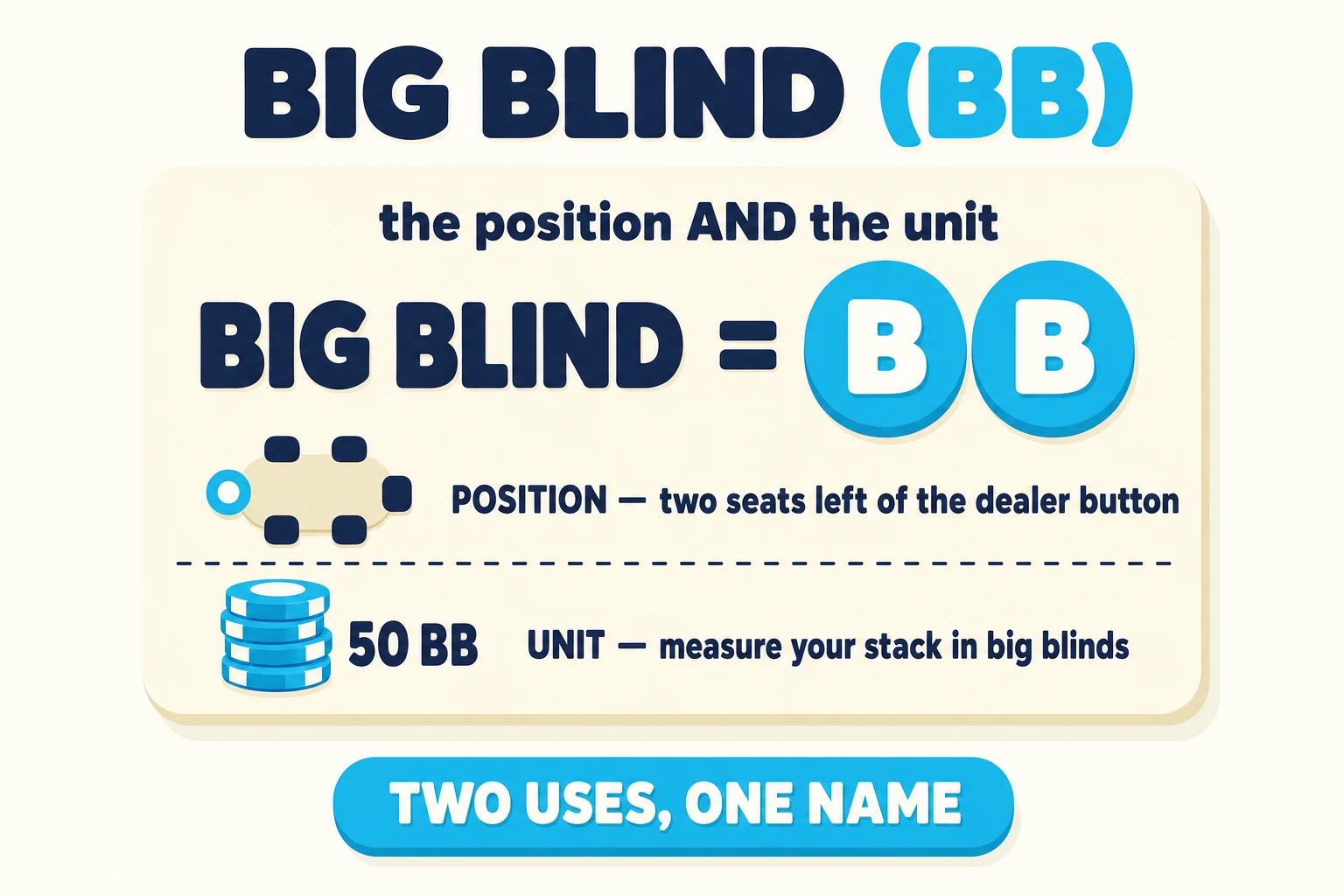
The seat is only half of what BB means. The other half is bb as a unit: the table’s baseline bet and the number players count stacks and raises in. A $200 stack at $1/$2 and a $500 stack at $2/$5 are both 100bb, so the same decisions carry from one game to the other without being relearned in a new currency.
Raise sizes read the same way. A 3bb raise means a raise to three times the big blind, which is $6 at $1/$2 and $15 at $2/$5. Poker books treat about 3bb as the standard opening raise when stacks are deep, with some players opening 2.5bb and dropping toward 2bb once stacks get short. Hand histories, coaching notes and stack displays all count in blinds for the same reason: the number keeps its meaning when the stakes change.
| Blind level | 1bb | 20bb (short stack) | 100bb (full buy-in) |
|---|---|---|---|
| $1/$2 | $2 | $40 | $200 |
| $2/$5 | $5 | $100 | $500 |
| $5/$10 | $10 | $200 | $1,000 |
For the forced bet itself and the seats around it, see how blinds work, the big blind position and the small blind beside it.
Pre-flop Position and Immediate Duties
The BB acts last in the pre-flop betting round, so you see opponents’ actions before deciding. That positional advantage helps you judge whether to call, fold or re-raise. Being invested in the pot creates a defensive duty to protect the blind and extra risk when facing raises.
A simple decision process from the BB:
- Note the opener’s seat and stealing frequency.
- Weigh hand equity and stack depth: strong hands and deep stacks favor 3-betting; marginal holdings may call or fold.
- Decide: fold if dominated, call to realize equity, or re-raise to punish wide raises.
Example: A cutoff open often contains a wide range. Holding A-7 suited in the BB, you might defend rather than fold because the hand fares reasonably well against a wide opener and you already have chips in the pot.
How Wide to Defend from the Big Blind
BB defenders commonly call or raise with a wide spectrum of hands; in some situations players defend up to about 75%. That does not mean calling with junk. Defense width should tighten or widen based on the opener’s position and table dynamics.
Guidelines:
- Versus early-position openers, tighten your defense; they open stronger ranges.
- Versus late-position steals (cutoff/button), widen your defense to prevent easy blind steals.
- Avoid overcommitting with hands that can’t realize equity or are heavily dominated.
Example: Defending widely against a button open is often correct; folding more to a UTG raise usually is too.
Post-flop Play and BB Defense
After the flop, adapt to bet sizes and opponent tendencies. A continuation bet (c-bet) is when the pre-flop raiser bets the flop regardless of flop strength. From the BB you can check, call, raise or fold depending on board texture and how your range matches the opponent’s range.
Practical approach:
- On dry boards where your range contains stronger hands, consider check-calling or check-raising.
- On coordinated, draw-heavy boards, be cautious with single-paired or weak holdings; fold more often unless you have real equity behind the call.
- Use a mixed approach (sometimes calling, sometimes raising) to remain hard to exploit; this mirrors game theory optimal (GTO) balance by randomizing choices.
Example: Facing a small c-bet on K-7-2 rainbow with a medium pocket pair, a call often makes sense to see the turn. On J-T-9 rainbow, raise with strong draws and fold thin single-pair hands.
Tournament Effects: Big Blinds as a Strategic Unit
In tournaments, blinds increase over time, changing how valuable the BB is and forcing strategic adjustments. Players measure stacks in big blinds to standardize decisions. Stack depth in BBs helps decide whether to play post-flop or to shove (all-in).
As the blinds rise:
- Shorter stacks (fewer BBs) move toward shove-or-fold play, and the shoving range gets wider as the stack shrinks.
- Deeper stacks allow more post-flop play and wider defenses.
- Reassess ranges and aggression as blind levels change to manage risk and exploit opponents.
Quick checklist
- The BB is a mandatory bet posted two seats left of the dealer before cards are dealt.
- It is typically twice the Small Blind and ensures there is always value in the pot.
- You act last pre-flop, but you are already invested. Factor that into calls, folds, and raises.
- Defend broadly (sometimes up to ~75%) but avoid overcommitting with weak hands.
- In tournaments, track your stack in big blinds and adjust play as blinds increase.
FAQ
What does bb mean in poker?
BB stands for big blind. The letters do two jobs. They name the seat two to the left of the dealer button that posts the bigger forced bet. They also name the unit the table measures stacks and bets in, so a $400 stack at $2/$5 is 80bb.
What is a bb bet?
A bet described in bb is a bet measured in big blinds instead of chips. A 3bb open at $1/$2 is a raise to $6. The same 3bb open at $2/$5 is a raise to $15. The number stays the same when the stakes change, which is the point of it.
Why are stacks measured in big blinds?
Because the big blind is the table’s baseline bet, so counting in blinds tells you what a stack can actually do. A $200 stack means nothing on its own. Saying 100bb tells you how many standard raises fit inside it and whether a shove is a real threat.
How much is 100bb?
One hundred times the big blind, which is the usual full buy-in at a cash table. That is $200 at $1/$2, $500 at $2/$5 and $1,000 at $5/$10. Tournament stacks get quoted the same way. The number drops as the blind level climbs.
Counting a raise in big blinds is also how you price a defence from the blind itself: big blind defense works through what each open size costs you.