


Dominated
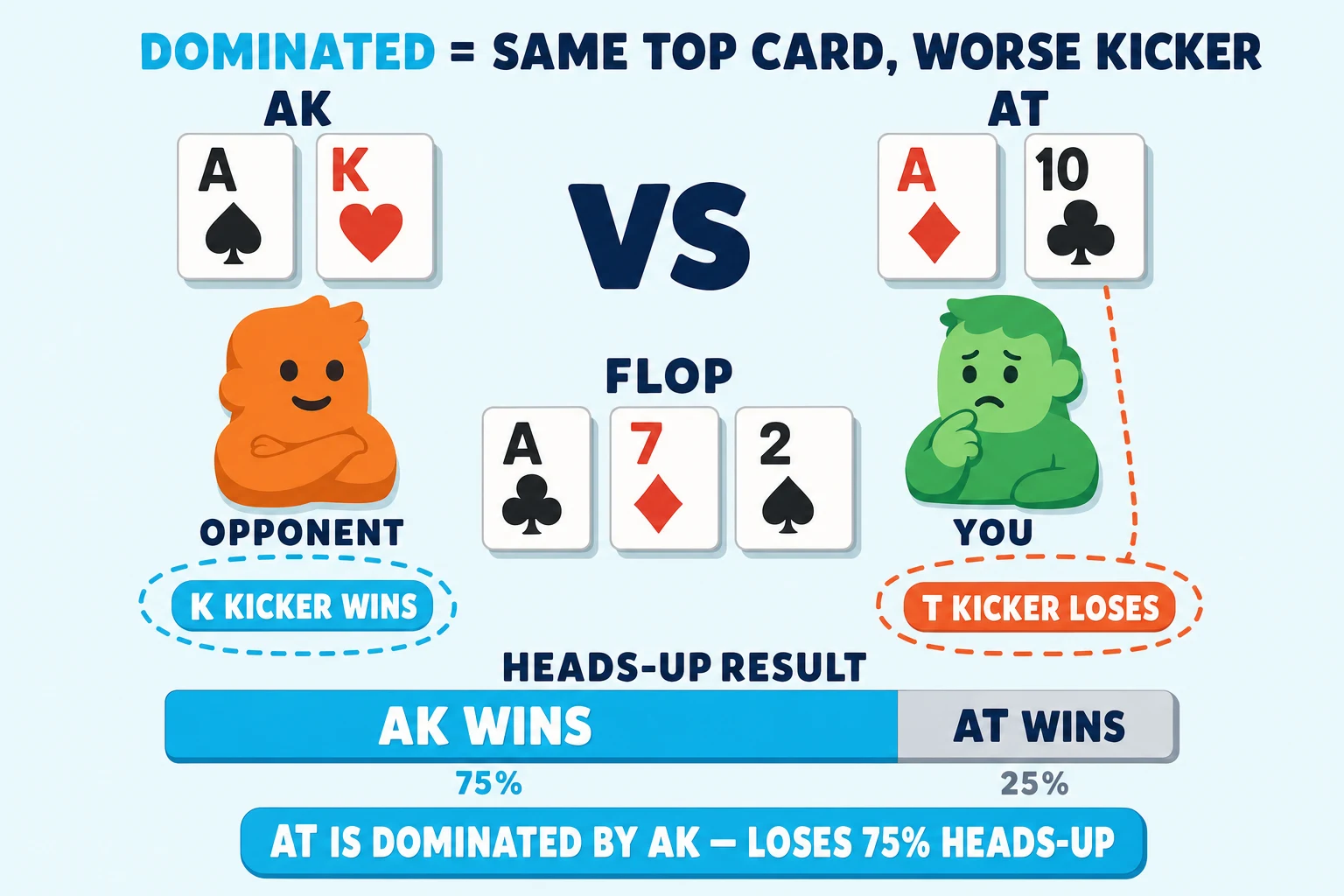
A hand is dominated when it shares a high card with an opponent but has an inferior kicker, the side card that breaks ties. That inferior kicker sharply reduces the dominated hand's showdown chances. For example, Ace-King (AK) dominates Ace-Ten (A10): if an Ace appears and both players pair it, AK wins because the King kicker beats the Ten.

Practice this in Poker Skill. Against an under-the-gun open, the lesson for the button has you fold A♥ 9♦ and K♥ 10♦, because a tight opening range dominates both too often.
Get the free appDominated
What “dominated” means
A hand is dominated when it shares a high card with an opponent but has an inferior kicker, the side card that breaks ties. That inferior kicker sharply reduces the dominated hand’s showdown chances. For example, Ace-King (AK) dominates Ace-Ten (A10): if an Ace appears and both players pair it, AK wins because the King kicker beats the Ten.
Domination turns otherwise decent single-pair hands into long-term losers heads-up, because the dominated hand can only win by improving to two pair, trips, a straight, or better - or by the opponent folding.
Recognizing common dominated matchups
Spot these patterns preflop to avoid trouble:
- Same top card, worse kicker: AK vs AQ or KQ vs KJ. The lower kicker loses most showdowns.
- Weak aces: A7-A2 are often dominated against big broadway hands from early positions.
- Big-card plus low kicker: K9 or Q8 can be dominated by KQ or KJ when a king or queen hits.
Pay attention to early-position raises. Early raisers open stronger broadway-heavy ranges, so calling with a shared top card and a weak kicker often creates dominated spots.
When domination matters most
Domination matters most in heads-up confrontations. In those spots, the dominant hand typically wins about 75% of the time, so calling with the dominated holding is a long-term losing play.
Domination matters less in multiway pots or at low limits, where concealed straights or two pair frequently win. As opponents thin or against tight, aggressive players, avoiding likely-dominated hands becomes critical.
Preflop adjustments and hand selection
Simple rules to reduce domination losses:
- Fold or three-bet rather than call a raise with weak aces and big-card low-kicker combos. Calling invites dominated showdowns.
- Prefer hands that dodge shared high cards or have strong drawing equity, like suited connectors (9♠8♠) or small pocket pairs, especially out of position.
- In late position, choose speculative hands over likely-dominated holdings against early raisers. Example: 9♠8♠ versus A♠T♦ facing a UTG raise has more ways to win without a kicker battle.
Postflop play: reading the board and folding when needed
After the flop, reassess constantly:
- Compare the flop to your opponent’s likely range. If the flop contains your shared top card and heavy betting follows, consider domination seriously.
- Fold premium single-pair hands when betting patterns and board texture indicate your opponent holds the superior kicker or range. Example: you hold A♣10♣, flop A♦7♠2♣, and the opponent leads big - A10 is often dominated by AQ or AK.
- Use pot control when you suspect domination. Check and call small bets rather than bloating the pot with marginal hands.
Willingness to fold a “good”-looking hand is a key practical skill when domination appears likely.
Quick checklist
- Check for a shared top card and compare kickers before committing chips.
- Avoid calling raises with weak aces or big-card low-kicker combos.
- Prefer speculative hands in late position instead of likely-dominated holdings.
- Reassess hand strength postflop and fold premium hands if evidence of domination appears.
- Remember: in heads-up showdowns, dominated hands lose about three-quarters of the time.