
Heads-Up

Heads-up poker occurs when only two players remain at the table, creating direct, high-variance confrontations. With only one opponent, the math and tactics from full-ring games change: you stop worrying about multiway pots (pots with three or more players) and focus on a single opponent's tendencies. Heads-up shows up online and in late tournament stages, where hands move quickly and blinds circulate fast. In this format, well-timed aggression often wins pots that would be marginal in larger games.

Heads-Up (No-Limit Texas Hold’em)

What heads-up play is

Heads-up poker occurs when only two players remain at the table, creating direct, high-variance confrontations. With only one opponent, the math and tactics from full-ring games change: you stop worrying about multiway pots (pots with three or more players) and focus on a single opponent’s tendencies. Heads-up shows up online and in late tournament stages, where hands move quickly and blinds circulate fast. In this format, well-timed aggression often wins pots that would be marginal in larger games.

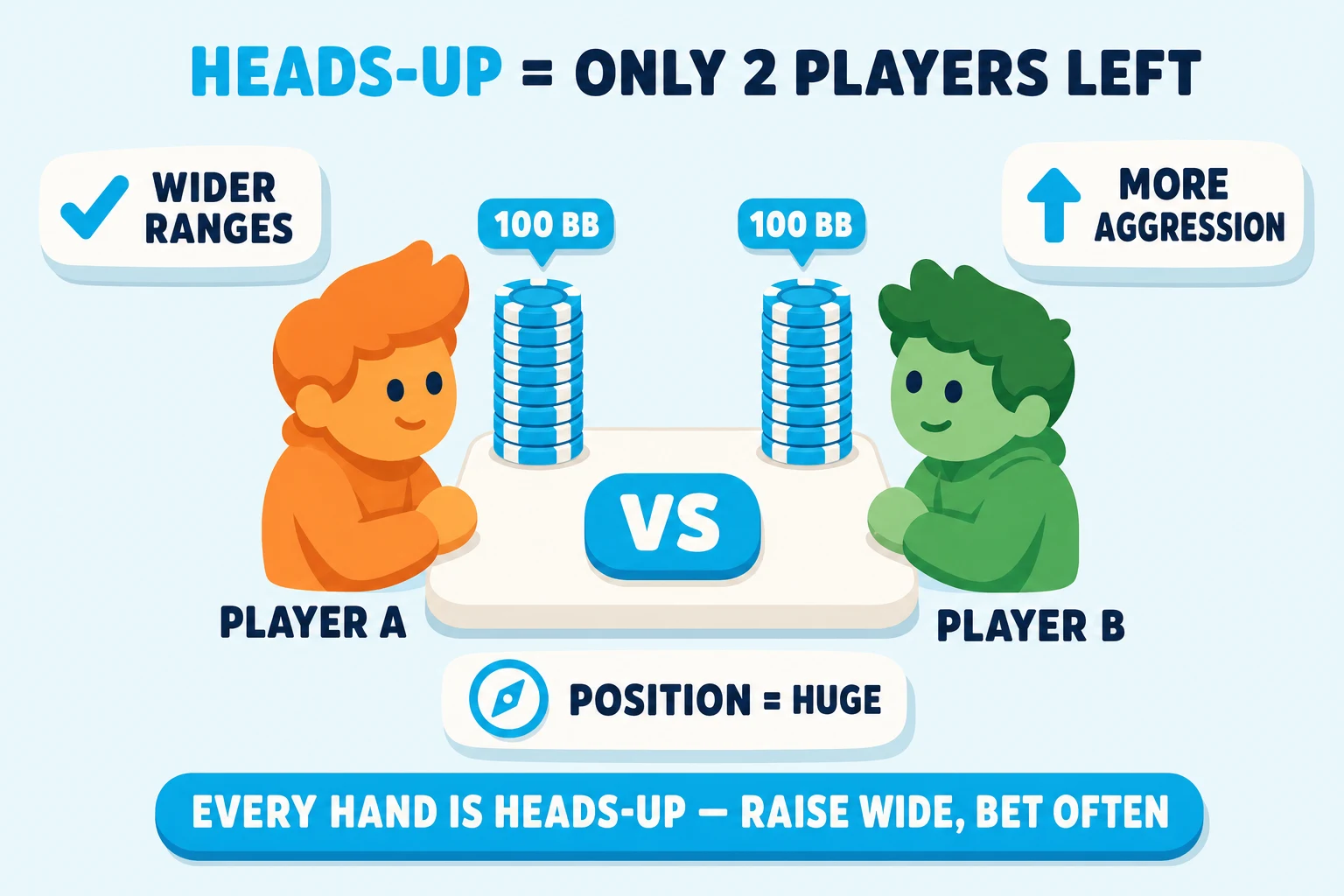
Diagram on a pale sky background under a 'HEADS-UP = ONLY 2 PLAYERS LEFT' header (HEADS-UP in cyan). Two cartoon avatars face each other across a small table — orange PLAYER A on the left and mint PLAYER B on the right — each topped by an equal cyan 100 BB chip stack. A bold cyan 'VS' pill sits between them. Three side annotations frame the scene: 'WIDER RANGES' with a cyan checkmark, 'MORE AGGRESSION' with a cyan up-arrow, and 'POSITION = HUGE' with a cyan compass icon. Cyan pill at the bottom: 'EVERY HAND IS HEADS-UP — RAISE WIDE, BET OFTEN'.
Heads-up means only two players are left — ranges blow up wide, aggression matters more than ever, and the position advantage swings every pot.

Core strategic principles

Aggression: Raise and continuation-bet frequently; c-bet means betting the flop after you raised preflop. Many flops miss both hands, so aggression turns those misses into immediate wins and builds fold equity.

Positional awareness: Position (acting last) is more valuable heads-up than in multiway pots; it lets you control pot size and see your opponent’s action first. From position you can apply pressure selectively and force tougher decisions.

Range expansion: A range is the set of hands you might hold. Opening and defending ranges widen dramatically heads-up, so hands like A7s or K9o become playable where they would be folded in nine-handed games.

Preflop tactics and ranges

  1. Small blind (on the button) opens very wide. The player on the button posts the small blind and acts last postflop; they should raise frequently and, with shallow stacks, be prepared to shove to maximize fold equity and simplify decisions.
  2. Big blind defenses mix calls, raises, and all-ins. Defend more hands than at a full table, but avoid calling blindly-choose hands that play well postflop or that have good shove equity.
  3. Push/fold under ~10 big blinds (bb). With roughly 10bb or less, simplify to all-in or fold preflop to avoid costly postflop mistakes and to maximize expected value.

Example: With 15bb effective, the button opens wide with hands like KQ, A5s, and 76s; the big blind should defend with a balanced mix-call with suited connectors and broadways, shove with hands that fare well all-in.

Postflop tactics and bet sizing

Continuation-bet frequently because many flops miss both players; c-bets win lots of pots heads-up. Out of position, c-bet most flops; in position, bet a high percentage but also check to induce bluffs and control the pot. Use position to probe and control pot size: in position you can check to induce bluffs or bet to fold marginal hands. Out of position, defend proactively-check-raise when appropriate or call with speculative hands that play well on later streets. Adjust sizing by stack depth and opponent type: shallow stacks favor min-raises and all-ins, while deeper stacks call for larger sizing to extract value or protect against draws. Versus a calling station, size up for value; versus a nit, apply pressure with targeted bets.

Advanced lines and when to use them

Limping (just calling the big blind preflop) and mixed raise sizes become useful with deep stacks to disguise hand strength. Use these tactics only when you can execute multi-street strategies reliably, because complex lines cost chips when misapplied. Switch between exploitative and balanced strategies based on reads: widen your bluffing range versus fold-prone opponents, and tighten up to value-bet more against calling opponents.

Practicing heads-up and format differences

Online play delivers high volume and rapid feedback-use it to practice push/fold drills and deep-stack postflop spots. Live heads-up adds physical reads and different pacing; account for timing tells and table talk when applicable. Drill by stack depth: practice all-in or fold decisions for short stacks and multi-street planning for deep stacks to build reliable instincts.

Checklist

  • Be aggressively proactive; use raises and c-bets to apply consistent pressure.
  • Prioritize positional advantage and explicit pot control on later streets.
  • Widen opening and defending ranges compared with full-ring play.
  • Switch to push/fold strategy under about 10 big blinds.
  • Vary bet sizes by stack depth; use larger bets deeper and min-raises when shallow.
  • Practice online for volume and drill stack-specific scenarios to build instincts.