


Hero Call
A hero call is a call with a hand that beats most bluffs and loses to most value, made because the line, sizing, blockers, or read tilt villain's range toward bluffs. The label is dramatic; the math is usually plain. Hero-calling is a specific kind of bluff-catch where the call looks brave on the surface and stops looking brave the moment you write down the bet size, the prior-street story, and the range that survived to the river.
Practice this in Poker Skill. In Practice vs AI you play full hands against AI opponents, and before a river call with a bluff-catcher, Coach Max, the AI poker coach, can give you the price and make you weigh how often the bettor is bluffing.
Get the free appHero call
What a hero call is
A hero call is a call with a hand that beats most of villain’s bluffs and loses to most of villain’s value, made because something about the spot (the line, the bet sizing, the blockers in your hand, or a concrete read) tilts villain’s range toward bluffs by enough to clear the price you’re being laid. The “hero” label is theatrical. The decision is usually math plus a sober read of villain’s story, not bravery. If the price says you need 36% bluffs to break even and the line says villain shows up with a lot more bluffs than that, the call is correct and the costume is optional.
Hero call vs guess vs station call
Three calls feel similar at the table and behave very differently long-term:
- Hero call. You have a structural reason: the line caps villain’s value, the size implies polarization, your hand unblocks his bluffs, or population data says he over-bluffs this branch. The math comes out.
- Guess. You don’t know whether villain has it, you call to see, and you’d make the same call regardless of the line. Sometimes right, never repeatable. Not a hero call.
- Station call. You call because folding feels uncomfortable. You don’t price the bet, don’t read the line, don’t check blockers. The pattern leaks money even on the times you happen to win.
A hero call also isn’t a routine bluff-catch of a small bet. The label gets used when the price looks scary (overbets, big rivers, lines that seem to scream value) and the call still goes through because the underlying read survives the price tag. With showdown value you already beat his bluffs; the question is only how often he’s bluffing.
Related terms:
How a hero call differs from a routine bluff-catch and a guess
| Decision | Trigger | What you’re pricing | Long-run result |
|---|---|---|---|
| Routine bluff-catch | Standard-size river bet on a polarizing line | Pot odds vs. estimated bluff frequency | Break-even or small edge across the population |
| Hero call | Big bet or scary line that still shows under-supported value | Same pot odds + a specific structural hook (line, sizing, blockers, read) | Profitable when the hook is real, painful when it isn’t |
| Guess call | Curiosity, frustration, or “I want to see it” | Nothing; the price isn’t actually checked | Net loss across thousands of repetitions |
The difference is whether you can write down the reason in one sentence before clicking call. If you can’t, it’s a guess.
When this matters most
Hero calls are loudest in spots where villain’s story is structurally weak even though his sizing is loud:
- River overbets after a passive turn. A check-call on the turn caps a lot of villain’s strongest hands; a pot-or-bigger river bet now needs to come from either the very top of his range or his missed draws. If the runout left him a lot of missed draws, the call is on the table.
- Polarized rivers on draw-heavy boards. When the obvious draws bricked, the river bet that “represents” them is exactly the bet villain wants you to fold to. The math here is the cleanest.
- Lines that don’t make sense for value. If villain wouldn’t logically bet his medium-strength value hands this big, his big-bet range is splitting between a few nutted combos and a wider missed-draw bluff bucket, and most populations skew toward the bluffs.
- Population reads on aggressive villains. A wide, aggressive opener with a high turn-stab and a high river-bluff percentage doesn’t need to put you in this spot every hand. When he does, his prior history is part of the read.
Hero calls don’t matter on under-bluffed lines, against passive opponents, or when villain’s sizing is consistent with thin value. Same call, different ecosystem, different result.
Worked example
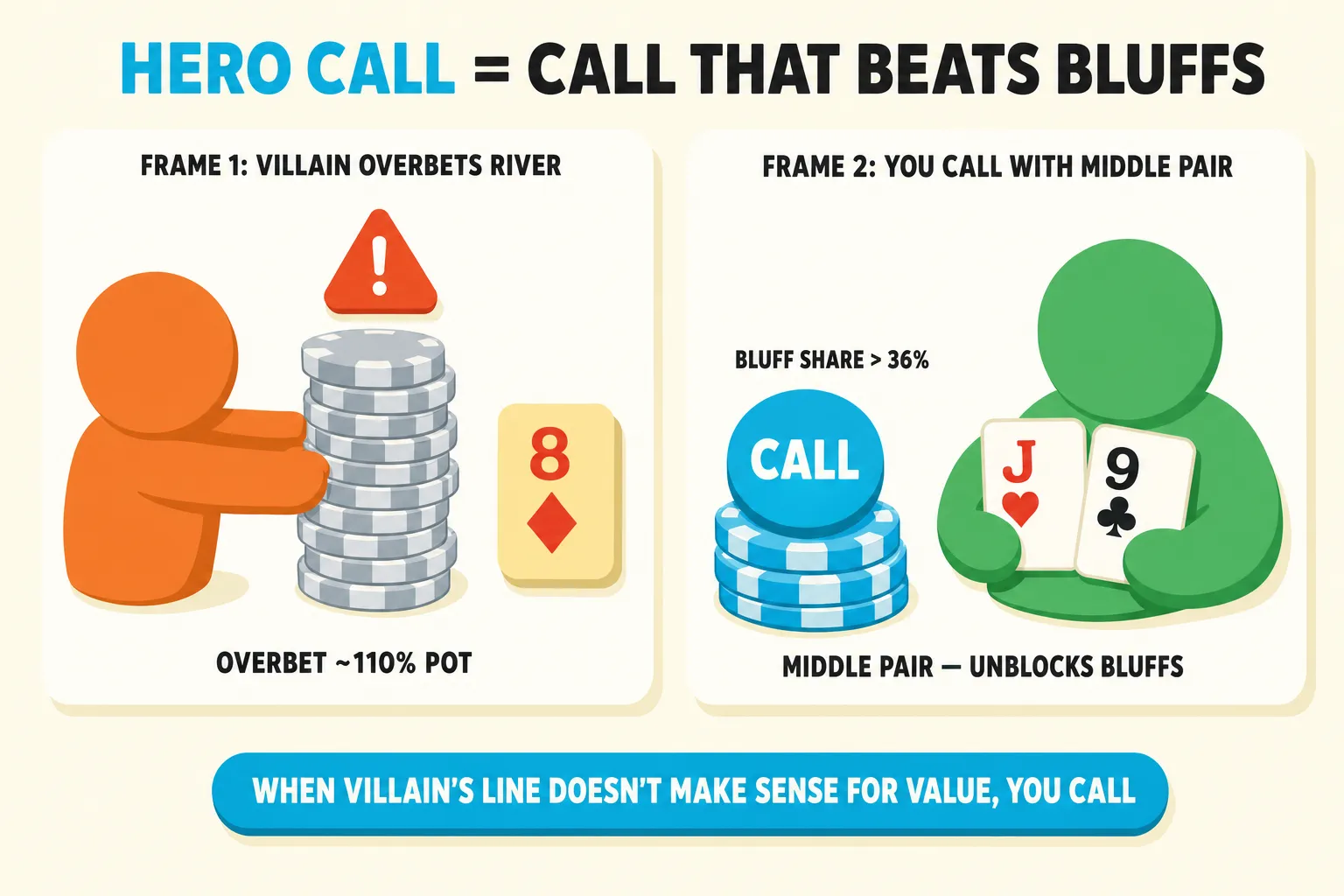
You’re 100bb deep in 6-max NLHE cash on the button. The cutoff (a known aggressive regular with a wide opening range) opens to 2.5bb, you call J♥ 9♣ on the button. The flop is A♦ 7♣ 4♠. He c-bets one-third pot, you call. Turn is the 3♥. He checks. River is the 8♦. Pot is around 16bb. He bets 18bb — a touch over pot — into your middle pair.
Walk it through:
- Price. You need to win 18 / (18 + 18 + 16) = ~35% to break even on the call. Round up for rake and call it 36% needed.
- Value combos. His turn check capped most of his stronger one-pair hands; sets and two pair would mostly bet the turn for protection on a draw-heavy board. The hands that overbet river for value here are roughly the few slowplayed sets that picked the turn to trap.
- Bluff combos. The flop is dry from his perspective, but his preflop opening range is wide; backdoor flush draws (♣ on the flop, ♦ on the river) and gutshots like 6-5 and 9-6s missed everything by the river. There are more missed-draw combos than slowplayed-set combos.
- Blockers. Your J♥ 9♣ unblocks all of his missed-draw bluffs and doesn’t matter much for his value combos. That’s a textbook unblocker for a bluff-catcher.
- The math. If his river-bet range is ~30% value and ~70% bluff, you’re well above the 36% threshold. Call.
The call looks heroic because middle pair vs. an overbet feels aggressive. It isn’t heroic. It’s a bluff-catch where the pot odds are good and the line tells you what’s in his range.
Common mistakes
1) Anchoring on absolute hand strength
“It’s only middle pair.” Hero calls aren’t sized to your hand’s strength in a vacuum — they’re sized to villain’s range. Middle pair on a polarized river is often the same call as top pair: both mostly beat his bluffs and lose to his value. Treating middle pair as automatically too weak misses the point of the spot.
2) Hero-calling an under-bluffed line
Some lines simply lack bluffs: passive flop and turn followed by a giant river bet, or a check-raise on a paired river by a player who never check-raise-bluffs. Calling there because the bet is “scary big” is the inverse of a hero call. The math wants the price to clear villain’s bluff frequency; if his bluff frequency is near zero, no price clears it.
3) Ignoring the line and reading only the river
If villain bet every street with sizing consistent with thin value, his river bet is probably more thin value, not a giant bluff. Hero-calling rewards lines that don’t make sense for value, not lines that simply got bigger.
4) Holding the wrong blocker
A great-looking call goes from break-even to losing when your hand blocks villain’s missed-draw bluffs. Holding the A♦ on a missed-flush board kills the natural bluffs and turns the same middle pair from a hero call into a fold. Blockers don’t justify wild calls; they just tip already-close decisions.
FAQ
Is a hero call the same as a bluff-catch?
A hero call is a specific kind of bluff-catch: the kind where the surface optics (small absolute hand, big bet, big pot) feel brave and the math is still in your favor. Every hero call is a bluff-catch; not every bluff-catch is dramatic enough to earn the name.
How do I know when a hero call is profitable?
Three quick checks. One, the price: write down the equity you need against the bet size. Two, the line: ask whether villain’s prior streets make sense for value. Three, the blockers: confirm your hand doesn’t kill his bluffs. If the price clears, the line is suspicious for value, and you don’t block his bluffs, the call is on.
Should I hero call more often as I move up in stakes?
Not on its own. Population reads change. Lower-stakes opponents tend to under-bluff big rivers, which makes hero calls trap-heavy and folding more often correct. Mid-and-up regulars bluff closer to balanced, so the math tracks population data more cleanly. Pick a call-down frequency that matches the player pool, not your sense of bravery.