


Hero Fold
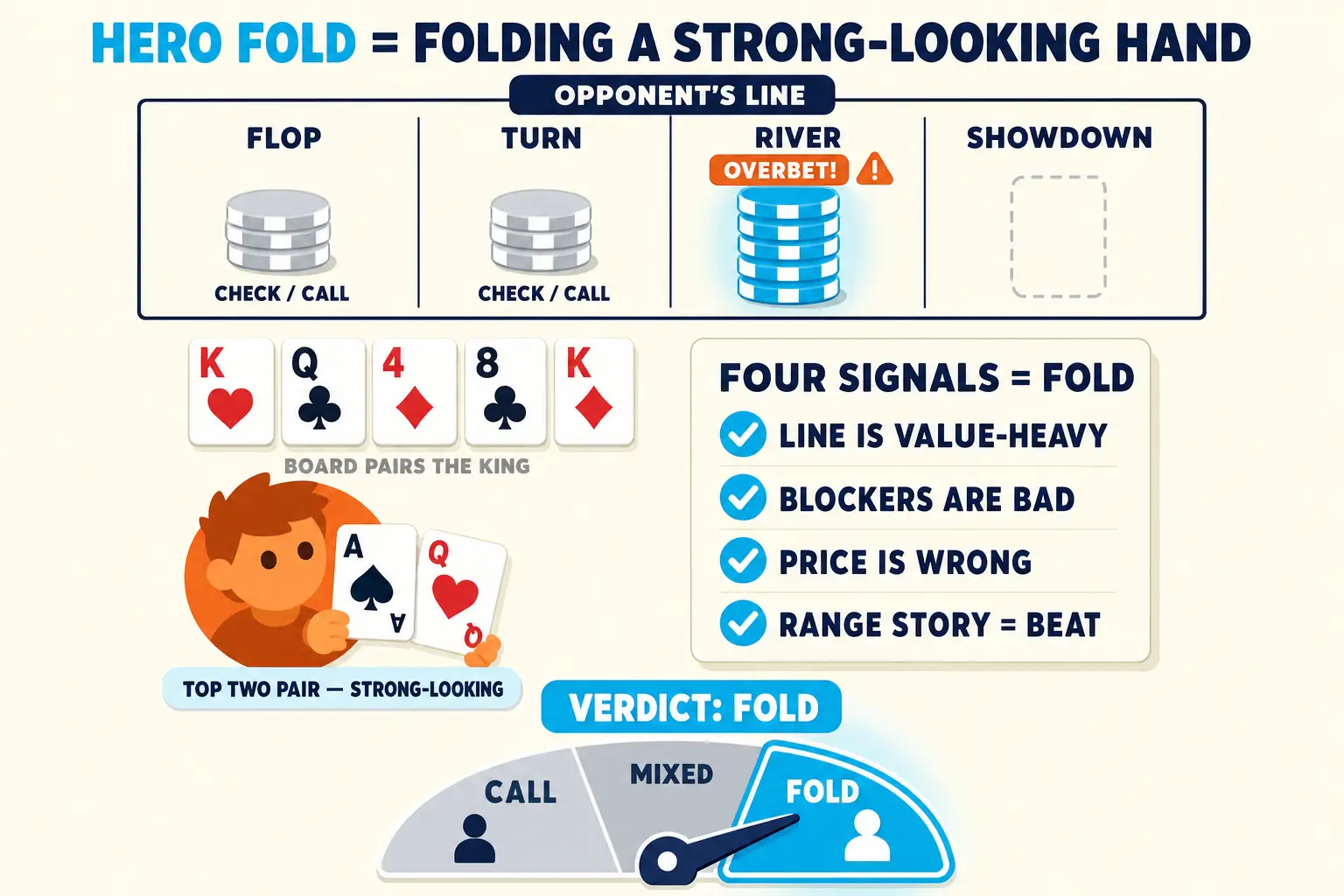
A hero fold is folding a strong-looking hand because the opponent's line is value-heavy, your blockers are bad, the price is wrong, or the range story says you're beat. It's a single justified release in a specific spot, not a habit. Most often a river decision against an under-bluffed line, where calling looks tempting because the hand is too good to fold but the line and the range say otherwise.
Practice this in Poker Skill. Before a close fold in Practice vs AI, where you play full hands against AI opponents, Coach Max, the coach at the table, can point you at the bettor’s bluffing habits, the read that separates a hero fold from an overfold.
Get the free appHero fold (No-Limit Texas Hold’em): folding a strong-looking hand because the line says you’re beat
What a hero fold is
A hero fold is folding a hand that looks strong enough to call with, because the way the betting played out tells you you’re behind anyway. It’s the opposite of a hero call. Top pair, an overpair, or even a small set in a single spot where the opponent’s line, blockers, price, and range all point the same direction: you’re beat. A hero fold is one disciplined release on one street in one hand. It is not a habit, not a style, and not something to be proud of at the bar.
The phrase hides a small trap. “Hero” makes it sound impressive, like you saw something other players couldn’t see. In practice, a good hero fold is just a careful read of the line. The hand stays in the muck, the chips stay in your stack, and you move on. If you walk away thinking the move was heroic, you’ll start finding hero folds where they don’t exist, which is a different leak — overfolding.
Hero fold vs. ordinary fold vs. overfold
These three words get used interchangeably and they should not be.
| Term | What you’re folding | Why |
|---|---|---|
| Ordinary fold | A clearly weak or dominated hand | Hand strength alone — too thin to continue. |
| Hero fold | A strong-looking hand in one specific spot | Line, range, blockers, and price all say you’re beat right here. |
| Overfold | A pattern across many spots | Frequency leak: you fold so often that bluffs work too often against you. |
A hero fold is a one-off decision. Overfolding is a habit. You can hero-fold correctly and still overfold across a session — they describe different timescales.
When a hero fold is the right call
There are four signals worth checking before you release a strong-looking hand. The cleaner the signals stack up in the same direction, the safer the fold.
- The line is value-heavy. Two streets of check-call followed by a sudden river overbet, or a check-raise on a runout that completes obvious draws, is a textbook under-bluffed line. The earlier passive action did not build a credible bluff range for a big late commitment.
- Your blockers are bad. On the river, blockers matter most. A hand that blocks the opponent’s bluffs without blocking their value combos becomes a worse bluff-catcher, not a better one. If your strong-looking hand removes hands they would bluff with and leaves the value combos intact, the math tilts toward folding.
- The price is wrong, even with pot odds. Pot odds tell you the breakeven equity for a call, but they don’t tell you whether your hand actually has that equity against the line you’re facing. A 3-to-1 price means nothing if the opponent’s range beats you 80% of the time.
- The range story says you’re beat. Walk the hand back from preflop and ask which combos still make sense. If the only hands that play this exact line are sets, two pair, made flushes, or boats, your top pair is fighting a losing battle.
When two of those four point clearly toward “beat,” it’s a fold. When all four do, it’s a fold without a sigh.
Hero folds matter less when
- The opponent is a calling station who never bluffs anyway. There’s nothing heroic about folding to a player who only bets when they have it; that’s just a fold.
- The pot is small and the bet is small. If the price is generous and the line could plausibly contain bluffs, just call. Hero folds are decisions about big commitments, not pot-controlled streets.
- You have no read on the villain. Without a player read, the default assumption is balance, and folding strong hands at high frequency against an unknown opponent is overfolding by another name.
Example: top two pair on a paired king runout
Hero defends the big blind with A♠Q♥ vs. a button open. The flop comes K♥Q♣4♦. Hero checks, button c-bets, hero calls with top pair, top kicker. The turn is 8♣. Hero checks, button bets again, hero calls. The river is K♦, pairing the board. Hero checks. Button overbets the pot.
Hero now has top two pair, kings and queens, with an ace kicker. It looks strong. Walk the line back. The button bet flop, bet turn, then overbet a board-pairing river. Their value range here is heavy: any K-x has trip kings, K-Q makes a full house, A-K does as well, K-K is the absolute nuts (quads), Q-Q full of kings, sets of 8s and 4s also boat up. The bluff range is thin. The board ran out with no completed flush, no straight, and the river K does not give natural missed-draw bluffs anything new to fire.
Hero’s hand is strong-looking but its only relevant target on the river is the small slice of the opponent’s range that contains K-x worse than A-K — and against the overbet sizing, even most of those play conservatively. The line is value-weighted. The blockers don’t help: the A♠ blocks some A-x value, and the Q♥ blocks K-Q and Q-Q. Both signals point the same way. Fold the kings and queens. The chips you save here are the chips you’ll have for the next hand.
This is what a hero fold looks like in practice: not a thunderclap of insight, just a quiet release after the line stops adding up.
Common mistakes
1) Treating a hero fold like a feat
The biggest mistake is the one that creates the rest. If you decide hero folds make you a great player, you’ll start finding them where they don’t belong, fold strong hands at way too high a frequency, and slide into overfolding. Good hero folds are routine. They are not stories.
2) Folding from fear instead of from a range read
A pot-sized river overbet is uncomfortable. Discomfort is not a read. Before folding a strong-looking hand, walk the line back and ask which combos still make sense. If you can’t name the value hands you’re losing to and the bluffs you’re afraid of, the fold is fear, not analysis. Fear leaks money slower than calling, but it still leaks.
3) Pricing the call without re-reading the line
Pot odds are necessary but not sufficient. A favorable price only matters if your hand has the equity to beat the line. Don’t let pot odds alone drive a marginal call when the betting story tells you you’re behind. Check the price, then check the line, then check both against your hand.
4) Hero-folding against the wrong opponent
Trying to hero-fold against a calling station or an aggressive player who genuinely overbluffs is a category error. Hero folds work when the opponent’s line is credibly value-heavy. Against a player who mixes bluffs into every line, you’re surrendering showdown value and paying for the privilege. The move is opponent-dependent, not just situation-dependent.
FAQ
Is a hero fold the same as overfolding?
No. A hero fold is one decision in one spot, justified by a specific read on a specific line. Overfolding is a frequency leak across many spots. You can hero-fold correctly five times in a session and still overfold overall, because overfolding is about how often you fold across all comparable river decisions, not about any single hand.
How do I know if my last hero fold was right?
You usually don’t. Results don’t validate the decision; the same fold can fire into a bluff one time and land on the nuts the next, and the right answer is the same in both cases. The honest test is reconstructing the hand: did the line credibly represent value, did the runout leave you mostly beat, and did your blockers point toward folding? If the answer to all three is yes, the fold was correct, even if the bet was a bluff. Long-run discipline is the metric, not single-hand outcomes.
Why do strong players still talk about hero folds if they’re routine?
Because the inside of the move is not flashy, but the moment is. Folding top two pair on a board-pairing overbet feels heavy at the table, even when it’s the obvious read. The label “hero fold” sticks because of the feeling, not the math. Strong players use the term casually and treat the decision routinely. Treat both the way they do.