


Under-Bluffed Line
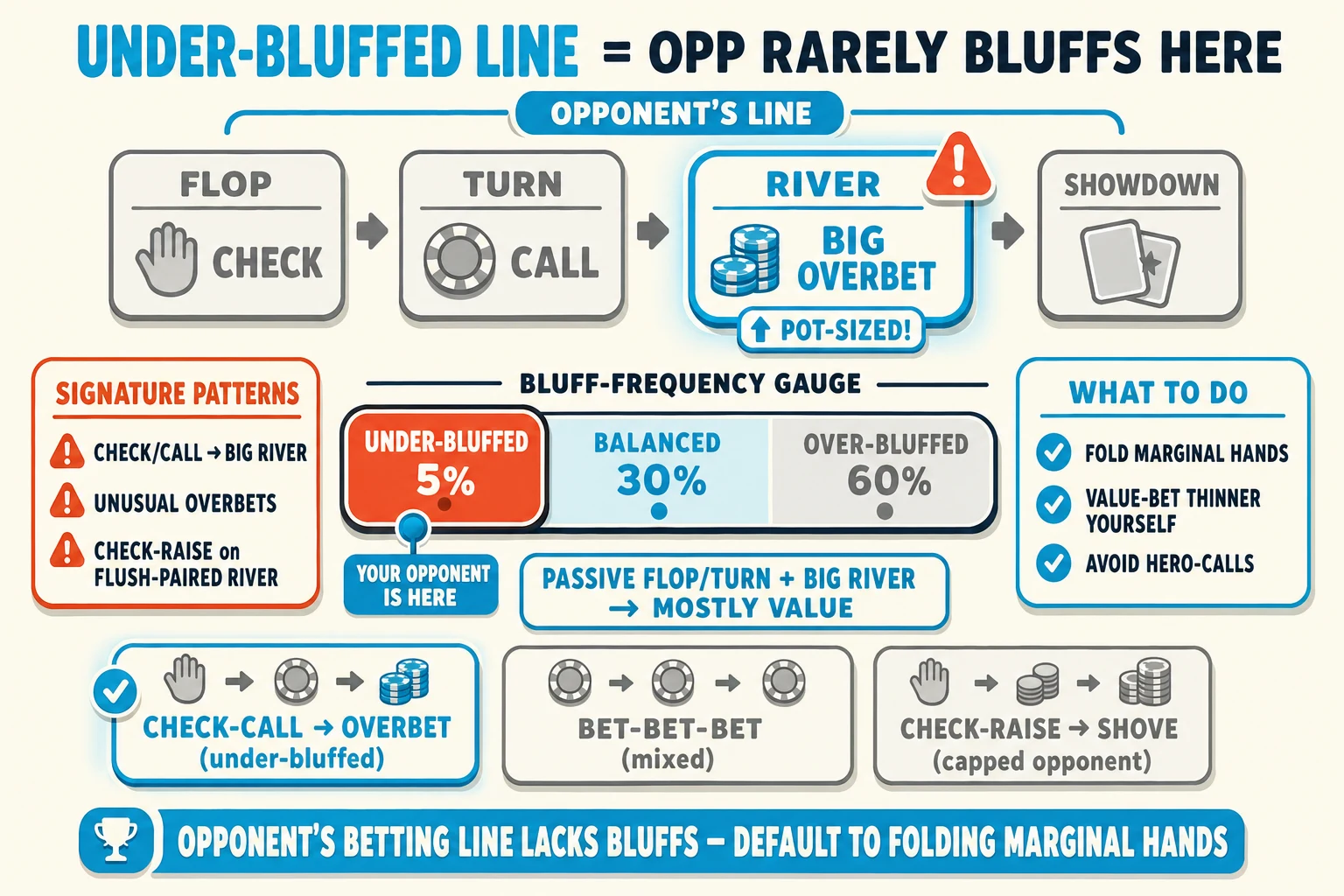
An under-bluffed line is a betting sequence weighted toward value hands, with few natural bluffs. Value hands have real showdown equity; bluffs rely on folding better hands without showdown. These lines often start passively with checks and calls, then end with big river commitments. Because earlier action didn't create believable missed-draw combos, a large river bet rarely works as a bluff. Example: A player checks the flop and calls the turn, then bombs the river.
Practice this in Poker Skill. The Give Up on Purpose lesson practices the disciplined fold on the turn, letting bottom pair go to a bet once a third spade lands, because the hands that bet there beat it.
Get the free appUnder-Bluffed Line (No-Limit Texas Hold’em)
What an under-bluffed line is
An under-bluffed line is a betting sequence weighted toward value hands, with few natural bluffs. Value hands have real showdown equity; bluffs rely on folding better hands without showdown. These lines often start passively with checks and calls, then end with big river commitments. Because earlier action didn’t create believable missed-draw combos, a large river bet rarely works as a bluff. Example: A player checks the flop and calls the turn, then bombs the river.
Common spot signatures of under-bluffed lines
Focus on repeatable betting patterns instead of relying on single-hand intuition or gut reads:
- Large river bets or raises after passive earlier streets (check/call patterns). Check/call earlier action seldom builds a believable bluff range for a big river shove.
- Unusually large overbets on runouts that completed most draws signal few credible missed-draw bluffs. An overbet is any bet larger than the pot.
- Check-raises or sudden aggression on textures where completed draws leave a very strong range. A river check-raise that pairs the board often signals polarization toward value hands.
Example: The button faces a pot-sized river overbet on A-K-7-8-K after check/calling earlier streets. Few hands missed meaningful draws there, so the overbet is likely value-heavy.
Reading the river: what to ask yourself
Use this short checklist when facing a decisive river action.
- Did the opponent show passivity earlier (checks/calls) then suddenly bet big on the river?
- Does the board runout leave few believable missed-draw hands that could be used as bluffs?
- Is the bet size extreme relative to pot and prior action, making bluffs less plausible?
If you answer yes to any, the line is probably under-bluffed. Default to caution unless you have a specific, reliable read the opponent mixes river bluffs.
Practical adjustments: disciplined folds and thin value
Turn recognition of under-bluffed lines into concrete adjustments at the table:
- Fold wider on turns and rivers when you identify an under-bluffed line, even with normally calling hands. This discipline avoids paying off frequent value bets and reduces costly calls.
- Against players who seldom bluff, use thinner value bets to extract extra calls. Prefer smaller, frequent value bets instead of polarizing bluffs that rarely get called.
- Avoid hero-calls on large bets unless you have a narrow, reliable read the opponent mixes bluffs. Hero-call means calling with a marginal hand expecting a bluff.
Example adjustment: Against a player who rarely overbets the river after check/calling, fold middle pair. Value-bet thinner with top pair on similar runouts to extract extra calls.
Theory vs practice: balance and real-game exploitability
Game theory optimal (GTO) strategies recommend mixing bluffs to balance value bets. In practice, many live and low-stakes opponents fail to include enough bluffs in certain lines. Exploit this by folding more and adjusting your value-bet sizing instead of forcing bluffs. Stay alert: over-exploiting with predictable folds or thin bets invites opponents to adapt and bluff those lines. When they adapt, rebalance by mixing bluffs and adjusting sizes.
Quick checklist
- Does prior action show passivity (check/call) before a late large bet?
- Does the board runout leave few plausible missed draws?
- Is the bet size large or an overbet relative to pot and prior line?
- Default to a disciplined fold unless you have a concrete read of a bluff.
- Increase thin value betting when an opponent rarely bluffs in identified lines?