


Check
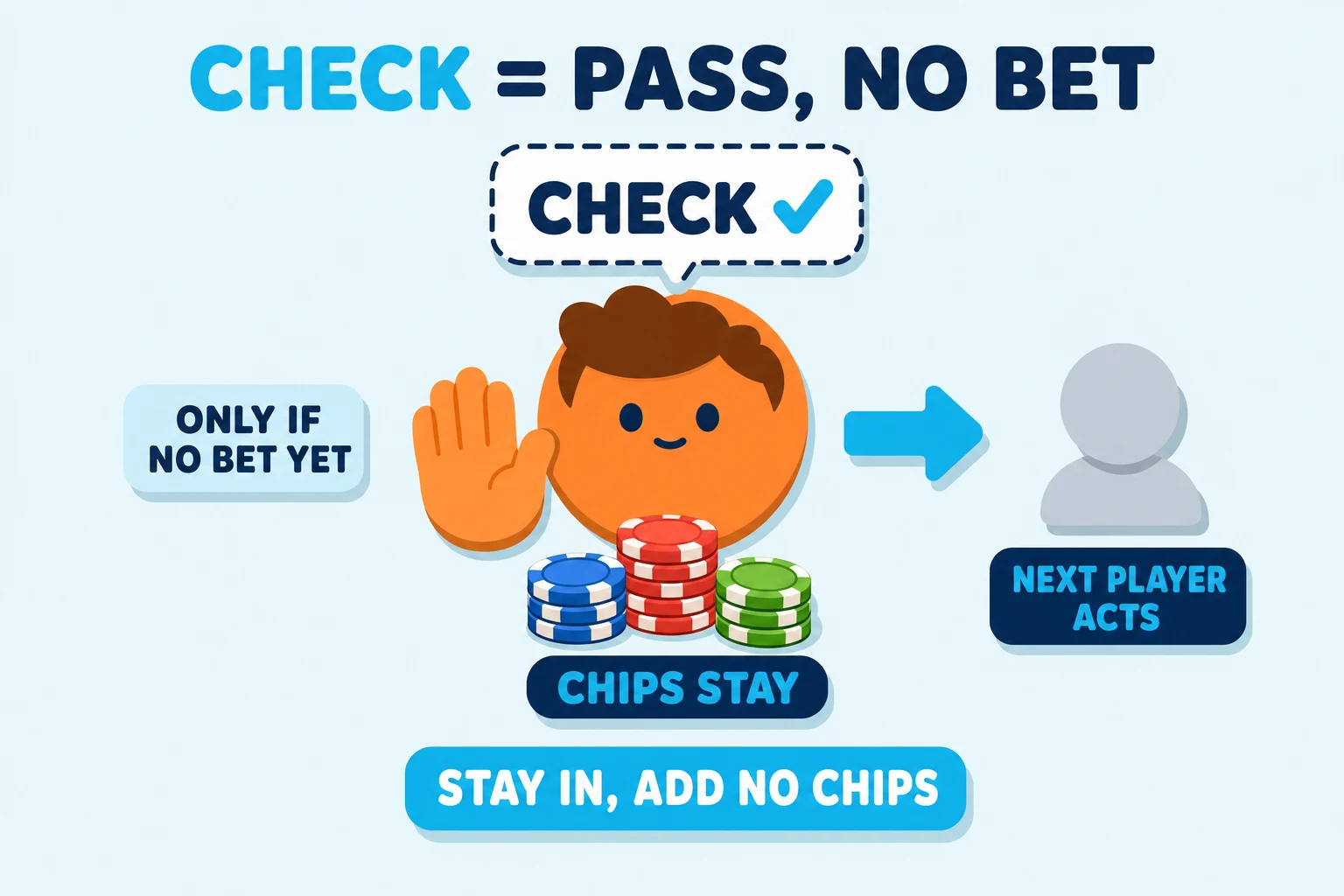
A check means you decline to bet while remaining in the hand, provided no bet has occurred this betting round. By checking, you pass action to the next player without adding chips to the pot. Pre-flop, you may check only if no one has raised, such as in the big blind when others folded. You may also check on the flop, turn, or river if no bet has been made that street. Once any player bets, checking is no longer legal; you must call, raise, or fold.

Practice this in Poker Skill. Checking strong hands to invite a bet is a drill in the Lead and Donk Bets lesson, where even a monster draw like Q♥ J♥ on 10♥ 9♥ 3♣ checks to the preflop raiser, because the raiser’s bet is worth more than your lead.
Get the free appCheck (No-Limit Texas Hold’em)
What a check is and when you can use it
A check declines to bet without folding, but only when no bet has been made on the current betting round. Checking passes action to the next player without adding chips to the pot. Preflop, you can check only if nobody has raised, like the big blind in a folded-around pot. On the flop, turn, or river, you can check whenever no one has bet that street. Once any player bets, the check option is gone: you call, raise, or fold.
Primary strategic goals of checking
- See more community cards for free by checking when you have a draw. This lets you try to complete your hand without committing additional chips.
- Control the pot size with marginal hands when you are uncertain. Checking prevents the pot from growing and avoids difficult decisions on later streets.
- Induce bets from aggressive opponents by checking to invite a reaction. You can then call for value or raise (a check-raise) to extract more from bluffs or thin value hands.
Example: Holding 8♠9♠ on J♣7♠2♦, check to see the turn for free and keep the pot small if you miss.
Common check-based plays and sequences
- Check-call: You check, then call a bet to control your commitment size. Use it to let opponents bluff or continue with weak value hands. Example: With middle pair on a dry board, call small bets to avoid bloating the pot.
- Check-raise: You check to provoke a bet, then raise to extract extra value. Use this against frequent bluffers or when your hand is strong enough to punish bluffs. Example: Holding A♠A♦ on K♣9♣2♦, check-raise an opponent who frequently bluffs out of position.
- Check-fold: You check and then fold to a bet when you don’t want to continue. This concedes the street cheaply and preserves chips for better future spots. Example: With K♦7♣ on a coordinated turn that completes straights, check-fold to a large bet.
Position, range protection, and balancing checks
Position means the order of action; acting before opponents is out of position. When out of position, checking helps control the pot and avoid difficult decisions later. Range refers to the spectrum of hands you could hold in a given situation. If you always check only weak hands, opponents will bluff more often after your check. Occasionally check strong hands, for example a flopped set, to protect your range and remain unpredictable. Balance your checks between strong and weak holdings to avoid predictability and exploitation.
How opponents typically react and how to counter them
Aggressive opponents often bet when you check, seeking to seize the initiative. Counter by check-calling light with draws or marginal hands, or by check-raising strong holdings to punish that behavior. Passive opponents often check behind, handing out free cards or cheap showdowns which you can exploit. Use checks to keep the pot small or to induce a river bet when you want value. Track how often and how much opponents bet after your checks; these tendencies guide whether to check for information or protection.
You check on the flop, and the next player bets into you. Your options:
- Call (check-call) to control the pot and see a cheap turn.
- Raise (check-raise) to extract value or punish frequent bluffs when appropriate.
- Fold (check-fold) if the bet is large and your hand is weak. Decide based on hand strength, opponent tendencies, and your level of pot commitment.
Quick checklist
- Only check if no bet has been made in the current betting round.
- Use checking for pot control with marginal hands or to see free cards.
- Mix checks with strong hands occasionally to protect your range and avoid predictability.
- Prepare to exploit opponents who bet too often after your checks by adjusting.
- Choose check-raise, check-call, or check-fold based on opponent tendencies and pot commitment.