


Check-Raise
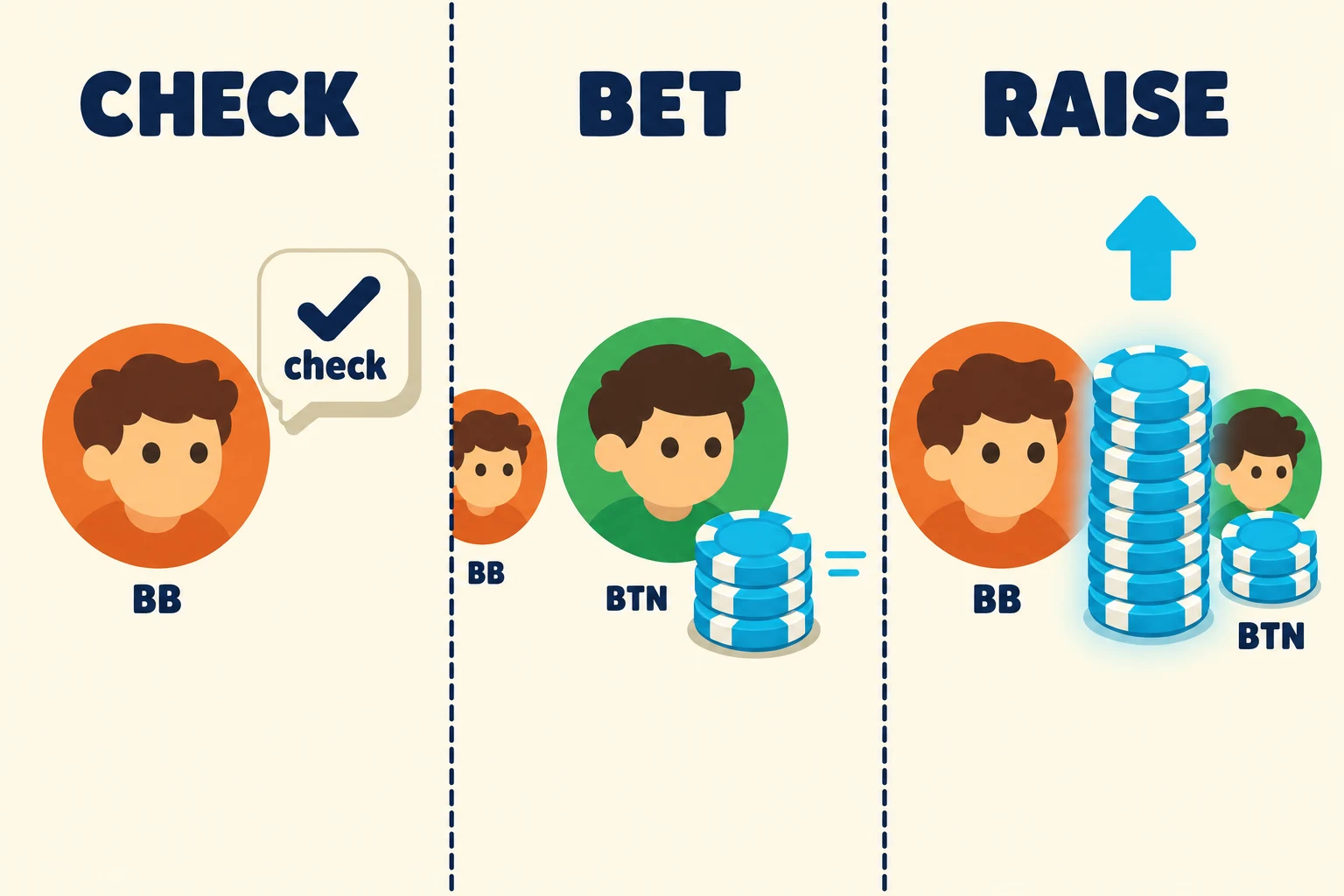
A check-raise is when you check intending to induce an opponent to bet, then raise. In No-Limit Hold'em, unconstrained raise sizes let the check-raise drastically grow the pot and alter decisions.

Practice this in Poker Skill. Out of position against the preflop raiser, the Lead and Donk Bets lesson has you check even a strong draw first and save the raise for after the bet.
Get the free appCheck-Raise (No-Limit Texas Hold’em)
What a check-raise is and why it matters
A check-raise is when you check intending to induce an opponent to bet, then raise. In No-Limit Hold’em, unconstrained raise sizes let the check-raise drastically grow the pot and alter decisions.
Use the check-raise for three purposes: trapping, extracting value and applying pressure. Trap by hiding a very strong hand, like a set (three of a kind using your pocket pair and a board card) or two pair, to build pot size. Extract value by converting passive action into bigger pots when you expect to be ahead. Apply pressure by bluffing or semi-bluffing (a bet or raise with improvement potential) to force folds or win the pot immediately.
Example: You flop a set of 7s on a J-7-2 board. Checking to induce a c-bet from an overcard-heavy opponent and then raising builds a much bigger pot than betting out yourself. Poker Skill drills the same trap with bottom set on 6-3-2: you check, let the button bet and then raise.
Main situations to consider using a check-raise
Use the check-raise most often in these situations:
- Against opponents who continuation-bet frequently: a check-raise punishes over-aggression and extracts value.
- With very strong hands (sets, two pair) on action-heavy boards: check, induce, then raise to build the pot.
- As a bluff or semi-bluff when you have strong equity (chance to win at showdown) or fold equity (chance opponents fold to your raise). For example, check-raising with a nut flush draw on a coordinated board can win immediately or improve to the best hand.
On A♠9♠4♦, holding K♠Q♠ gives a strong spade draw. Checking to induce a bet, then check-raising can fold out medium pairs and charge worse draws.
How opponent tendencies change your decision
Read opponents before using this line. Use this decision checklist:
- Will they bet if I check? If yes (an aggressive c-bettor), then check-raise becomes viable. If they often check back, the line fails.
- Do they call light or re-raise? If they call light, avoid bluff-heavy check-raises. If they often re-raise, restrict check-raises to premium holdings.
- What is my table image? If you rarely check-raise, opponents will bet more often into you. If you’re known for check-raising, they may stop betting light.
Example: Against a nit who rarely bluffs, a check-raise bluff has low fold equity. Against a frequent c-better who rarely folds, prioritize value check-raises.
Sizing and pot-management objectives
Match raise size to your objective. Make larger raises to build value and charge draws. Use medium-to-large raises to maximize bluff fold equity. Avoid oversized raises with marginal hands: they fold out worse hands and commit you to a big pot when a better hand calls.
Consider later streets and pick sizes that preserve believable lines. A small flop check-raise keeps the pot small, which leaves room to bet the turn for value. Conversely, overcommitting can create awkward decisions facing raises or calls later.
Practical guidelines and frequency balance
Balance matters. Mix value-heavy check-raises with occasional bluffs so opponents can’t always call or stop betting. Don’t overuse bluff check-raises; strong opponents will adjust by calling lighter or re-raising. A reputation for check-raising can deter light bets and boost long-term profit.
Quick checklist
- Target aggressive bettors and action-heavy boards for most check-raises.
- Match raise size to your objective: build value or generate fold equity.
- Mix value check-raises with occasional bluffs; avoid predictable patterns.