


Chop Pot
Chopping the pot means dividing it equally among the players whose best five-card hands tie at showdown. It's the verb players use at the table for the same outcome the rules call a split pot.
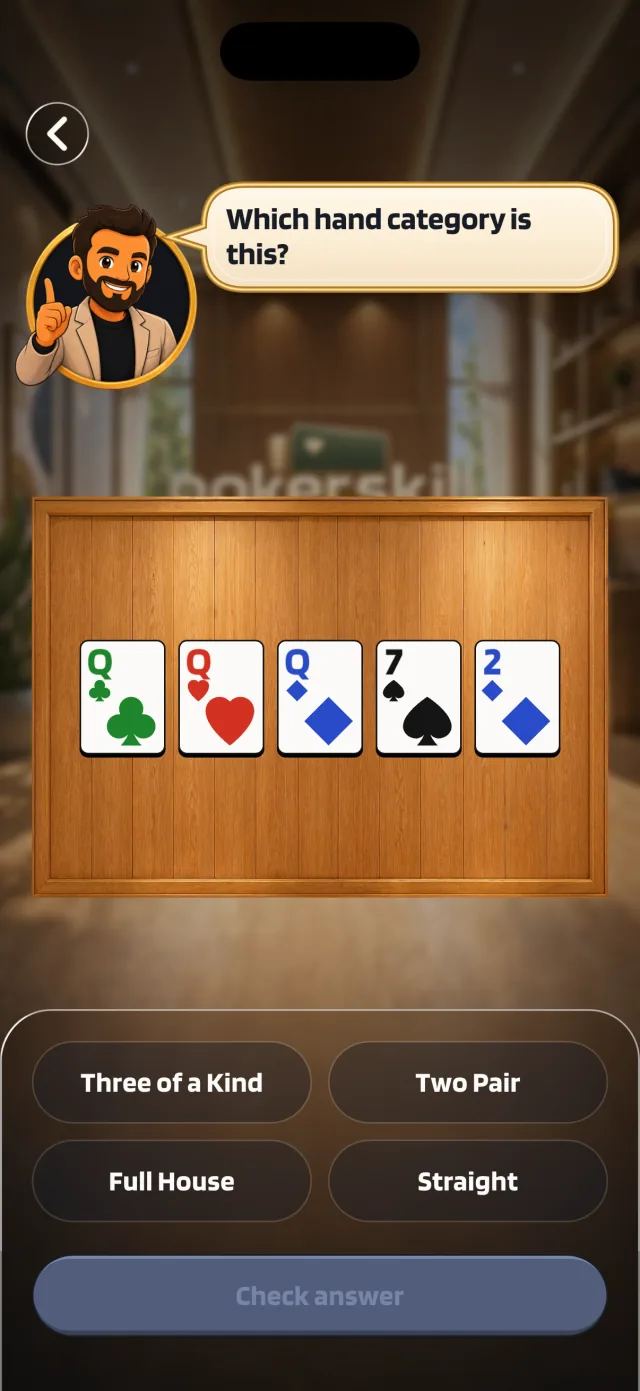
Practice this in Poker Skill. Spotting a chop is a drill in the Winners & Splits lesson, where a tie is one of the answers: when the board’s own 3-4-5-6-7 is both players’ best five, the pot splits.
Get the free appChop pot: dividing the pot when hands tie at showdown
What chopping the pot means
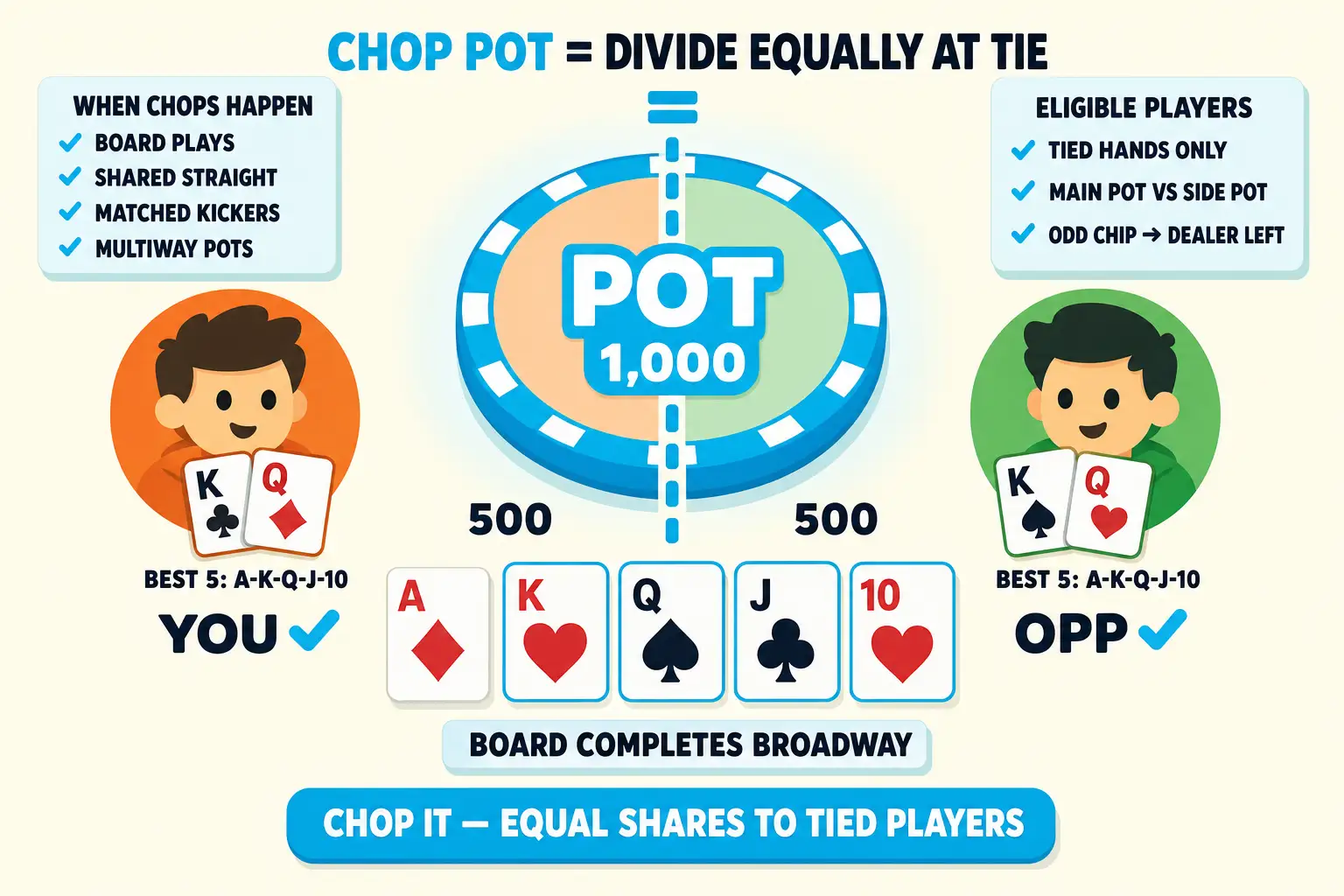
Chopping the pot is the table verb for dividing a pot equally among the players whose best five-card hands tie at showdown. When a dealer or player says “chop it” or “we’re chopping,” they mean the same outcome the rulebook calls a split pot: the pot is shared in equal parts among the tied players. In No-Limit Texas Hold’em the rule is simple. Identical best five-card hands divide the pot evenly, and suits never break a tie. The pot being divided is everything the betting built during the hand, blinds included.
Three different things “chop” can mean
The word “chop” gets used for three different table situations. The showdown chop above is the one most searches are about, but it helps to know the other two so you don’t confuse them:
- Showdown chop (this entry). Two or more players reach showdown with identical best five-card hands. The pot is divided equally among those tied players.
- Blind chop. It folds to the small blind and big blind. The two blind players agree to take their blinds back without playing the hand. This is a cash-game / live-table custom, not a hand result.
- Tournament deal chop. Late in a tournament the remaining players agree to split the prize pool by stack size or by an ICM calculation rather than play it down. This is a payout negotiation, not a chip outcome at the table.
If a search brought you here for a deal chop or a blind chop, those are separate concepts. The rest of this entry is about the showdown sense.
Related terms
Chop pot vs split pot vs tie
These three sit side by side in the glossary and get mixed up. The cleanest way to keep them straight:
| Term | What it names | Where it lives |
|---|---|---|
| Chop pot | The action of dividing the pot equally; what players say at the table | Showdown moment |
| Split pot | The formal rule and the resulting outcome | Rules / awarding the pot |
| Tie | The reason a chop happens: equal five-card hands | Hand comparison |
Same outcome, different lens. A search for “chop pot poker” is usually a vocabulary question; a search for “split pot rule” is usually a procedure question; a search for “tie at showdown” is usually a hand-comparison question.
Which pot gets chopped: main pot vs side pots
When everyone has chips behind, only one pot exists, so a chop divides that whole pot. The interesting case is when someone is all-in. With an all-in player and deeper stacks who keep betting, the chips build into a main pot plus one or more side pots. A chop only applies to the pot whose eligible players actually tie.
A few rules of eligibility:
- An all-in player is eligible only for the pots they paid into. They cannot win or chop a side pot built from bets above their own stack, regardless of hand strength.
- Each pot is awarded (or chopped) separately, based on the best five-card hand among that pot’s eligible players.
- If the all-in player ties the deeper stack on the best hand, they chop the main pot only. Any side pot is contested between the deeper-stacked players.
- One player can win one pot outright while another pot gets chopped. The pots don’t have to share an outcome.
Practical effect: an all-in short stack can table the same hand as a 200bb opponent and still walk away with only half the main pot, while the rest of the chips go to whoever wins the side pot.
When chops happen most
A few common shapes:
- The board plays. The five community cards already form the best five-card hand for everyone. Neither hole card improves it, so every player still in the hand chops.
- Shared straight. Two players hold cards that complete the same straight using the board (for example, two players each play a king for the high end of Broadway when QJ10 is on the board).
- Matched kickers. Both players make the same two pair from the board with kickers that tie.
- Multiway pots. With more players seeing showdown, more combinations of identical five-card hands become possible; chops show up more often than in heads-up pots.
- Counterfeited pairs. A river card pairs the board higher than your hole-card pair, so your “best five” becomes the board’s two pair plus a kicker. That’s the same five everyone else can play.
If you can spot one of those shapes on the river, you’ll usually save chips by checking instead of value-betting into a hand you can only chop.
Example: a board-play chop
Six-max NLHE cash, 100bb effective, blinds 1/2.
You open the hijack to 5 with 4♣ 4♠. The button calls. Both blinds fold.
- Flop: 8♥ 9♠ 9♥. You c-bet 7, button calls.
- Turn: K♣. You bet 16, button calls.
- River: 8♦.
The board now reads 8 9 9 K 8. Your best five-card hand is 9-9-8-8-K — using both pairs from the board plus the king. Your pocket fours have been counterfeited: a 4 doesn’t help you because two pair from the board outranks your underpair.
The button checks. You check behind. They show A♠ Q♣. Their best five is also 9-9-8-8-K, since the king kicker is the highest card either player can add to the board’s two pair. The hands are identical.
The dealer chops the pot. Each player gets half. If the pot is 47 chips after the rake, that’s 23 each, with the odd chip going to the player closest to the dealer’s left by house rule.
The recognition skill matters here: a value bet on the river is a mistake. Worse hands won’t call you (Q-high will fold), and the only hands that beat the board are full houses (any 9, any 8, any K-K), which would raise. The check-back is correct, and the chop is the rule outcome of two identical best fives.
Common mistakes
1) Treating “chop” and “split pot” as different rules
They aren’t. Chop is the verb at the table; split pot is the rule on paper. Same chips, same shares, same outcome. The only reason this glossary has separate entries is that searchers use both phrases.
2) Forgetting eligibility on all-in chops
A short-stack all-in tying the deeper player chops the main pot only. The side pot is fought over by the deeper stacks. Players who skip this step end up disputing chips they were never eligible for.
3) Trying to break a tie by suit
In Texas Hold’em, suits don’t rank. If both players make the same straight or the same flush by rank, the pot chops. Spades are not better than clubs, and a king-high straight made with the K♥ ties one made with the K♦.
4) Value-betting into an obvious chop
If the board already plays both hands and the only worse hands fold, betting just builds a pot you can only divide back. The fix is to check the river when you can see the chop coming and let the chips stay where they are.
FAQ
What does it mean to chop the pot in poker?
Chopping the pot means dividing it equally among the players whose best five-card hands tie at showdown. The dealer counts the pot, splits it into equal shares for each tied player, and gives any odd chip to the player closest to the dealer’s left.
Is a chop pot the same as a split pot?
Yes. “Chop pot” is the casual, at-the-table phrasing; split pot is the formal rule term. Both describe the same outcome: equal shares to the players whose best five-card hands tie. Search-wise they’re often used interchangeably.
Can an all-in player chop the main pot but not the side pot?
Yes. Eligibility for each pot is set when the chips go in. An all-in player is eligible only for the pots they paid into, so a tie that includes them divides only those chips. Any side pot is decided separately among the deeper-stacked players who contributed to it.
What happens to the odd chip when a pot won’t split evenly?
In most house rules, the smallest indivisible chip goes to the player closest to the dealer’s left among the tied winners. So a 23-chip pot between two players becomes 11 and 12, with the player nearest the dealer’s left getting the extra chip. Some rooms use other tiebreaks; the dealer announces the rule when it comes up.