


Multiway Pot
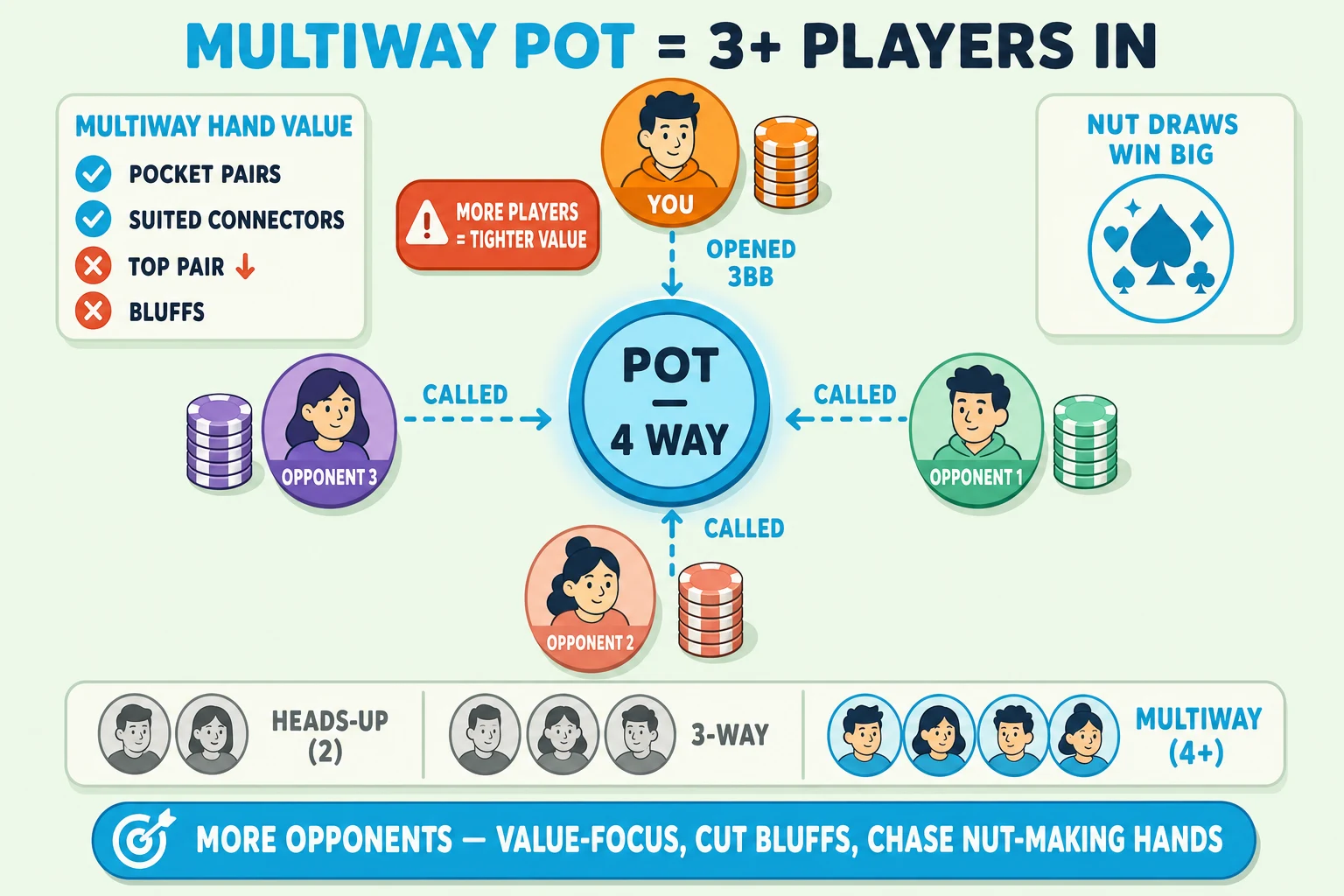
A multiway pot occurs when more than two players contest the same pot. More opponents increase the chance someone connected with the board or holds a strong draw. You must consider multiple ranges instead of a single opponent's range. Implied odds grow in multiway pots. Implied odds are the extra money you can expect to win if you hit a drawing hand. Speculative hands gain value for that reason. Conversely, heads-up strong hands like top pair lose value in multiway pots. The chance someone has you crushed or will outdraw you rises.

Practice this in Poker Skill. Two callers change the c-bet in the Multiway Continuation Bets lesson: you check K♥ T♥ on A♥ 9♦ 4♣, since a miss has too little fold equity three-way, and you bet 5♠ 5♦ on Q♥ 5♣ 2♦, where a set is clean value even against two players.
Get the free appWhat a multiway pot is and why it changes decisions
A multiway pot occurs when more than two players contest the same pot. More opponents increase the chance someone connected with the board or holds a strong draw. You must consider multiple ranges instead of a single opponent’s range. Implied odds grow in multiway pots. Implied odds are the extra money you can expect to win if you hit a drawing hand. Speculative hands gain value for that reason. Conversely, heads-up strong hands like top pair lose value in multiway pots. The chance someone has you crushed or will outdraw you rises.
Preflop hand selection and opening actions for multiway spots
Choose hands that can make big, disguised hands: pocket pairs, suited connectors, and suited aces. These hands win big pots when they hit sets, straights, or flushes against multiple callers.
- Call more with speculative holdings. Example: In middle position with 5♣5♦ and several limpers, calling to set-mine makes sense. A set can win a large multiway pot.
- Play suited connectors more liberally. Example: 8♦7♦ gains value when three players see the flop. A straight or flush can pay off many callers.
- Raise to thin with big-card hands. Example: With A♠K♦, raise preflop to avoid a bloated multiway pot. Big-card hands become vulnerable as only one pair when called by several players.
Post-flop priorities: draws, nut hands, and top-pair caution
After the flop, prioritize hands and draws that can become the nuts (the best possible hand on that board).
- Nut draws are especially valuable. Example: With A♠5♠ on K♠9♠2♦ you have the nut flush draw. Nut flush draws play well multiway because many opponents will likely pay you off if you hit.
- Non-nut draws are riskier. Example: Q♠J♠ on the same flop is a second-nut flush draw. You can still lose to an ace of spades or to already made hands.
- Treat top pair more cautiously. Example: On A♣8♦4♠ with A♦9♣ you have top pair. In a three-way pot expect more resistance and a greater chance someone holds a better hand or strong draw.
Betting strategy: value, bluffs, and straightforward play
Multiway pots favor simple, value-focused lines.
- Reduce bluffs. Multiple opponents make bluffing less effective because the chance at least one calls rises.
- Value-bet strong hands. When you have a nut or near-nut holding, extract value rather than try to fold opponents out.
- Use selective aggression. If you have position and reads that certain players fold often to pressure, a well-timed bet can work. Avoid heavy deception against several callers.
Table dynamics, position, and exploiting multiway tendencies
Position and observation matter more in multiway pots because hand-reading gets harder.
- Position increases your options to control pot size and gather information.
- Many players simplify their play in multiway spots. Watch who overcalls with draws, then target them with value bets.
- Exploit tendencies carefully-there is more variance and a bigger chance someone holds or draws to a better hand.
Rundown and connected hands: why they shine multiway
Rundown hands are connected cards that make many straights, e.g., JT98 or T987 in Omaha, or two-card connectors like J♠ T♠ and 8♦ 7♦ in Hold’em. Their connectivity raises the chance of making the nuts against multiple opponents. When these hands hit straights or strong two-way draws, they often win big pots.
Quick checklist
- Prefer pocket pairs, suited connectors, and suited aces when multiway action is likely.
- Consider calling with speculative hands; raise big-card hands to thin the field.
- Focus on nut draws and be cautious with non-nut draws and top-pair hands.
- Reduce bluff frequency; prioritize straightforward value betting.
- Use position and player tendencies to find profitable multiway lines while managing extra risk.