


MTT (multi-table tournament)
An MTT is a multi-table tournament: a single poker event with one buy-in and a fixed start time, played across many tables that get consolidated as the field shrinks. The format pivots from deep-stack patience early to short-stack pressure late, and every other tournament format defines itself relative to this one.
MTT (multi-table tournament): the format that gets bigger as it shrinks
What an MTT is
An MTT, or multi-table tournament, is a poker event with one buy-in, a fixed start time, and a field spread across many tables. Everyone starts with the same chip stack. As players bust, tables are broken and survivors are reseated to keep the remaining tables roughly balanced. When your chips are gone, you are out, unless the event is a rebuy or re-entry format. Most televised tournaments and almost every online evening grind happens in this format. Cash games and single-table sit-and-gos are usually defined against it. For how correct play changes from the first level to the final table, read MTT strategy phase by phase.
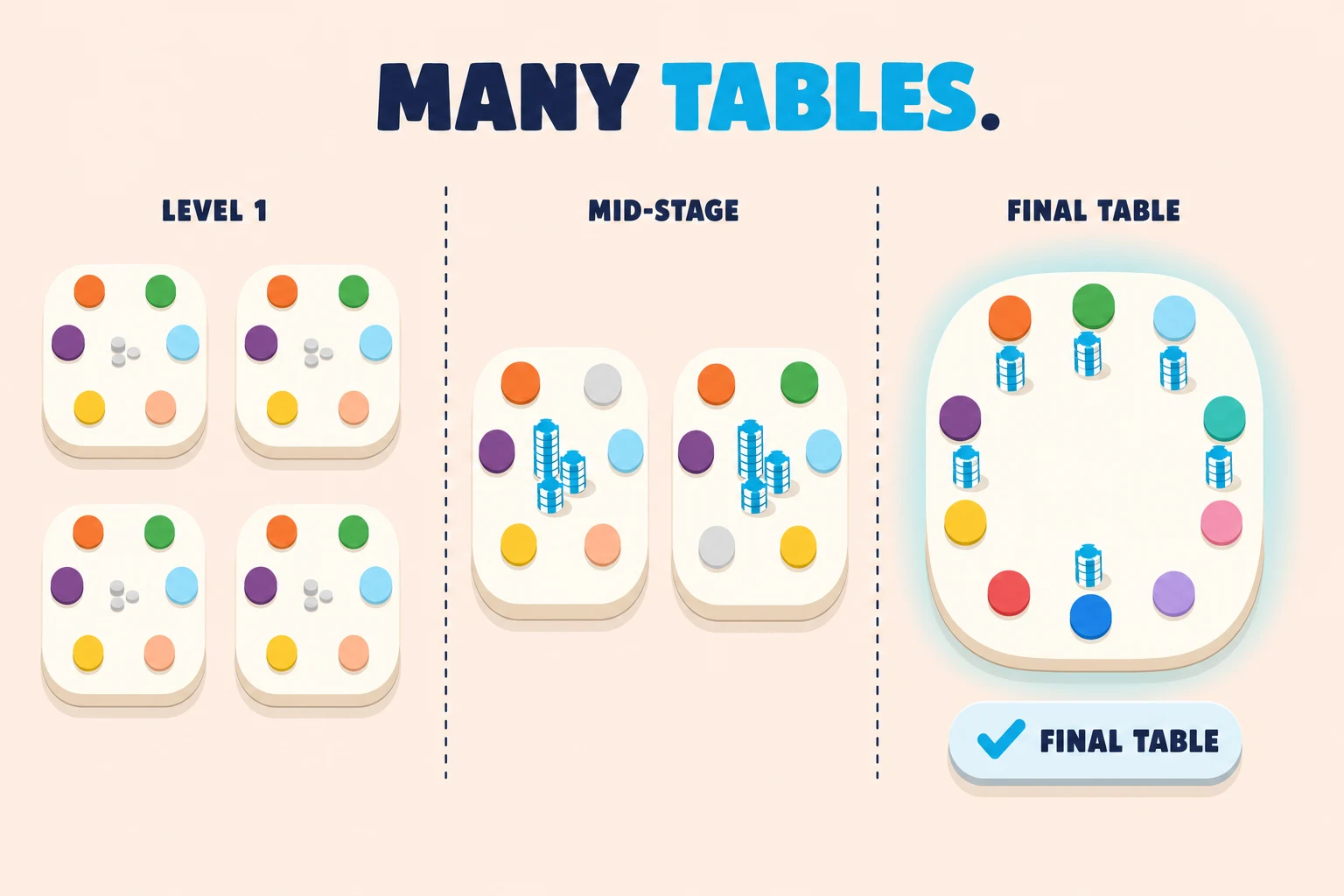
How an MTT differs from a cash game and a sit-and-go at a glance
- Cash game: chips equal money at face value. You can sit down, leave, or top up your stack at any time. There is no scheduled end. Decisions are about chip-EV.
- Sit-and-go: one or two tables, no scheduled start. The event begins when every seat is filled and ends quickly because the field is tiny.
- MTT: scheduled start, many tables, one prize pool, and chips that are worth less per chip the more of them you accumulate. Decisions late in the event are driven by ICM, not chip-EV.
Related terms
- Freezeout: the MTT subtype with one buy-in and zero re-entries.
- Rebuy: an MTT format that lets busted players buy more chips inside a window.
- Satellite: an MTT that awards seats to a bigger event instead of cash.
- Late registration: the window during which players can still join an MTT after cards are in the air.
- Bubble: the spot in an MTT where the next bust-out is the first non-paid finisher.
- Pay jump: the discrete cash steps between MTT finishing positions.
MTT vs. cash game vs. sit-and-go
The three formats are easy to confuse because the words sound similar. The distinctions matter because each format is a different game.
| Format | Scheduled start | Tables | Reload between hands | Chips equal money? | Endgame |
|---|---|---|---|---|---|
| MTT | Yes, fixed time | Many; consolidated as field shrinks | No (unless rebuy) | No: chip value diminishes via ICM | Final table, then heads-up for first |
| Cash game | No, drop-in | One | Yes, top up any time | Yes, at face value | None; you leave when you want |
| Sit-and-go | No, fills first | 1–2 | No | Mostly no; usually top three pay | Heads-up for first |
The rightmost column is the headline. An MTT has an arc: deep-stack opening, mid-stage stealing, bubble compression, in-the-money laddering, final table, heads-up. A cash game has no arc; you are always trying to make a chip-EV-correct decision. A sit-and-go has the same arc as an MTT but compressed into one or two hours instead of eight.
When the MTT format shapes your decisions
The format matters at every level, but it bites hardest at the transition points where the math changes.
- Early levels (~100 BB stacks). Patience pays. You have a long event ahead and post-flop room is wide. Marginal pre-flop flips for a full stack hurt your equity more than they help, even when chip-EV looks even.
- Middle stages (~30–50 BB). Antes kick in and there is real money in the middle before cards are dealt. Steal more, defend a bit looser, and avoid the spew that bored players burn through here. From the button over a raise and a call in Poker Skill’s squeeze lesson, you 3-bet A♥ Q♦ to take the chips already in the pot against fewer players.
- Late mid-stage (~15–25 BB). You are functionally in shove-fold territory. Most decisions facing a raise are jam-or-fold, and your hand range narrows accordingly.
- Bubble. ICM tightens calling ranges sharply and lets the chip leader pressure middle stacks who cannot afford to bust here. Close chip-EV calls become folds because the seat you give up by busting is worth real cash.
- In the money. Pay jumps get bigger as you climb. Short stacks who survive can ladder into real money even without winning chips.
- Final table. The biggest pay jumps live here. Medium and short stacks fold marginal hands they would call in any cash game. Big stacks press harder for the same reason.
- Heads-up. All payouts are decided. Both stacks pivot from survival math to first-place equity, and play opens up.
Example: stack depth across a single MTT day
You sit down in a $200 online MTT at 7:00 p.m. with 30,000 chips. Levels are 20 minutes. The field is 1,200 entries; 180 will be paid.
- 7:00 p.m., level 1 (100/200, no ante). You are 150 BB deep. Open ranges play deep. You see a flop, raise on a strong board, and stack a player who refuses to fold top pair. You are now 240 BB deep at one of the top stacks in the room.
- 9:30 p.m., level 8 (500/1,000, 100 ante). Stacks have come down even though yours has grown. The average stack is now around 60 BB. Your stack is 90 BB. The pace of the event has shifted. You are stealing more, defending the big blind wider, and folding the bottom of your opening range.
- Midnight, around the bubble (3,000/6,000, 750 ante). 200 players left, 180 paid. You are at 25 BB. Two stacks at your table are shorter than yours. The big stack to your left has 70 BB and is opening every other hand. You fold marginal pre-flop hands you would call in a vacuum because busting on the bubble turns a min-cash into a zero. The next twenty minutes are about surviving the bubble, not winning the tournament.
- 2:30 a.m., final table (60,000/120,000, 15,000 ante). You are nine-handed at 18 BB. Pay jumps between rungs are the biggest of the night. Your decisions collapse to a small set of profiles: shove this hand from this position with this stack, fold otherwise. The deep, post-flop game from level 1 is gone. The arc that started seven hours ago has tightened into a push-fold endgame.
The same event used four different sets of decisions across one night. Treating any of those stages like the others is the most common MTT leak.
Common mistakes
1) Treating tournament chips like cash chips
Tournament chips do not equal money at face value. Chips you risk are worth more than chips you can win, especially as you climb the prize ladder. The whole reason MTT strategy departs from cash strategy is this asymmetry. Players who carry cash-game intuition into an MTT make calls that are profitable in chip-EV but lose real money in $EV.
2) Overplaying premium hands at deep stacks
A♠ K♠ and pocket queens are the most-overplayed hands in the early levels of an MTT. They play well, but they are not hands you should commit 100 BB with on a tight three-bet. The cost of being wrong in level 2 is the entire tournament. Save the flip for a stack depth where the flip is forced or where you have meaningful equity to spare.
3) Ignoring ICM on the bubble
The single biggest leak near the money. “A chip is a chip” is true in a cash game and false in every tournament that pays by finishing place, freerolls included. When the field is one bust-out from the money, your calling range against an opponent’s shove should tighten sharply, and your stealing range against the players who cannot afford to bust should widen. Both adjustments are driven by the same number: how much the next pay jump is worth versus how much your stack is worth if you bust.
4) Refusing to fold at the final table
The pay jumps at a final table are the largest in any MTT. Medium stacks fold hands they would call in cash without thinking. Short stacks ladder by surviving, not by gambling. Big stacks press the gas because their opponents must call extremely tight. The mistake is to play the final table like a deep cash game. One old rule still holds even here: the Zeebo theorem says no player folds a full house at any bet size, so aim your pressure at the hands that can fold.
FAQ
How is an MTT different from a sit-and-go?
A sit-and-go is a small tournament that begins as soon as every seat is filled. It is usually one or two tables, the top two or three players cash, and the whole event finishes in one or two hours. An MTT has a fixed start time, runs across many tables, and lasts long enough that stack depth changes shape several times across one event. Strategically, a sit-and-go is most similar to the final table of an MTT compressed into the whole event.
Why are MTTs so swingy?
Because variance compounds. To finish first in a 1,200-runner MTT you need to win or hold your ground in something like 30 to 60 critical pots, against many opponents, across many hours. Each of those pots has variance. The longer the chain, the wider the swing. Strong MTT players measure success in cashes per hundred entries and ROI over thousands of events, not by the result of one Sunday night.
How long does a typical online MTT last?
A standard online MTT runs four to ten hours, depending on field size, blind structure, and how late you go. Live MTTs are slower because a live table deals far fewer hands per hour. The Sunday Million-style flagship tournaments often run eight to twelve hours from start to first place. Smaller turbos compress the same arc into ninety minutes or less.