


Rebuy
A rebuy is the option to post the buy-in again during an early window of a tournament if your stack falls below the starting amount or you bust. The window typically runs through the first break, after which the format hardens into a freezeout. Rebuys change how you play the early levels, how much the event actually costs you, and where the real strategic moments hide.
Rebuy: a tournament with a second-chance window
What a rebuy is
A rebuy is the option to post the buy-in again during an early window of a tournament. You can normally use it any time your stack falls under the starting chip amount, including the moment you bust, and the window stays open until a fixed point in the structure (usually the end of the rebuy period at the first scheduled break). Each rebuy hands you a fresh starting stack at the current blind level for the same cash as the entry, often with the registration fee waived. Once the window closes, the event hardens into a freezeout: no more chips for sale at any price.
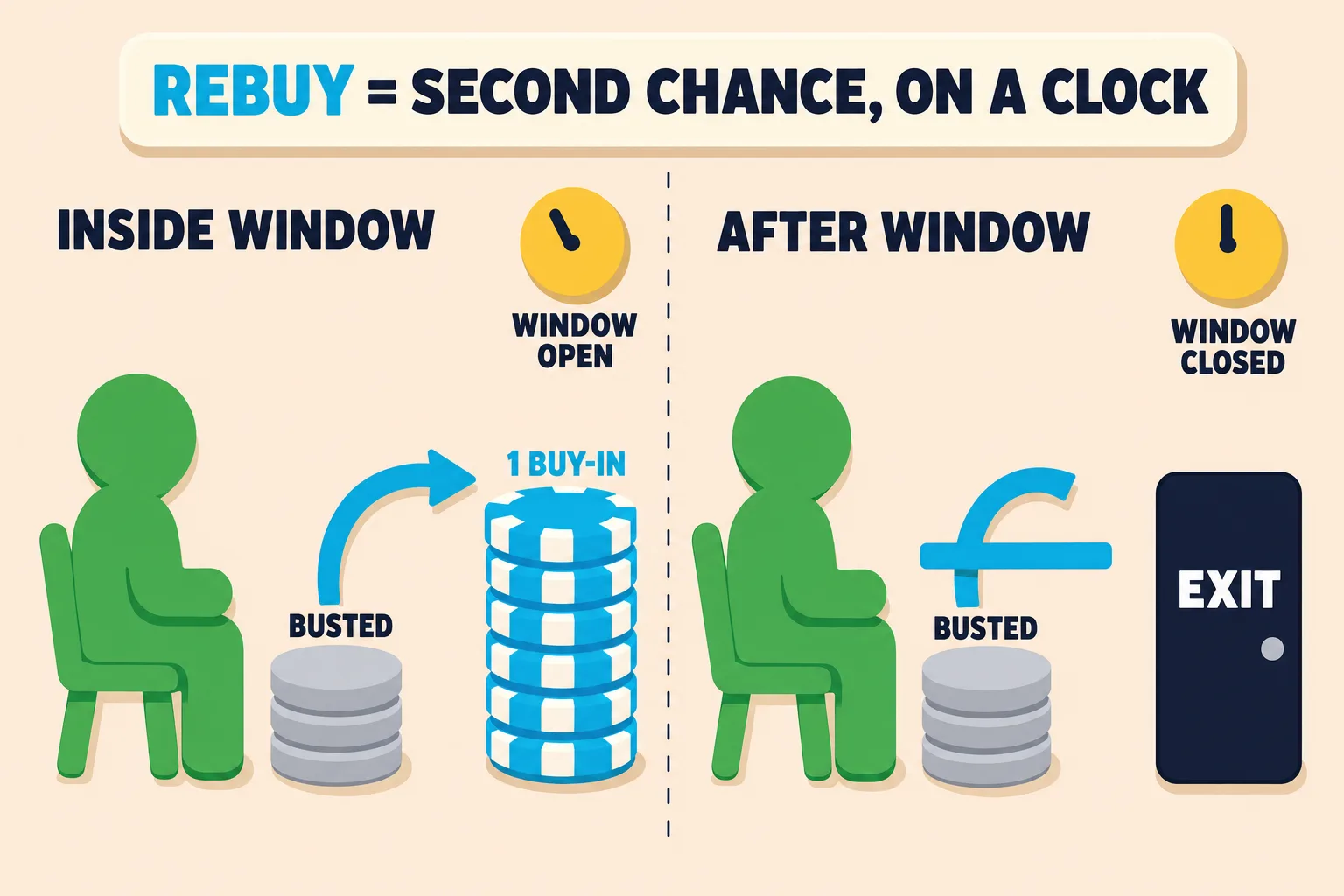
The rebuy is sometimes paired with an add-on: an optional one-time chip purchase offered at the end of the rebuy period, usually at a small chip discount and available regardless of your stack. A rebuy is a replacement stack while the window is open; an add-on is an extra stack at the moment the window closes. They live next to each other in the same structure and players often confuse them, but only the rebuy is conditional on busting or running short.
Why the format changes how you play
The single rule “you can replace your chips during a window” inverts the survival pressure that defines a freezeout. Early on, the chips in front of you are not your tournament life — they are a bullet, and you have more bullets in your wallet. That makes early-level chip-EV mistakes recoverable in a way they are not in a one-shot event. After the window closes the format reverts to standard tournament rules, and the same chips that were cheap to replace are now your only stack.
Poker Skill has no rebuys to make, because there are no chips to buy in it, and its lessons deal cash-game hands, the format a rebuy window plays most like.
Related terms
- Freezeout: the format rebuys are most often contrasted with — one buy-in, no second chances.
- ICM: the math that takes over once the window closes and the event approaches the money.
- Bubble: the late-stage spot where rebuy and freezeout converge on tight calling ranges.
- Short stack: the band most rebuy survivors play in for hours after the window ends.
- Stack depth: measured in big blinds, and the lever that decides which mode you are in.
- Cash game: the closest mental model for how the rebuy window actually plays.
Rebuy vs. freezeout vs. add-on
The three terms get tangled because they all touch buy-ins, but they are different mechanics doing different jobs.
| Mechanic | When it applies | What you get | Total commitment per shot |
|---|---|---|---|
| Freezeout | Single buy-in, no second chances | One starting stack | 1× the entry |
| Rebuy | Inside the rebuy window, when your stack is below the starting amount or you bust | A fresh starting stack at current blinds | Often 1× to 4×+ the entry |
| Add-on | At the end of the rebuy period, regardless of stack | One extra chip block, usually slightly more chips than starting | Adds one fixed payment to whatever you already spent |
The point of the table is the right column. A freezeout’s price is fixed before you sit down. A rebuy’s price is bounded by the rebuy rules and your willingness to keep posting; the rule of thumb players use for budgeting is “buy-in plus two rebuys” as a baseline, with three or four common in events where the field plays loose. The add-on is a third decision that arrives at the window’s edge and is almost always correct to take when offered with a chip overlay.
A re-entry tournament is sometimes confused with a rebuy because both let you post the buy-in again. The difference is structural: a re-entry seats you at a new table with a fresh random draw, usually capped at one or two re-entries; a rebuy keeps you at the same table and often allows buying in twice at once for a double starting stack.
When the rebuy window changes how you play
The format matters at every stage, but the spots where it changes your decisions are concentrated around the window itself.
- Early levels of the window. Chips are replaceable. You can take chip-EV-positive flips you would fold in a freezeout because the downside is a posted rebuy, not your tournament life. That does not mean every spot is a flip — it means the marginal call you would never make in a freezeout is fine here.
- End of the rebuy period. The last hand or two of the window is the most chaotic moment of the event. Short stacks gamble for double-or-bust because a single all-in either hands them a useful stack or sends them to one final rebuy. Pay attention to who is shoving and adjust your calling ranges wider against them.
- The pivot to the post-window event. Once the window closes, the structure is a freezeout with deeper-than-starting stacks and an unusually loose recent history. Players who keep playing rebuy-window-loose into the post-window event give chips back to anyone who tightens up. This is the moment to switch to your A-game.
- Near the money (the bubble). Same math as any other tournament. ICM tightens calling ranges; close chip-EV calls become folds because the seat you give up by busting on the bubble is worth real money.
- Final table. Pay jumps live here. Medium and short stacks fold marginal hands they would call in a cash game without thinking; big stacks press harder for the same reason.
The handoff is the load-bearing moment. Players who treat the post-window event like the rebuy window leak chips; players who treat the rebuy window like a freezeout leave chips on the table by folding spots that are clearly profitable when the bullet is replaceable.
Example: the end-of-window double-up shove
You are at a $100 rebuy with five-minute levels, blinds at 100/200, no ante, ten minutes left in the rebuy period. Starting stack was 5,000 chips. You are sitting on 1,800 chips after a rough early run — about 9 big blinds.
A loose-aggressive player from the cutoff opens to 500. Folds to you in the small blind with 8♠ 8♣. You have two real choices.
Option A — fold. In a freezeout, this is a fold for most stacks. 9 BB is shove territory but a marginal pair is not your best shove hand against a wide opener.
Option B — shove for 9 BB. In the last orbit of a rebuy, this changes shape. If you shove and lose, you bust with eight minutes of rebuy time still on the clock. You post another $100, sit back down with a fresh 5,000 chips at the same 100/200 blinds, and you are now a 25 BB stack at a level where most opponents are deeper than that. If you shove and win, you double to roughly 18 BB and you have not posted another rebuy.
The math leans toward shoving here, because your equity sitting on 9 BB at 100/200 is poor and the cost of being wrong is one buy-in for a 25 BB starting stack at the same level. The same shove from the same hand ten minutes after the window closes is closer to a fold — there is no replacement stack waiting, so the cost of being wrong is your tournament.
This is the asymmetry the rebuy window creates and the asymmetry that vanishes the second the window closes.
Common mistakes
1) Refusing to rebuy on principle
Some players treat a single buy-in as a personal rule, then refuse to rebuy even when the table is soft and the price is correct. The rebuy is part of the format. If the field around you is replacing chips and you are not, you are conceding chip-supply ground that compounds for the rest of the event.
2) Unlimited-rebuy spew
The opposite mistake: playing pots you would not play in any other format because the chips are cheap, then posting rebuy after rebuy without an exit plan. The number that matters is what you actually invested when the window closes. The rule of thumb is two rebuys; if you are at five with no chips to show for it, the table is not soft enough or your read is wrong, and another posting will not fix either problem.
3) Playing the post-window event like the rebuy window
The most common in-game leak. Players who built a stack by punting wide hands in the rebuy period often keep punting after the window closes. The chips that were cheap an hour ago are now your only chips. Tighten up, switch to your A-game, and let the opponents who did not get the memo donate.
4) Ignoring ICM on the bubble
Once the money is in sight, the post-window event behaves identically to a freezeout. Calling ranges should tighten. Players who think “a chip is a chip” call off marginal hands, bust on the bubble, and turn a min-cash into a zero. The right reaction to ICM pressure is to fold tighter when called, then steal more when stealing.
FAQ
How many times can you rebuy in a typical tournament?
Most rebuy events allow unlimited rebuys during the window, conditional on your stack being below the starting amount (or you having busted). The window almost always closes at the first scheduled break, somewhere between 60 and 120 minutes into the event. A handful of events cap rebuys at a fixed number per player; check the structure sheet before you sit down. The practical bankroll number is “buy-in plus two rebuys” as a baseline; three or four is common in soft fields.
Can you rebuy if you still have chips?
Most rooms let you rebuy any time your current stack falls below the starting chip count. Some only allow it on a busted seat. Read the event’s structure sheet — the rule varies by venue. Where the option exists, posting a second buy-in while still holding chips is usually called a “double-up rebuy” or “double rebuy” and is most useful early when 5,000 extra chips at the same level genuinely matters.
Are rebuy events still common?
Less common than they used to be. Most live and online operators have shifted toward re-entry formats, where a busted player gets a fresh stack at a new table for a fixed number of bullets, capped at one or two re-entries. The rebuy format still appears in dedicated rebuy events (“$10 rebuy nightly”), in some satellite structures, and in older live tournament series, but the modern default for “second-chance” tournaments is re-entry rather than rebuy.