


Realized Equity
Realized equity is the share of the pot a hand actually converts into expected value once position, future betting, folds, and the runout play out. It is the result that equity realization measures — the chips your raw equity becomes after the hand finishes.

Practice this in Poker Skill. The Button vs CO Open lesson calls with suited A9 and J9 because position helps them realize their equity, while J8 offsuit still folds on the button.
Get the free appRealized equity: the share of the pot your hand actually keeps
Realized equity in plain English
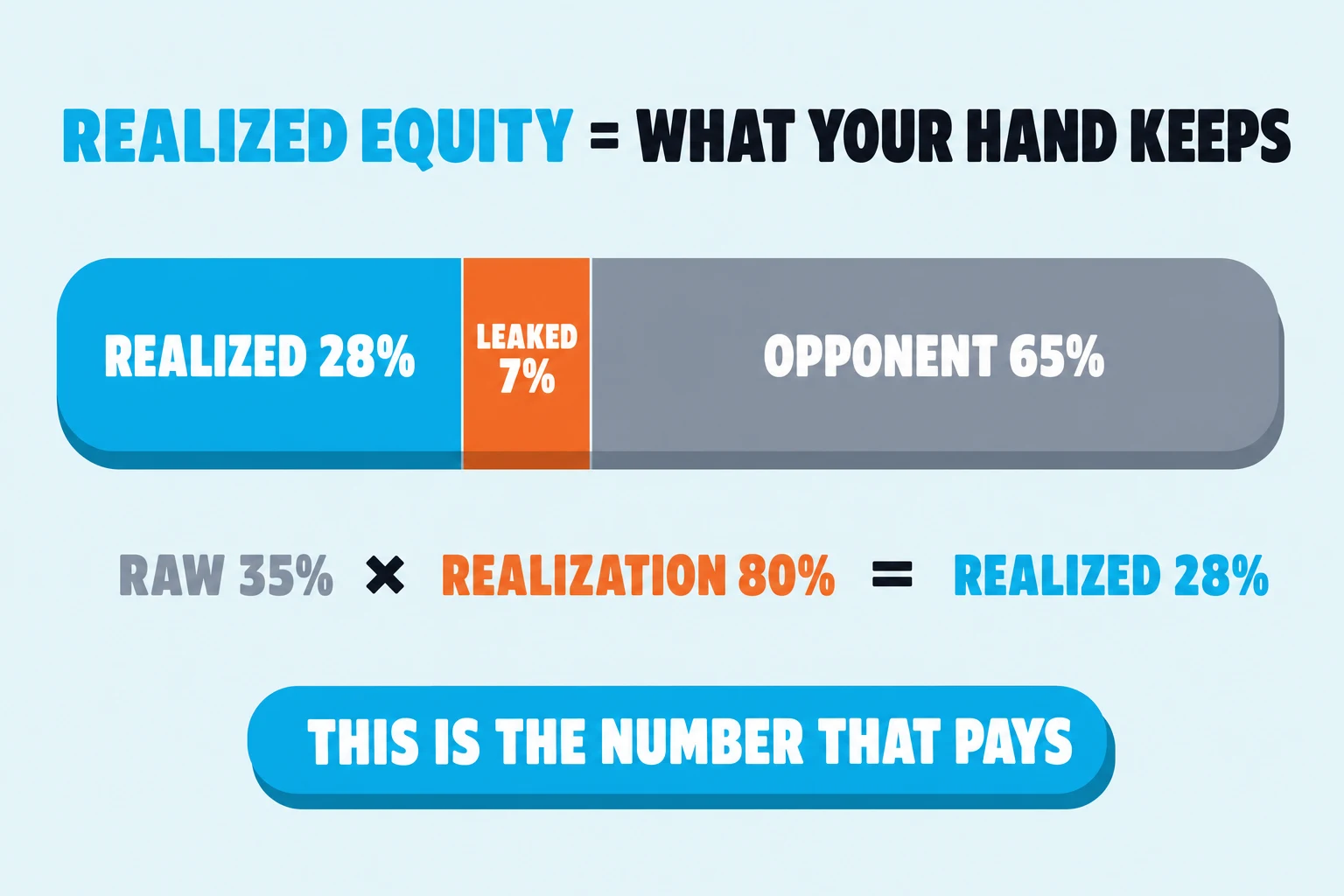
Realized equity is the share of the pot a hand actually turns into expected value by the time the hand is over. It is the outcome after equity realization has run its course — the chips, expressed as a fraction of the pot, that the hand ends up with on average across many runs of the same spot. If raw equity is the showdown number a calculator returns and equity realization is the ratio between what should pay and what actually pays, realized equity is the answer at the end: the share you keep.
A useful mental shortcut:
- Raw equity is the input. Equity realization is the multiplier. Realized equity is the output.
- A hand with 35% raw equity and an 80% realization factor has a realized equity of 28% of the pot.
- In an all-in spot there is nothing to leak, so realized equity equals raw equity. Outside of all-in, the gap between the two is where most postflop EV is won or lost.
Related terms
- Equity realization
- Raw equity
- Equity
- All-in equity
- Pot odds
- Implied odds
- Reverse implied odds
- Position
Realized equity vs raw equity, equity realization, and all-in equity
These four ideas point at the same pot from different angles, and they get blurred together constantly. Holding them apart is most of the work.
| Concept | What it is | Form |
|---|---|---|
| Raw equity | Showdown win-rate if cards just run out, no betting, no folds | Pot share (the input) |
| Equity realization | The fraction of raw equity a hand converts to EV across the rest of the hand | Ratio, e.g. 80% (the multiplier) |
| Realized equity | The share of the pot the hand actually keeps after realization is applied | Pot share (the output) |
| All-in equity | Realized equity in the special case where both stacks are committed | Pot share, with realization frozen at 100% |
The shortest version: equity realization is the verb, realized equity is the noun. Equity realization describes how much of your raw equity survives the realities of the hand. Realized equity is what is left once it has.
What raises or lowers the share you actually realize
Realized equity is shaped by the same inputs as the realization ratio behind it. None of them are about the hole cards in isolation.
- Position. Acting last is the single biggest realization lever. In position the hand can take free cards, control pot size, and react to the opponent’s action, so more of its raw equity survives. Out of position the same hand faces bets that fold out live equity before the river.
- Suitedness and connectedness. Hands that flop draws, backdoor draws, or pair-plus-draw combos keep finding ways to continue, so they realize more of their raw share. Offsuit, weakly connected hands have to either pair and hold or fold, which leaks more.
- Stack-to-pot ratio. Lower SPR favors strong made hands that want to commit; higher SPR rewards speculative hands when they hit and punishes dominated hands when they make second-best. Stack depth pulls realization up for some hands and down for others in the same spot.
- Range advantage. A hand that lives inside a range with a range-vs-range edge realizes more of its share, because the opponent cannot bet aggressively into a range that has them beat.
- Hand strength shape. Very strong and very weak hands are easy to realize — call or fold cleanly. Medium-strength hands are the hardest, because they want showdown but cannot stand pressure, and that is exactly where realized equity drifts furthest from the raw number.
Example: 8♠7♠ in position vs A♣Q♦ out of position
Two defends with similar raw equity against a typical button opening range, very different realized equity.
Setup: 6-max NLHE cash, 100bb effective. The button opens to 2.5bb. Use the same opening range for both hands so the only thing that changes is the seat and the cards.
Hand A: 8♠7♠ defended on the button — suited, connected, in position.
- Raw equity versus a typical button opening range is roughly 38–40% (illustrative; the exact number depends on the range you load).
- Realization factor runs high. The hand flops a piece of the board often (pair, gutshot, open-ender, flush draw, backdoor combo draws) and acts last on every street. It can take free cards on the turn, semi-bluff when the opponent shows weakness, and hit a disguised straight or flush that gets paid on the river.
- Realized equity lands above raw, often in the 40–45% range of the pot in many runouts. The hand over-realizes because nearly every flop has a credible plan.
Hand B: A♣Q♦ defended in the big blind — strong unpaired broadway, out of position, played as a flat rather than a 3-bet.
- Raw equity against the same button range is also in the 38–42% neighborhood, similar to 87s.
- Realization factor runs low. AQo flops top pair on roughly one in three flops; the rest of the time it is ace-high or queen-high with limited paths forward. A flop c-bet folds out the live ace-high half of the equity. When the queen pairs into a king-high flop, it pays off worse hands and gets stacked by better ones, classic reverse implied odds.
- Realized equity lands well below raw in many runouts when the hand is flatted out of position. The hand under-realizes because the cleanest paths to use that ace-high equity get charged or folded off.
The takeaway is not that AQo is the weaker hand at showdown. AQo is the stronger hand at showdown by some margin. The point is that two hands with similar raw equity can land at very different realized-equity numbers depending on position, structure, and the action that follows. The number that actually pays is the realized one.
Common mistakes
1) Reading raw equity as realized equity
The most common leak: pot odds say you need 30% to call, the calculator shows 35% raw equity, the call goes in. Then the flop misses, the turn barrel comes, the river bluff peels off. The hand had 35% raw equity and realized 22%. The decision was negative the whole way through, even though the price looked right. Realized equity is the only number that prices the bet and the streets that follow.
2) Forgetting position is most of the story
The same hand realizes wildly different equity in different seats. A hand that is a clear over-realizer in position can be a clear under-realizer out of position against the same range. Defending ranges built on raw equity alone are the kind that bleed on the OOP half of the spreadsheet.
3) Treating dominated hands at their raw-equity share
A dominated kicker (KQo against an opening range that has KK, AK, AQ, KJs all hard to fold) has decent raw equity on paper. The realized number is much worse, because the hand routinely improves to second-best and pays off, while the times it has the opponent dominated rarely play a big pot. Reverse implied odds eat realized equity from the inside.
4) Ignoring stack depth’s two-way effect
Stack depth pushes realized equity in both directions. The same suited connector that under-realizes at 30bb can over-realize at 200bb, because the times it hits a flush get paid much harder. The same dominated kicker that scrapes by at 50bb realizes worse at 200bb, because second-best costs a stack instead of a pot. Stack depth is not a one-way dial.
FAQ
What is the simplest definition of realized equity?
Realized equity is the share of the pot a hand actually keeps once the hand is over, averaged across many runs of the same spot. It is what raw equity becomes after position, future betting, folds, and the runout finish acting on it. A hand with 40% raw equity that captures 32% of the pot on average has 32% realized equity.
How is realized equity different from equity realization?
Equity realization is the ratio: the fraction of your raw equity a hand converts into EV (e.g. 80%). Realized equity is the result: the share of the pot the hand keeps after that ratio is applied. Equity realization is the dial; realized equity is where the needle lands. The two ideas describe the same process from different sides, and most people use the terms loosely. Holding them apart helps when reading solver outputs or training material that reports both numbers.
Why does a hand with more raw equity sometimes have less realized equity than a hand with less raw?
Because raw equity is silent on which hand can keep its share. Strong unpaired broadway hands defended out of position often have high raw equity and low realization, because their paths to use that equity get folded out or charged. Suited connectors in position often have lower raw equity and higher realization, because almost every flop gives them a path forward. Same range, same price, very different realized equity.
Does realized equity ever exceed raw equity?
Yes. Whenever a hand realizes more than 100% of its raw equity, realized equity is the larger number. That happens most often in position, with playable suited or connected hands, against opponents who fold too much to barrels or pay off draws too thinly. The hand wins pots its raw equity alone would not have won, by collecting fold equity and implied odds on top of showdown equity.