


All-in Equity
All-in equity is the share of the final pot a hand expects once both players are committed and no more betting can change the outcome. It's the equity number a calculator returns when only the runout is left.

Practice this in Poker Skill. The rule of 2 and 4, taught in the draw lessons, is the quick version of this number for a draw: nine flush outs times four, with the turn and river still to come, lands near the true 35%.
Get the free appAll-in equity: your share of the pot once betting is over
All-in equity in plain English
All-in equity is the share of the final pot a hand expects once both players are committed and no further betting can change the outcome. It’s the percentage an equity calculator returns when the chips are in the middle and only the runout is left. In that frozen moment, expected value collapses into one calculation: equity × pot. Nothing else can move it.
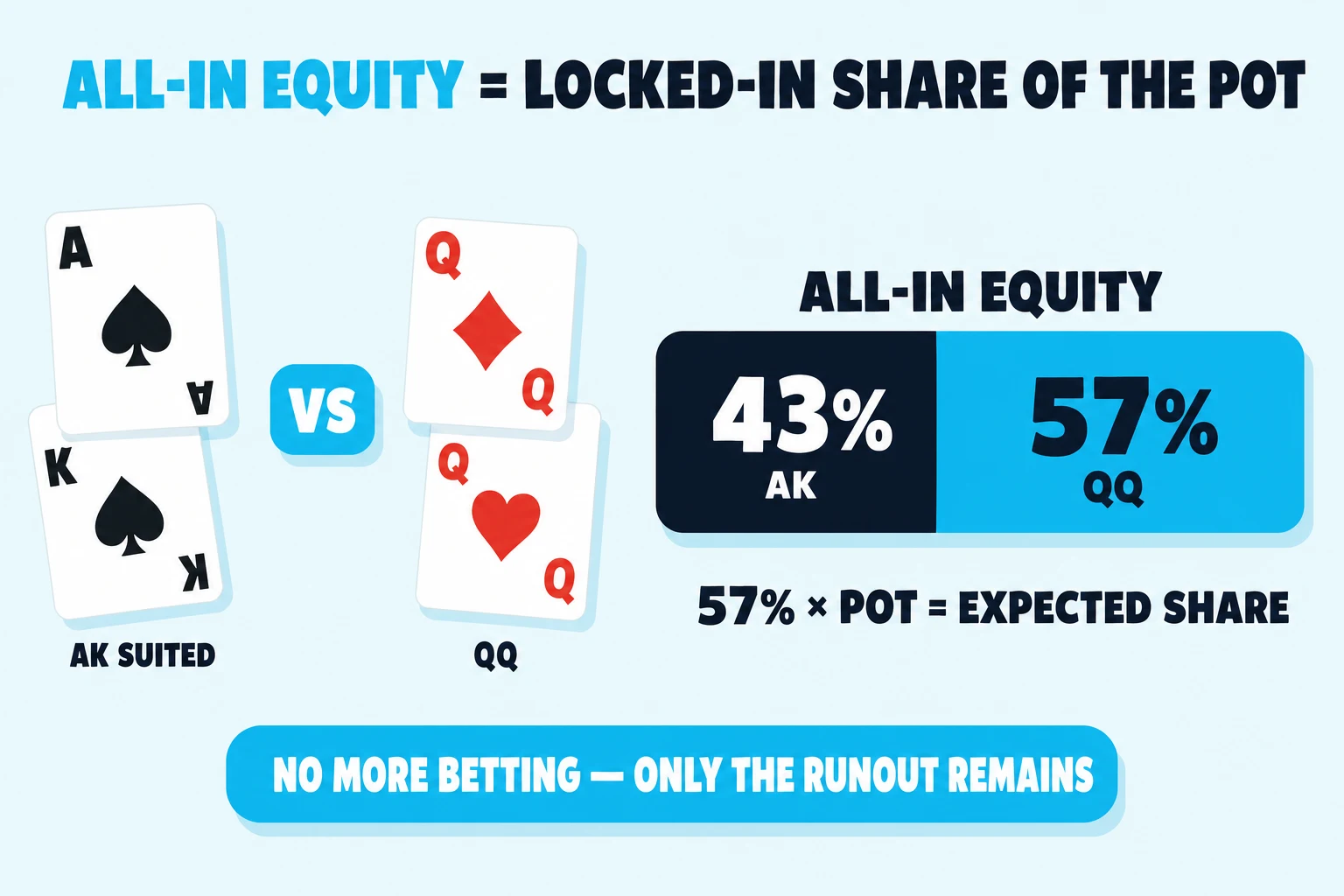
A useful mental shortcut:
- All-in equity is a probability over runouts, not a guarantee. A 57% favorite still loses 43 hands out of 100.
- It can be measured against a single known hand (hand-vs-hand) or against the spread of hands a caller could have (hand-vs-range). Calculators do both.
- The same hand has different all-in equity on different streets. AK has ~43% all-in preflop against QQ; flop a king and the number jumps; flop a queen and it craters. Each new card resets it.
Related terms
All-in equity vs raw equity, equity realization, and pot odds
These four concepts overlap in the same hand but answer different questions. Mixing them up is the most common reason a “+EV” call turns out negative.
| Concept | What it tells you | What it does NOT tell you |
|---|---|---|
| All-in equity (raw equity) | Your % share of the pot if no more betting happens and the runout resolves the hand | What happens in spots where there IS more betting |
| Equity realization | The fraction of your raw equity you can actually convert to EV when betting continues | The price tag on this exact decision |
| Pot odds | The minimum equity you need right now to call this bet at break-even | How equity will move on later streets |
| Expected value (EV) | The chip outcome of a decision averaged over many runs | Which decision was responsible for which slice of EV |
The shortest version: all-in equity is the version of equity that doesn’t have to be realized. Once both stacks are in, the realization factor jumps to 100% by definition. That’s the reason “raw” equity and “all-in” equity get used interchangeably — when no more betting can leak equity to folds, raw equity IS realized equity.
When all-in equity matters most
The value of the concept changes by spot. A few situations where it’s the deciding number:
- Calling an all-in shove. No streets left. No realization concerns. The decision collapses into “is my equity better than the price I’m being laid?” If pot odds say you need 33% and you have 38%, call. If you have 28%, fold.
- Jam-or-fold spots at short stacks. When you shove 12bb, the only EV terms that survive are fold equity (how often the opponent folds) and your all-in equity when called. Both stack-depth math and Nash push-fold charts assume realization is 100%.
- Side pots. When stacks differ at the all-in moment, your all-in equity only cashes in the main pot you’re eligible for. Any chips beyond your stack form a side pot that you cannot win — your equity in those chips is zero, full stop.
- Multiway all-in math. Three-handed all-ins price out differently from heads-up. Your all-in equity gets divided across two opposing ranges, and the dead money from the bust pays out per-side-pot.
- Runout reasoning before the bet. Even when you’re not all-in yet, asking “if we both got it in here, what’s my all-in equity?” gives you the floor for the decision. If the floor is bad, any profit from betting has to come from fold equity.
When it matters less: deep-stacked, multi-street pots where most of the EV lives in future betting decisions. There, equity realization, fold equity, and implied odds matter more than the raw all-in number.
Example: AK vs QQ all-in preflop for stacks
A common spot where the equity number surprises people.
Setup: 6-max NLHE cash, 100bb effective. You open A♠K♣ to 2.5bb from the cutoff. The big blind 3-bets to 11bb. You 4-bet to 25bb. They 5-bet jam for 100bb. The pot in front of you sits at ~125bb (your 25 + their 100 + the dead small blind), and you’re being asked to call another 75bb to play for stacks.
The math:
- You’re risking 75bb to win 125bb. Break-even equity = 75 / (125 + 75) = 37.5%.
- A♠K♣ vs Q♦Q♥ is approximately 43% / 57%. That’s about 5.5 points above the break-even line.
- EV(call) ≈ (0.43 × 125bb) − (0.57 × 75bb) ≈ 53.75 − 42.75 ≈ +11bb compared to folding. The call is +EV.
What changes if QQ is replaced with KK:
- A♠K♣ vs K♦K♥ is roughly 30% / 70%. That’s 7.5 points below the break-even line.
- EV(call) ≈ (0.30 × 125bb) − (0.70 × 75bb) ≈ 37.5 − 52.5 ≈ −15bb. The call costs chips on average compared to folding.
Your ace-king is the same in both versions. The all-in equity changes because the opponent’s holding changes. That’s the whole point: all-in equity is relative to whoever is on the other side of the chips.
In a real spot you don’t know if it’s QQ or KK; you weight both (and AA, and AKs) by how often you think the opponent holds each. That weighted average is your all-in equity vs their range.
Common mistakes
1) Treating all-in equity as a guaranteed outcome
A 57% favorite is favored, not safe. Over four hundred all-ins for stacks at 57%, you’ll lose 172 of them. That’s a lot of buy-ins from a hand that “should win.” All-in equity is a long-run average. Expecting it to hold over a small sample is how confidence in the math turns into mistrust of the math.
2) Mixing up all-in equity with realized equity in non-all-in spots
The mistake reads “I have 35% equity, pot odds are 30%, this is +EV.” Pot odds are correct. The 35% is raw all-in equity, not realized equity. If the hand can’t continue past most flops it sees, the realized number is closer to 22%, and the call is a quiet leak. All-in equity is the right number only when a call puts all the chips in, as when you face a shove or choose to jam.
3) Forgetting side-pot eligibility
Three-way pot, you’re the short stack with 30bb and you shove. The other two players have 100bb each and one calls, the other goes deeper. Your all-in equity only matters for the main pot you’re matched into. The side pot the deeper stacks contest is invisible to you — your equity in it is zero, no matter what the runout does. Counting side-pot chips into your EV counts chips you cannot win.
4) Reading single-hand results as equity feedback
Your all-in equity for AK vs QQ is ~43%. You jam, get called, lose. That outcome is not evidence the math was wrong. It’s one of the 57 outcomes per hundred where QQ holds. Equity numbers are validated by sample sizes in the thousands. Single hands are noise.
FAQ
What is the simplest definition of all-in equity?
All-in equity is the share of the pot a hand expects to win when both players are all-in and the runout decides the result. If your hand has 60% all-in equity in a $200 pot, you expect to take $120 on average over many runs. Single hands still resolve as one or the other.
How is all-in equity different from regular equity?
It’s the same idea, applied to a frozen moment. Regular equity is your win probability at any point in the hand. All-in equity is the version of that probability where there’s no more betting to come — only cards. The distinction matters because regular equity has to be “realized” through future streets, and folds give some of it back. All-in equity skips that step. Once chips are in, equity = expected share, no discount.
Why does AK only have 43% against QQ all-in preflop?
Because QQ already holds a pair and AK holds two overcards that still have to pair. AK only catches a king or ace on roughly half the runouts. QQ already holds a made pair and just needs to fade the broadway-pair outs and the backdoor flush draws AKs adds. The number is counterintuitive but stable: a calculator has been confirming it since the 1970s.
Does all-in equity matter in tournaments and ICM spots?
Yes, but it’s not the whole answer. In a cash game, all-in equity in chips equals all-in equity in dollars. In a tournament, ICM means chips lost are worth more than chips won, so the break-even all-in equity for a call is higher than the chip-EV math suggests. A spot that’s a clear chip-EV call at 50% equity can be a tournament fold at the same 50% — the all-in equity number is still correct; the price you’re paying for those chips just isn’t.