


Alpha (Poker)
Alpha is the fold rate a zero-equity bluff needs to break even: `alpha = bet / (pot + bet)`. It is the bettor's mirror of minimum defense frequency: the two always sum to 1. Pot-sized bets need 50% folds, half-pot needs 33%, two-times-pot needs 67%. Use it as a river benchmark and treat the flop and turn with care, because semi-bluffs change the math.
Practice this in Poker Skill. The bluffing lesson makes the fold-rate judgment on the flop: A♥ 4♥ bets 5♦ 9♣ 5♠ as a pure bluff, because the big blind misses that paired board so often.
Get the free appAlpha: the fold rate a zero-equity bluff needs to break even
What alpha means in poker
Alpha is the share of the time an opponent must fold for a zero-equity bluff to break even on the spot. It is the bettor-side number that drops out of the same algebra that gives the defender minimum defense frequency. The formula is short: alpha = bet / (pot + bet). If the bet is half the pot, alpha is 33%; pot-sized, 50%; two-times-pot, 67%. Bigger bets risk more to win the same pot, so they demand more folds.
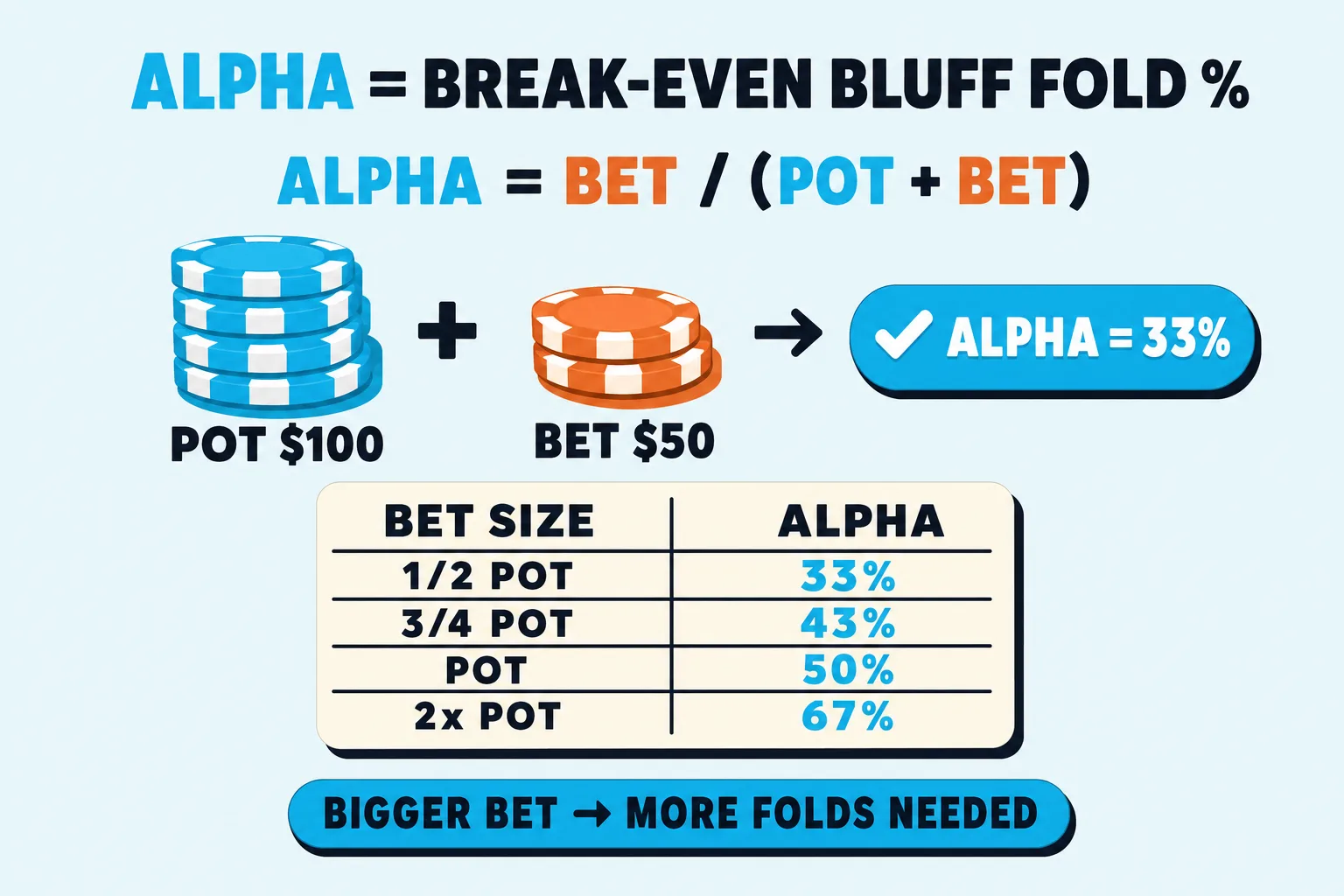
Alpha lives in the same family as pot odds and fold equity, but it is a different object. Pot odds tell you what equity a call needs to break even. Fold equity is the chance villain folds. Alpha collapses fold equity into a single break-even number tied to your bet size: the threshold above which a pure bluff starts to work.
A useful mental shortcut:
- The bettor asks: “How often does villain need to fold for my zero-equity bluff to break even?” That is alpha.
- The defender asks: “How often must I continue so villain cannot bluff me with any two cards?” That is MDF.
- The two questions describe the same equilibrium from opposite seats. They always sum to 1.
Related terms
Alpha by bet size
Memorize this table. The math gets faster every time you face a familiar size, and the same row tells you both seats’ jobs at the equilibrium.
| Bet size | Alpha (folds the bluff needs) | MDF (defender must continue) | Bluff share at this size |
|---|---|---|---|
| 1/3 pot | 25.0% | 75.0% | 1 : 3 |
| 1/2 pot | 33.3% | 66.7% | 1 : 2 |
| 3/4 pot | 42.9% | 57.1% | 3 : 4 |
| Pot | 50.0% | 50.0% | 1 : 1 |
| 1.5x pot | 60.0% | 40.0% | 3 : 2 |
| 2x pot | 66.7% | 33.3% | 2 : 1 |
Two patterns drop out of the table:
- Bigger bets need more folds. A 2x-pot overbet must work two-thirds of the time; a quarter-pot stab only needs to work one time in five. Sizing up moves the alpha bar.
- Bigger bets allow more bluffs in the bettor’s range. That is the bluff-to-value ratio column. At pot, a balanced range carries one bluff per value bet; at 2x pot, two bluffs per value bet. Same equilibrium, opposite chair.
Alpha, MDF, and the break-even fold percentage
Three names, one piece of math. Use the one that matches the seat you’re in and the question you’re answering.
| Name | Whose question | Formula | What it says |
|---|---|---|---|
| Alpha | The bettor with a zero-equity hand | bet / (pot + bet) | Fold rate the bluff needs to break even |
| MDF | The defender facing a bet | pot / (pot + bet) | Continue rate that stops “any two cards” bluffs |
| Break-even fold percentage | The bettor in plain English | risk / (risk + reward) | Same as alpha, framed in dollars |
Alpha and MDF always sum to 1. Alpha and the break-even fold percentage are the same number under two different names. If the table feels redundant, that is the point: the same indifference equation answers all three questions.
When alpha matters most
Alpha earns its keep on the river. There are no more cards to come, the bluff really is zero-equity, and the assumption baked into the formula actually holds: a called bluff loses the full pot. Bet sizes and ranges close cleanly into a single fold-or-call decision.
On the flop and turn, alpha is a rough guide that often overstates how often you need villain to fold. Three reasons books warn against using it raw on early streets:
- Most “bluffs” before the river are semi-bluffs that pick up equity when called. A flush draw shoves $100 into a $100 pot and only needs villain to fold about 29% of the time when the draw hits one in five, well below the raw alpha of 50%.
- Future streets still matter. You may face another barrel, realize equity, or have a raise option. That is different from a final fold-or-call.
- Board texture and range composition can swamp the percentage. A bet that “only needs to work 33%” on a low-equity board is still a losing bet if villain’s continuing range crushes you when called.
Treat alpha as a river anchor and an early-street sanity check. Use the full EV equation when you have draw equity, future cards, or range-vs-range mismatches.
Worked examples
A clean river spot first. Pot is $100. You hold a missed flush draw on a paired runout with zero showdown value and zero outs, and you bet $50 on the river.
- Alpha =
50 / (100 + 50)= 33.3%. Villain must fold at least one time in three for the bluff to break even. - MDF =
1 − 0.333= 66.7%. From villain’s seat, that is the continuing share that stops you from bluffing any two cards.
If you read villain as folding more than 33% of the time to half-pot rivers in this spot, the bluff prints from a fold-equity standpoint. If villain calls 80% of half-pot rivers here, you are donating; bigger sizes do not save you, because they raise the alpha bar faster than they raise villain’s fold rate.
A multiway example, on the preflop side. The button opens to 2.5bb in a 6-max cash game. Two players are still to act in the blinds, and you are stealing with no equity for the math’s sake.
- Alpha vs the field =
2.5 / (2.5 + 1.5)= 62.5%. The steal needs the field to fold five times in eight to break even. - Per-villain fold rate ≈
0.625^(1/2)≈ 79%. Each blind must fold roughly 79% of the time individually for the pure-air open to clear the bar.
That is why ATC opens are an exploit, not a baseline. With three players left to act, the per-villain fold rate climbs to about 86%, and almost no real opponent folds that often, so the multiway adjustment quietly closes the door on raising any two cards from earlier seats.
Common mistakes
1) Using raw alpha on the flop with outs
Alpha assumes a called bluff loses the full pot. A semi-bluff with a flush draw or an open-ender does not. The right framework on the flop and turn is the EV equation: weigh how often villain folds, how often you improve when called, and how often you miss and lose. Many “alpha says yes” flop barrels are actually losing without the draw equity that turns them into semi-bluffs.
2) Forgetting the multiway adjustment
The single-opponent formula is the headline; multiway is the asterisk. With more than one player still to act, the per-villain fold rate scales as alpha^(1/N). A pot-sized bluff needs each of two villains to fold about 71% individually, not 50%. Bluff less in multiway pots because the at-least-one-call probability shifts, even when the headline alpha looks unchanged.
3) Confusing alpha with edge or aggression
Alpha is a specific EV-derived threshold for a single bet. It is not a measure of how aggressive you are, not a synonym for “edge,” and not the trading-finance alpha. You can have a high aggression factor and still pick bluffs whose alpha bar is unrealistic; you can also be a passive player whose few river bluffs sit comfortably above their alpha threshold. The two ideas live in different drawers.
4) Treating alpha as a strategy
Modern Poker Theory is explicit on this point: alpha and MDF are rough guides, not stand-alone strategies. They assume the bettor’s checking EV is zero and the defender’s calls always win when ahead. Real spots have implied odds, board-texture filters, blocker effects, and range constructions that shift the actual equilibrium frequencies. Use alpha as a benchmark; build the strategy from EV.
FAQ
What is the formula for alpha in poker?
alpha = bet / (pot + bet). Plug in the pot before the bet and the bet size; the result is the fold rate a zero-equity bluff needs to break even on the spot. The same number can be written as risk / (risk + reward), which is why alpha and the break-even fold percentage are the same idea under two names. Alpha and MDF always sum to 1.
Is alpha the same as edge or aggression?
No. Alpha is a single number for a single bet: the fold rate that makes a zero-equity bluff break even at that size. “Edge” describes a long-run skill advantage; aggression describes how often a player bets and raises. Two players with the same alpha-aware decisions can have very different results depending on hand reading, sizing tree, and equity realization. Keep alpha in the bluff-math drawer.
Does alpha apply on every street?
Cleanly on the river. With care on the flop and turn. The formula assumes zero equity when called; a semi-bluff with outs needs less fold equity than raw alpha implies, because the draw provides extra EV when villain calls. Treat alpha as most reliable on the river and as a rough guide earlier; anchor with alpha, then walk the full EV equation when draws or future streets are in play.