


GTO (Game Theory Optimal)
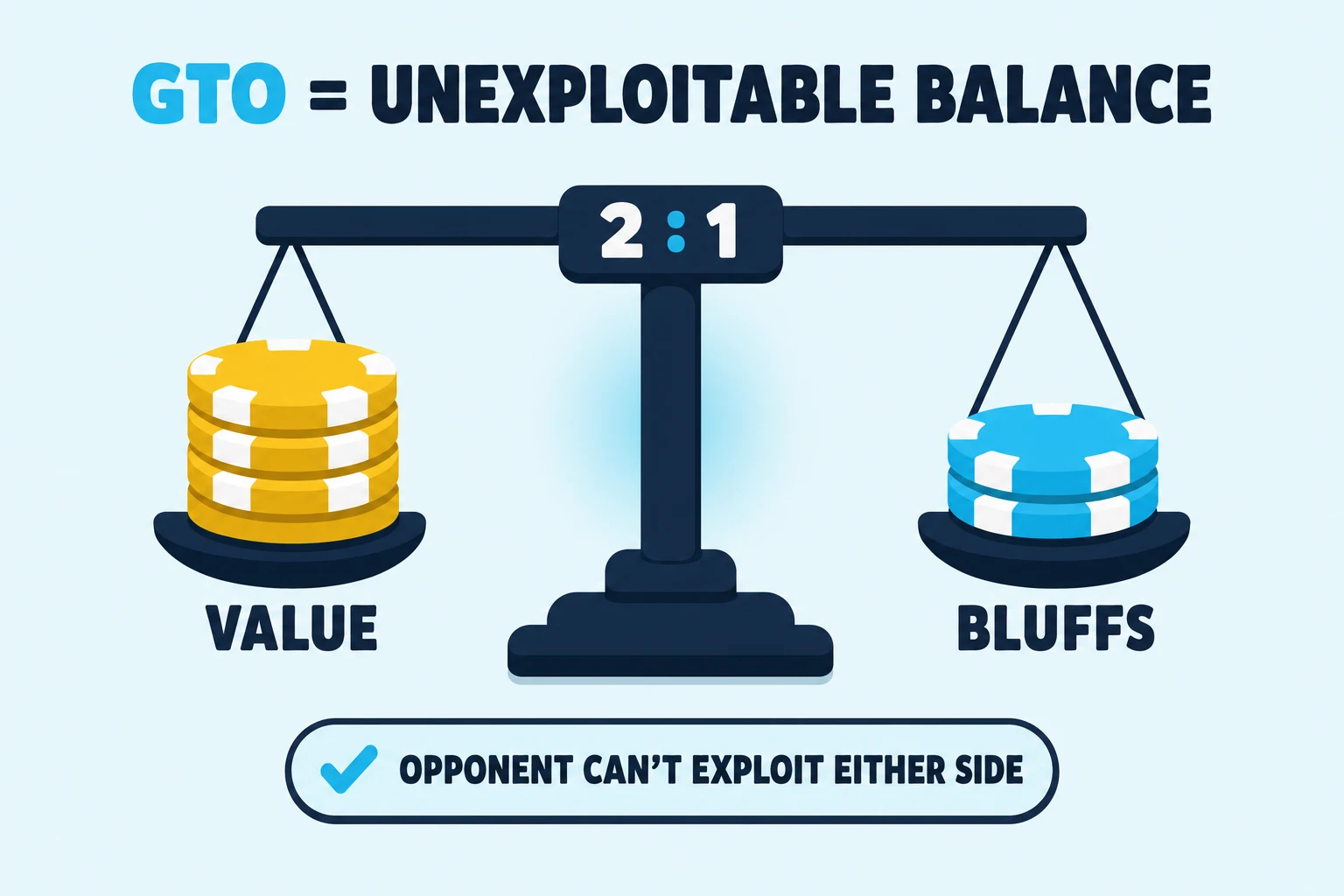
GTO play means choosing actions whose frequencies an opponent cannot exploit, drawn from a Nash-equilibrium approximation across your whole range. In short hands it looks like balance: value bets paired with bluffs at the right ratios. In long study it looks like a solver's mixed strategy on the river.
Practice this in Poker Skill. The Daily Puzzle turns study into one spot a day: you commit to a play, then see every option in the spot graded.
Get the free appGTO (Game Theory Optimal): an unexploitable strategy in plain English
What “optimal” means here
Game Theory Optimal poker, usually shortened to GTO, is a strategy your opponent cannot beat even if they know exactly what you’re doing. It’s not the play that wins the most against any one person. It’s the play that loses the least against the worst possible person, which in practice means it ranges between break-even and profitable against everyone.
The word “optimal” trips people up. GTO is optimal against a perfect opponent. Against a bad opponent, an exploitative strategy almost always wins more, but it also leaves you open to being counter-exploited if you read the bad opponent wrong.
A useful mental shortcut:
- GTO = play in a way that has no leak to attack.
- Exploitative = find their leak and attack it, accepting that you now have a leak yourself.
Most strong players use both. GTO is the baseline you hold when you have no read. Exploits are the deviations you take when you have one.
Related terms:
GTO vs exploitative play
Players often hear these two as opposites. They aren’t. They’re a default and a deviation.
| Approach | Goal | Where it wins | Where it loses ground |
|---|---|---|---|
| GTO | Be unexploitable | Tough regs, unknowns, tables where reads are weak | Soft tables where opponents have obvious, fixable leaks |
| Exploitative | Maximize EV against this specific opponent | Soft tables, recreational players, live games | Tough regs who notice and counter-exploit you back |
A common pattern: a player learns GTO ranges and frequencies as their default, then deviates when a calling station shows up by widening their value range and trimming their bluffs. When the calling station leaves, they go back to baseline. The GTO study built the floor; the exploit built the ceiling for that one session.
The trap is treating GTO as the always-correct answer. It’s not. GTO is the unbeatable answer, which is different from the highest-EV answer in any specific spot.
When GTO matters most
GTO matters most when the cost of being wrong about your opponent is high:
- Against tough regulars — if they’re already balanced, your exploits leak EV and your reads are usually wrong.
- Against unknowns — no sample, no read, no exploit. GTO is the safe baseline until information arrives.
- In multi-table online play — six or twelve tables means you can’t read anyone individually. GTO is the strategy that scales without per-opponent attention.
- Heads-up and in heads-up subgames — once a hand narrows to two players, Nash-equilibrium logic is mathematically airtight. The same is true in 6-max once everyone but two has folded.
- As a study tool — even players who never play GTO at the table use solvers to build pattern recognition for ranges, board textures, and bet-size structures.
GTO matters less when:
- The table is full of recreational players who fold too much, call too much, or never raise.
- The pot is multi-way, where fold equity drops and the equilibrium logic that worked heads-up loosens.
- You have a strong, repeated read and the opponent doesn’t notice you’ve adjusted.
- Your bankroll or attention budget can afford the variance of an exploit gone wrong.
Example: pure river bluff frequency
The single cleanest place to see GTO in action is a river bluff. No more cards are coming, no future streets to muddy the math, no equity to realize. The question reduces to: how often does my opponent need to fold to make this bluff break even?
Call the pot P and the bluff bet B. The break-even fold percentage — the fraction of villain’s range that must fold to make the bluff zero-EV — is:
required fold % = B / (P + B)That’s alpha in the textbook. It scales with bet size:
| Bet size | Required fold % |
|---|---|
| 1/2 pot (B = 0.5P) | 33.3% |
| Pot-sized (B = P) | 50.0% |
| 2x-pot overbet (B = 2P) | 66.7% |
The mirror of alpha is the break-even fold percentage for the defender, the rate they have to call to keep your bluff from being printed for free.
A worked spot: you bet pot on the river with a missed flush draw. Pot is $100, your bet is $100. Villain has to fold more than 50% of their continuing range for your bluff to print. If they’re folding 60%, your pure bluffs make money. If they’re folding 35%, the same bluffs lose money, and the GTO answer is to bluff with fewer hands at this size, not to keep firing.
GTO doesn’t tell you to bluff every river. It tells you the ratio of value bets to bluffs that makes your range balanced at the size you chose. At pot-sized, that ratio is roughly 2:1 value-to-bluff (because villain calling 50% of the time has to be indifferent between calling and folding). The matching internal-link concept is bluff-to-value ratio.
This same alpha-and-MDF math gets shakier on the flop, where future cards still matter and a “bluff” often has equity to improve. The clean version is on the river. Beware of strategy advice that quotes alpha numbers for flop and turn bets. The books that introduce these formulas explicitly caution against treating them as core strategy outside river spots.
Common mistakes
1) Treating GTO as solved
GTO for the full game of NLHE has not been computed. What solvers produce is an ε-Nash equilibrium, a strategy that is close to unexploitable, with a measurable distance from the true equilibrium. Saying “the solver said so” is shorthand; the solver said “this is approximately optimal under these specific assumptions.”
2) Ignoring population deviations
Most live and online pools have predictable leaks: calling stations don’t fold rivers, nits don’t 3-bet light, big-blind defenders defend too narrow. Playing pure GTO against a population that’s predictably loose-passive leaves real money on the table. The point of studying GTO is to know what the baseline is, so you can see how far the table is from it.
3) Memorizing solver charts without understanding why
Solvers don’t explain themselves. A chart that says “open 20% UTG” with a specific hand grid will rot in your memory unless you can answer why: which boards your opening range will hit hardest, what 3-bet sizing makes your range indifferent, why one hand opens and a similar-looking one folds. Memorize the why or the chart is throwaway. GTO poker charts covers what the label promises, what it assumes, and where those assumptions break.
4) Confusing solver output with table EV
A solver tells you the highest-EV play against an equally optimal opponent. Your table is not full of equally optimal opponents. The exploitative deviation often beats the solver line by a wide margin against a recreational player. GTO is the answer to one specific question. “What should I do at this table tonight” is a different question.
FAQ
Is GTO the same as solver output?
In practice, mostly yes, with caveats. Solvers compute equilibrium strategies for specific spots under specific assumptions about ranges and bet sizes. The output is a Nash equilibrium under that abstraction, which is what people usually mean by “GTO.” Different solvers, different bet-size trees, and different starting ranges produce different “GTO” answers for the same nominal spot. Treat solver output as one rigorous answer to one well-defined question, not as universal truth.
Does GTO beat weak players?
Yes, but more slowly than exploits would. GTO is unexploitable, so weak players will lose to it whenever their leaks bleed EV, which is most hands. But against a calling station, an exploitative strategy that value-bets thinner and bluffs less wins more chips per hand than the GTO baseline. The math is the same; the trade-off is whether you trust your read enough to deviate.
Do I need a solver to play GTO?
No, but it helps. The core ideas of GTO (balanced ranges, mixed frequencies, sized bluff-to-value ratios, randomization at indifference) can be learned from books and translated into table heuristics. A solver lets you check those heuristics against actual equilibrium output and find the spots where your intuition is wrong. Most players start with the heuristics and add solver work later.