


Linear Range
A linear range is a continuous block of your strongest starting hands in rank order. You start at the top of the hand rankings and include hands one after another without big gaps. Players often use a linear approach for aggressive actions like opening or 3-betting; a 3-bet is the re-raise after an initial raise. This contrasts with a polarized range, which mixes very strong hands with bluffs and skips middle-strength holdings.
Linear Range in No-Limit Texas Hold’em
What a linear range is
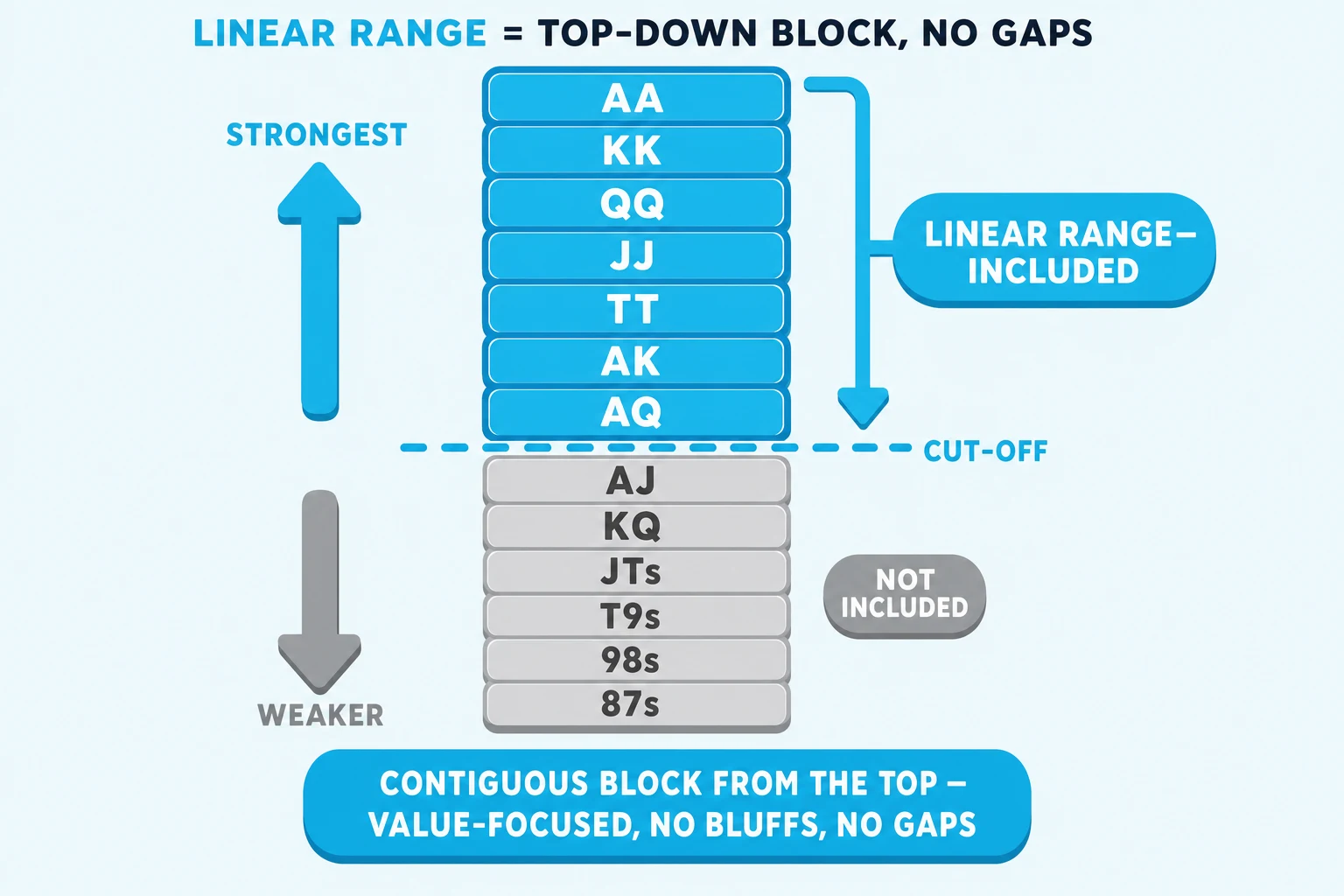
A linear range is a continuous block of your strongest starting hands in rank order. You start at the top of the hand rankings and include hands one after another without big gaps. Players often use a linear approach for aggressive actions like opening or 3-betting; a 3-bet is the re-raise after an initial raise. This contrasts with a polarized range, which mixes very strong hands with bluffs and skips middle-strength holdings.
Why a linear range matters
Linear ranges maximize value when opponents call with worse hands rather than fold. In No-Limit play, you can bet large amounts, so top hands can win very big pots. Linear ranges also simplify postflop decisions by reducing marginal, tricky hands when your goal is value extraction.
How to construct a linear range
Follow these steps:
- Rank hands by strength, starting with AA and moving downward.
- Include them sequentially until you reach your target frequency for the aggressive line.
- Adjust the cut-off using stack sizes, pot odds, and expected caller frequency.
Example 3-bet (linear): AA, KK, QQ, JJ, TT, AK, AQ - listed top to bottom. If you want a wider linear 3-bet versus a caller-heavy table, extend the sequence to include JJ-TT and AJo-AQo. Note: offsuit means different suits; suited means the same suit. Suited hands have better flush potential, but the linear principle stays the same: include hands in order without skipping.
When to choose linear vs. polarized
Rules of thumb:
- Use linear when opponents call a lot; load up on the top block of hands for value.
- Use polarized when opponents fold frequently or when bluff equity is needed to force folds.
- Position matters: earlier positions usually favor linear ranges because you must play tighter and stronger. Later positions can support polarization because you can apply pressure selectively.
The other shape shows up in Poker Skill’s Polarized Continuation Bets lesson: A♠ Q♠ bets top pair and the nut flush draw on A♥ 3♠ 7♠, while K♦ 6♦ checks its pair on K♣ A♥ 3♥, because a polarized bet leaves the middle out.
If your expected call frequency exceeds fold frequency, lean linear. If fold frequency is high, mix in bluffs and move toward polarization.
Adjusting linear ranges by position and opponent type
- Early position: tighten the linear set; include only the very strongest hands in sequence.
- Versus loose callers: expand the linear range to add top-mid pairs and broadway offsuit hands.
- Versus aggressive or sticky opponents: narrow the linear set and favor hands that perform well in multi-street pots.
Quick examples and rules of thumb
- Example opener (early position): AA-TT, AK, AQ in sequential order.
- Example 3-bet vs a loose caller: AA-QQ, JJ-TT, AK, AQ, AJo-AQo.
- Rule of thumb: expect callers, be linear; expect folds, polarize.
Quick checklist
- Start ranges from the very strongest hands and include them sequentially.
- Favor linear ranges when opponents call a lot or when you can build large pots.
- Tighten in early position; expand against loose callers; switch to polarized when bluffing value is necessary.