


Loose-Aggressive
Loose-aggressive is the long-form name for the style most players know as LAG: a player who enters more pots than the table average and applies pressure with bets and raises rather than checks and calls. The label is a table read built from repeated behavior, not a verdict on the player.
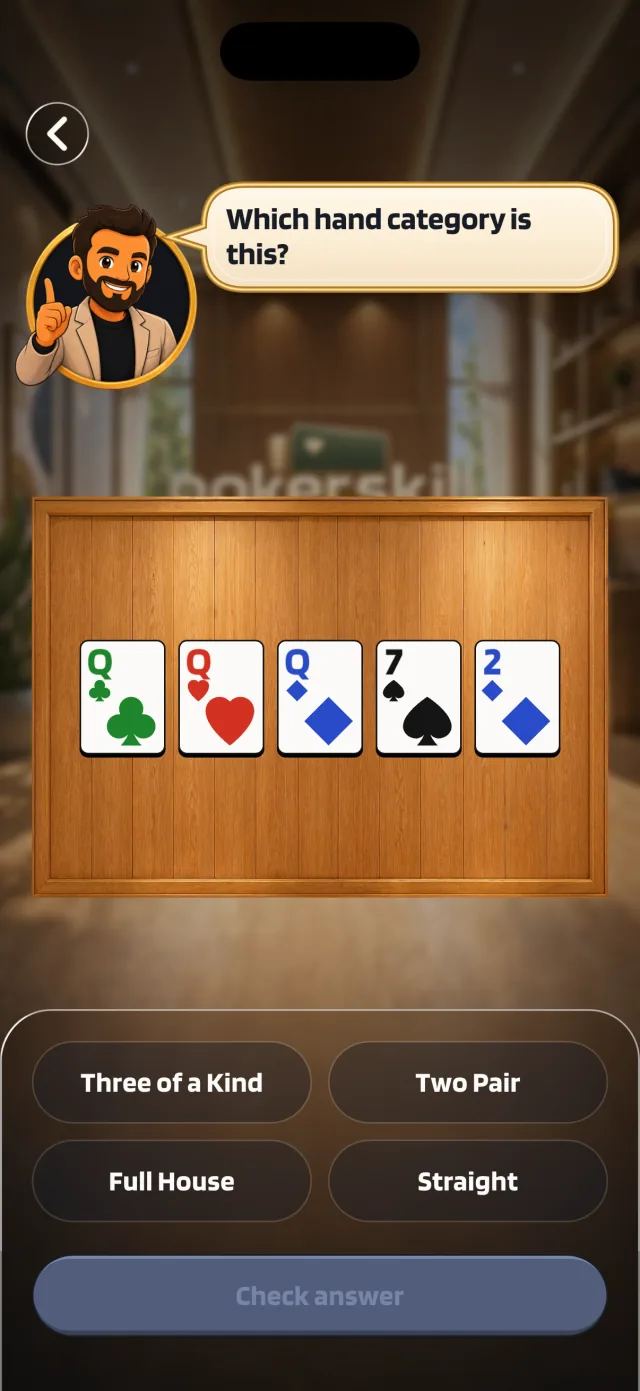
Practice this in Poker Skill. Against this style, letting the bettor bet for you is the skill the Check-Raise lesson drills: with a set of deuces on 6-2-3 you check, let the raiser bet, then raise to trap the extra chips.
Get the free appLoose-Aggressive: the long-form name behind the LAG shorthand
What “loose-aggressive” describes
Loose-aggressive is the long-form name for the style most regulars track on a HUD under the shorthand LAG. The two halves of the label point at two different axes. “Loose” describes hand selection: the player enters a wider share of pots than the table average. “Aggressive” describes the action axis: when the player is in a hand, the default is to bet or raise, not to check or call. Combine the two and the table sees more pots from this seat, more raises preflop, and more streets where someone has to make a hard decision against pressure.
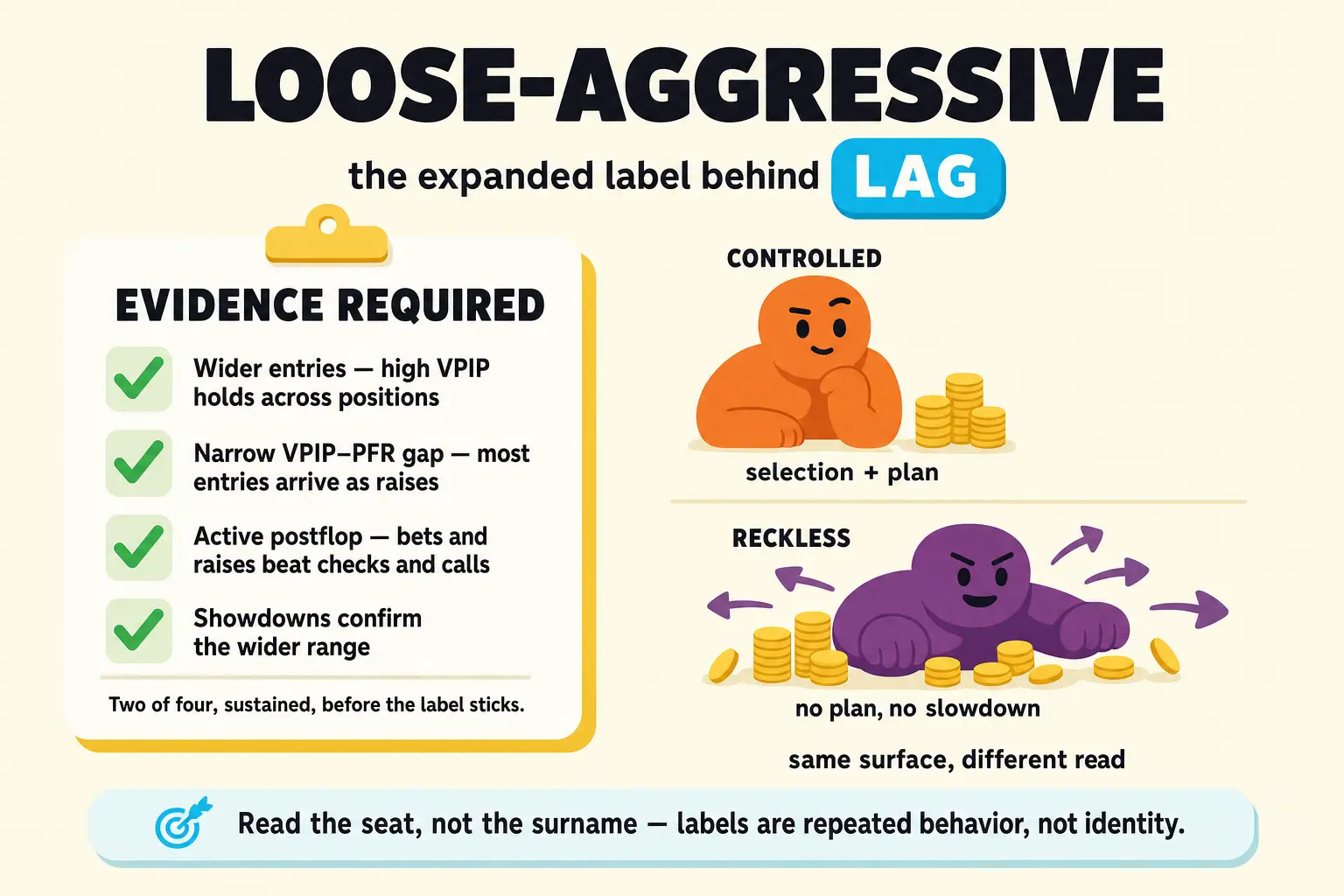
The expanded phrase is worth its own page because the LAG shorthand often gets used as a one-orbit gut read. Spelled out, the term is a reminder that two separate signals have to agree: wider entries on one axis and active betting on the other. A player who enters wide and check-calls is not loose-aggressive; that pattern lives at loose-passive. A player who enters tight and raises every time they enter is not loose-aggressive either; that is TAG territory. The full name keeps both halves in view, where the abbreviation can quietly drop one of them.
Evidence required before using the label
A real loose-aggressive read is built from repeated behavior, not from one big pot or one wild orbit. The label should clear a real bar before it changes how a hand is played.
- Repeated wider entries. The player has voluntarily entered more pots than the table average across several orbits, not just on a card-rush. The cleanest version of this signal is a VPIP that holds high across positions, including the seats where most regulars tighten up.
- Narrow VPIP–PFR gap. Most loose-aggressive players raise most of the hands they play, so PFR tracks close to VPIP. A high VPIP with a small gap is the loose-aggressive fingerprint; a high VPIP with a wide gap points to loose-passive instead.
- Active postflop betting. The player picks bets and raises over checks and calls once a hand is in. An aggression factor above the table average across multiple streets is the standard receipt; the per-street pattern matters more than any single number.
- Showdowns that confirm the wider range. Watching showdowns is how the label survives contact with the data. A loose-aggressive opponent should turn over hands a tighter player would not have entered with, including small suited connectors, wide offsuit broadways, and lighter 3-bets. The bet history on those hands should be active rather than passive.
Until two of those four signals have shown up across enough hands to be more than noise, the right label is “aggressive opponent, more data needed,” not loose-aggressive. Sample-size discipline keeps the read from collapsing the moment the player runs cold.
How loose-aggressive differs from neighboring styles
The same two axes, entry width and postflop action, separate every style worth naming at the table. Loose-aggressive is the corner where both axes are turned up; the neighbors live one axis away in each direction.
- vs LAG (shorthand for the same style). LAG is the abbreviation; loose-aggressive is the expanded phrase. Same population. The expanded phrase is more useful when the discussion turns on which half of the label is actually doing the work.
- vs maniac. A maniac shares the wide entries and the active aggression but removes the selection and the postflop plan. Same surface for one orbit, different player by the third. Loose-aggressive is the disciplined read; maniac is the no-plan version of the same shape.
- vs loose-passive. Loose-passive shares the wide entry axis and inverts the action axis. The player still enters too many pots but defaults to checks and calls once involved. The counter-plan inverts: load value bets against loose-passive opponents, do not over-bluff loose-aggressive ones.
- vs TAG. TAG and loose-aggressive share the active-postflop axis and split on entry width. A TAG plays a smaller share of hands and brings the same pressure to a narrower range. Misreading a TAG as loose-aggressive widens hero-call ranges that the TAG’s value-heavy showdown range does not deserve.
- vs nit. A nit is the diagonal opposite: tight entries, low postflop aggression. The two profiles share almost nothing on either axis, which is why a nit who suddenly fires three streets is more often a card-rush than a style change.
The single most expensive labeling mistake at the table is using “loose-aggressive” as a synonym for “any aggressive opponent.” Aggression alone is half of the picture; the wider entry range is the other half, and the showdown receipts are how the second half gets confirmed.
Practical recognition at the table
Once two or three orbits have gone by, the loose-aggressive pattern shows up in a recognizable shape rather than in any single hand.
- The same seat keeps opening from positions where most players fold. A 30 percent VPIP from the cutoff is normal for a balanced regular; the same VPIP from under the gun is the loose half of the label.
- Limp-and-flat lines are rare. Most voluntary entries arrive as raises or 3-bets, so PFR sits close behind VPIP.
- Continuation bets fire on more boards than a tighter regular would defend, including textures where the preflop range is supposed to give up.
- Turn and river barrels show up at a higher frequency than the rest of the table. Some of those barrels go to showdown as hands a tighter range would have folded preflop.
- Table image cycles faster from this seat. After a couple of hours, the rest of the table starts treating the player as someone who applies pressure, and that perception alone changes how their bets get called or raised.
The signature is the combination, not any single line. A balanced regular can show one of these signs in a session and never look loose-aggressive across the rest. The loose-aggressive read needs the pattern to repeat across positions and across stack depths.
Adjusting without caricaturing the opponent
The biggest risk of any loud archetype label is over-rotating. A confirmed loose-aggressive opponent is still a person playing real ranges; they fold turn raises sometimes, give up rivers when the runout gets ugly, and value-bet thinly when their hand is genuinely strong. The adjustments below are tilts, not full inversions.
- Tighten the base range, especially out of position. A loose-aggressive opener earns a wider 3-bet range with value than a TAG does, but the preflop ranges that defend best are still the strong ones. The instinct to fight fire with fire by opening wider yourself tends to put weaker hands into raised pots out of position.
- Value-3-bet a tier thinner. Hands that would call against a TAG can 3-bet for value against a loose-aggressive opener because the calling and 4-bet-bluff range absorbs them at a higher rate.
- Cut bluff frequency, keep value sizing honest. A loose-aggressive opponent calls more often than a balanced regular, so river bluffs need real backup, such as a clear blocker or a runout that hurts their range, rather than fold-equity alone.
- Let their aggression do work for value hands. The cleanest profit against a loose-aggressive opponent is from check-calling and raising into their barrels rather than leading into them, because the bets they would not have called are now the bets they made themselves.
- Update the label between sessions. Loose-aggressive is a style read on the last few hours of behavior. A player who switches gears, settles into a smaller VPIP, or starts giving up rivers is not loose-aggressive anymore. Holding the label past the data costs more than the read saves.
The point of the label is to focus the read, not to lock the opponent into a caricature. The same player can be loose-aggressive at one table and a steady regular at the next. Read the seat, not the surname.
Common mistakes when applying the label
1) Calling any aggressive opponent loose-aggressive
A TAG who fires three turn barrels in an orbit is still a TAG. The aggression count climbs without the entry range moving. The label only earns the “loose” half once the player has shown up at showdown with hands a TAG would have folded preflop.
2) Treating loose-aggressive and maniac as the same opponent
The aggression rate looks similar at first glance, but the postflop plans are different. A loose-aggressive opponent slows down on bad runouts, sizes the bluff differently on a wet board than a dry one, and folds turn check-raises with a clear share of their range. A maniac does not. Reading them the same way costs full stacks against the disciplined version, because their bluff frequency is lower than the maniac caricature suggests.
3) Confusing loose entries with loose-aggressive entries
A 35 percent VPIP can be either loose-aggressive or loose-passive, and the counter-plans invert. The aggression axis has to be confirmed before the full label gets used. Until PFR and aggression factor line up with the wider entries, the read is “loose with action axis unknown.”
4) Letting one wild orbit set the read
A two-orbit run of opens, 3-bets, and check-raises is not the loose-aggressive pattern. It is one stretch of cards. The label only sticks once the same shape repeats across positions, across stack depths, and across at least a few showdowns that confirm the wider range. Acting on the read before the data lands is how the counter-plan turns into a leak.
FAQ
Is loose-aggressive the same thing as LAG?
Yes. LAG is the everyday shorthand on a HUD badge or in a hand history; loose-aggressive is the expanded phrase that spells the two halves out. Same population, different lens. The expanded phrase is most useful in conversation, in study, and any time the question is which half of the label is actually doing the reading work: the wider entries, the active postflop, or both.
How is loose-aggressive different from a maniac?
Both bring wide entries and active aggression. A loose-aggressive player keeps hand selection inside the wider range, sizes bluffs to the board, and slows down on runouts that hurt their range. A maniac drops the selection, fires the same size on every texture, and keeps barreling rivers with no clear value-or-bluff plan. The cleanest separator is showdown: a loose-aggressive river bet has a story, a maniac river bet often does not.
Is loose-aggressive a good style by default?
The label describes a style, not a result. A disciplined loose-aggressive game can hold its own at certain tables, including short-handed lineups, weak postflop opponents, and a tight-image background, and struggles at others, especially at tables full of calling stations where the bluffs find no folders. Tournament structures and stack depths shift the picture again. Treating the style as a default for every seat usually leaks more than it earns.
How long until I can trust a loose-aggressive read?
Two signals matter more than any time count: how many orbits the wider entries have held up across positions, and how many showdowns have shown hands that confirm the wider range. A small sample of pressure on its own is not enough. Aggression factor and PFR settle faster than rare-event stats but still need a few hundred hands before the number is more than a hint. Until then, the working label is “aggressive opponent, more data needed.”