


Loose-Passive
A loose-passive style enters more pots than the table average and, once involved, leans on checks and calls instead of bets and raises. The label is broader than calling station: every calling station is loose-passive, but plenty of loose-passive players still fold to enough pressure on the right runouts.
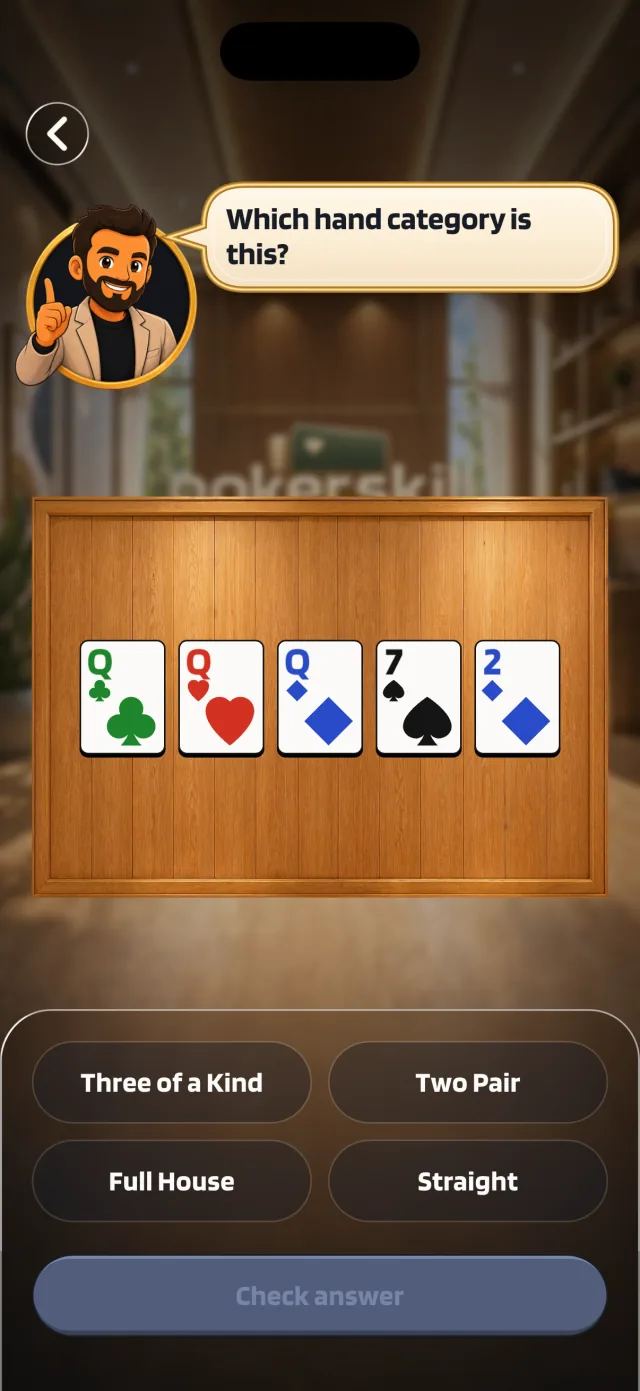
Practice this in Poker Skill. Against loose-passive players thin value pays, and the Value Betting lesson trains it: K♦ Q♥ bets on Q♣ 7♠ 7♦ because the king kicker still gets paid by worse queens.
Get the free appLoose-Passive: the style that sees too many flops and rarely drives the action
What loose-passive style means
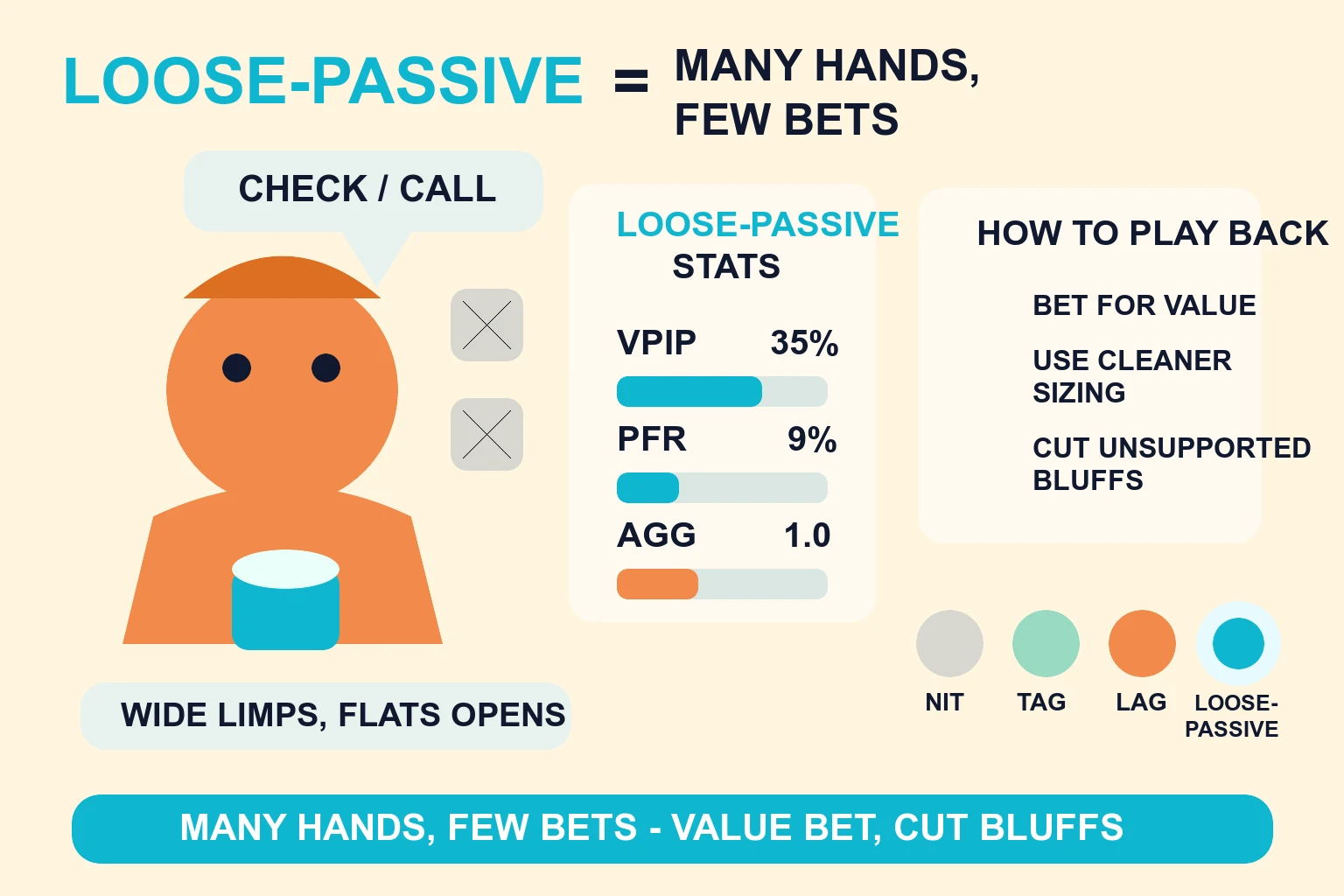
A loose-passive style describes a player who enters more pots than the table average and, once they are involved, leans on checks and calls instead of bets and raises. The two halves are independent. “Loose” lives on the entry axis: many limps, many flat calls, few folds preflop. “Passive” lives on the action axis: when the action is on them postflop, the default is check or call, not bet or raise. Combine the two and you get a style that creates extra pots without putting pressure on anyone in them.
Loose-passive is best treated as a style read, not a permanent identity. Players drift in and out of it across sessions, especially as stack depth changes or as a softer table breaks up. The label describes the last orbit or two of behavior, not who the player is.
How loose-passive differs from neighboring archetypes
Most player labels split cleanly across two axes: how often someone enters a pot, and how they act once they are in. Loose-passive sits in a corner that overlaps with several familiar archetypes without being identical to any of them.
- Calling station is the loaded version of loose-passive. Same wide entries and low aggression, plus a refusal to fold once they have a piece — even on bad runouts. Every calling station is loose-passive; not every loose-passive player is a calling station.
- Calling-station profile is the documented evidence bundle that earns the calling-station label: high VPIP, low aggression, high WTSD, low fold-to-cbet, with showdown receipts. Loose-passive is the broader style description; the calling-station profile is one specific endpoint of it.
- Sticky caller is narrower still. A sticky caller’s defining trait is refusing to fold under pressure once they are in a hand. A loose-passive player who folds reasonably to a large turn or river bet is not a sticky caller, even with a wide entry range.
- LAG shares the loose entry axis but flips the action axis. A LAG enters wide and presses; a loose-passive player enters wide and yields.
- TAG is the diagonal opposite: tight selection, aggressive postflop. Most coaching content treats the TAG shape as the default 6-max regular, which is partly why loose-passive stands out so quickly at the table.
- Nit and loose-passive share the passivity, not the entry frequency. A nit folds preflop where a loose-passive player limps or flats.
Reading loose-passive from the stat block
Most loose-passive reads start as table observation and get cross-checked against HUD numbers later. Stat bands below are 6-max NLHE cash shorthand, not formal definitions; tournaments and other formats need their own bars.
| Stat | Typical loose-passive band | What it means |
|---|---|---|
| VPIP | 30 percent and up | Enters far more pots than a TAG or nit. |
| PFR | 5 to 12 percent | Mostly limps and flats; rarely the preflop raiser. |
| VPIP–PFR gap | Wide (often 15+) | Big gap between hands played and hands raised. |
| Aggression factor | Under 1.5 | Bets and raises clearly underweight calls postflop. |
| WTSD | Often high | Sees more showdowns than a nit or TAG, especially when sticky. |
A wide VPIP on its own is not a loose-passive read. A player at VPIP 32 with PFR 28 is a LAG, not loose-passive — they share the loose half but invert the action half. The signature of loose-passive is the gap between VPIP and PFR plus the low aggression factor, not the VPIP number alone.
How loose-passive style behaves at the table
The same shape repeats across hands once you have a loose-passive player tagged.
- Limps from middle and early position. A lot of entries come in for one big blind rather than as a raise.
- Flats opens that a TAG would 3-bet or fold. A wider preflop calling range, a narrower preflop raising range.
- Calls flop continuation bets with a wide range, often without a clear plan for the turn.
- Checks turns and rivers that a more aggressive player would barrel. Even when the runout favors their range, the default is to check the action over.
- Pays off thin value. Marginal pairs, weak top pairs, and ace-high get to showdown when a balanced regular would have raised earlier or folded earlier.
None of these behaviors are wrong in isolation. The pattern is the loose-passive read: many entries, few raises, a long string of called streets, and a check-call default whenever the line is unclear.
When the read matters most
Loose-passive players reshape the math on a few specific decisions:
- Bluff frequency. Their fold equity is lower than a balanced regular’s. Multi-street bluff lines that work against a TAG often fail here because the calls keep coming.
- Value sizing. Hands that would size a half-pot bet against a regular can use a larger size against a loose-passive opponent without losing many calls. The sizing choice should match what the opponent will actually call, not what a balanced opponent would call.
- Thin value on later streets. Showdown-bound hands that a balanced opponent would not pay off often get called by a loose-passive player. The threshold for “is this a value bet” shifts down a tier.
- Marginal turn decisions in position. A loose-passive player’s turn check carries less information than a regular’s; they often check both made hands and air. Lean on equity and runout, not on their action, to size the turn.
Where the read matters less: against players you have only one orbit on, against opponents who have just sat down with a short stack, and once an alert loose-passive player has been outplayed for a stretch and starts mixing in raises. The label is conditional, not durable.
Example: a loose-passive opponent on the river
100bb effective, 6-max $1/$2 NLHE cash. Three orbits in, the small blind has limped four hands, called two opens, and shown down K7 offsuit and Q9 suited after calling flop and turn bets each time. They have raised exactly once preflop (with aces, shown).
Hijack folds. Cutoff folds. You open from the button to $6 with A♣J♠. Small blind calls. Big blind folds. Pot is $14.
Flop: J♦ 8♣ 4♥. Top pair, top-five kicker. Small blind checks. C-bet $9 (about two-thirds of pot) — sized for a loose-passive caller, not for a balanced regular who would fold out hands like 6-5 suited. Small blind calls. Pot is $32.
Turn: 5♠. Small blind checks. Bet $22 — about two-thirds again, sized to be called by hands like Q-J, T-J, weak J-x, and hopeful 9-x or 6-7 suited. Small blind calls. Pot is $76.
River: 2♦. Small blind checks. The natural sizing into a balanced regular would be smaller because their calling range is narrower. Against a loose-passive opponent, the river call comes with K-J, Q-J, T-J, 9-9, and even some ace-high or middle-pair hands that a regular would have folded earlier. Bet $48 — about 60 percent of pot. Small blind calls with K♥J♥.
The same hand against a balanced TAG looks different. A smaller river bet keeps marginal hands in; a check-back lets them save the river chips. Against the loose-passive player the larger value bet is the cleaner line because their calling range stays wide all the way to the river.
A reckless adjustment in the same spot — barreling a 9♣ turn after missing the flop with K♠Q♠ — runs into the loose-passive read in the wrong direction. The bluff stalls because there is nothing to fold out, not because the hand selection was wrong.
Common mistakes when reading loose-passive
1) Tagging every loose opponent as loose-passive
A wide VPIP without an aggression read is half a profile. A 32 percent VPIP can be a LAG or a loose-passive player, and the counter-plans invert. Confirm the action axis with at least a couple of postflop streets, or with PFR and aggression factor numbers, before locking the label in.
2) Treating loose-passive as a synonym for calling station
A calling station is the loaded version of loose-passive: same wide entries and low aggression, plus a refusal to fold under pressure. A loose-passive player who folds reasonably to a large turn bet is not a calling station, and the bluff frequency you choose against them is closer to your normal default than to “zero.” Mixing the two leads to over-folding bluffs against the milder version and under-bluffing at the wrong end of the spectrum against the stickier one.
3) Sizing the same way against loose-passive and against a regular
The sizing that fits a balanced regular leaves value behind against a loose-passive player. Bigger sizes on later streets pull more chips from a wider calling range. Going further the other way — overbetting because “they call everything” — usually loses calls instead of gaining them. Pick the size their actual calling range tolerates, not the size that maximizes pressure.
4) Running unsupported bluffs
The instinct after a loose-passive player calls twice is to fire a third bet anyway. The read says the opposite. Reserve bluffs for spots with real backup: a draw that improves on the river, a clear blocker to their value, a runout that flips ranges in your favor. Bluffs that depend on fold equity alone are weak choices into a loose-passive opponent.
Quick checklist
- Confirm both axes before applying the label: high VPIP, low PFR, low aggression factor, wide VPIP–PFR gap.
- Watch the WTSD and the showdown receipts to separate plain loose-passive from a full calling-station profile.
- Choose value-heavy lines: bet thinner on later streets, size for the calling range you actually see.
- Cut unsupported bluffs; lean on bluffs that have backup equity or strong blocker stories.
- Re-read the label between sessions. Loose-passive is a style read, not a permanent identity.
FAQ
Is loose-passive the same thing as a calling station?
No. Loose-passive is the broader style: many entries, low aggression, a default to check or call. A calling station is the extreme archetype within that style — same entry and aggression profile plus a habit of refusing to fold once they have a piece. Every calling station is loose-passive; many loose-passive players are not calling stations and will fold to enough pressure on the right runouts.
How do I tell loose-passive apart from a sticky caller?
A sticky caller is defined by refusing to fold under pressure. A loose-passive player who calls a flop and a turn but reasonably folds a large river bet is not sticky. The receipts are different too: stickiness shows up in late-street showdown decisions, while loose-passive shows up earlier, in the entry and aggression frequencies across hands. The two often overlap, but they are not interchangeable.
What are typical VPIP and PFR for a loose-passive player in 6-max cash?
Most loose-passive players sit at VPIP 30 percent or higher with PFR in single digits or low teens — a wide gap of fifteen points or more between the two. The aggression factor usually sits below 1.5, separating the style from a wide-but-aggressive LAG profile. Stat bands are reading tools, not formal definitions; small sample sizes can move any of these numbers around.